KiwiSaver vs Australian Super: there’s no comparison

Nicola Russell’s new employer will pay a 17% superannuation contribution.
Default KiwiSaver contributions are increasing to 3.5% and Christopher Luxon says if National is in government after the election he’ll increase them to match Australia’s 12% rate. But Nicola Russell says the comparison just doesn’t add up.
There are many reasons I moved to Sydney late last year – my son lives there, you can rely on public transport without losing your mind, and there are places open past 8pm on a Tuesday. Plus, I became a mum early, so I didn’t do a classic Kiwi OE in my 20s.
I didn’t go to the “lucky country” to make money. Sure, population size alone provides plenty of opportunity, but it wasn’t the focus. Then I started looking at jobs, and something struck me as distinctly as the kookaburra’s squawk – their superannuation would be a financial game changer for me. It’s at least 12% and that’s just the employer contribution. In comparison, New Zealand’s sits at 3% each for the employer and employee, and will rise to 3.5% this April, then 4% in 2028.
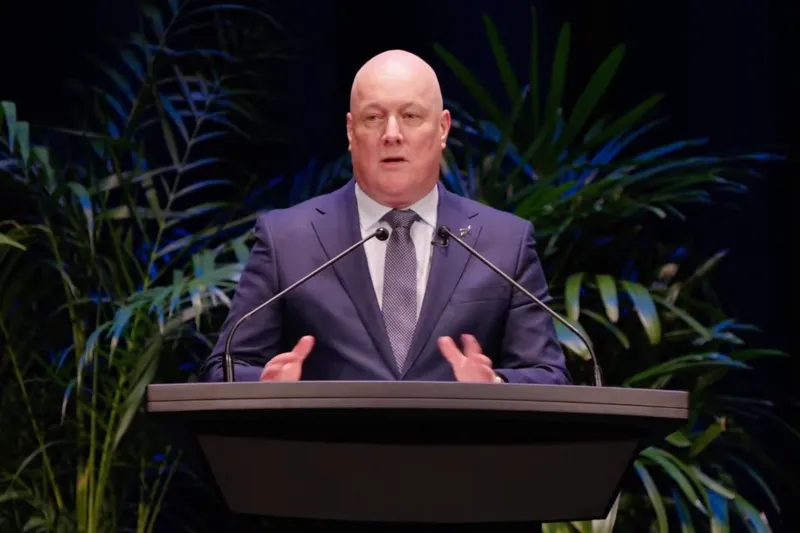
When I saw National leader Christopher Luxon announce that if his party was re-elected Aotearoa would match Australia’s 12% superannuation by 2032, my ears pricked up. Until I read the details.
In Australia the employer’s 12% is compulsory, and employees can choose to make a voluntary contribution on top of that. Under the National Party proposal, it’s a very different scenario. By 2032, the employer will be mandated to pay up to 6% if – and only if – the employee pays 6%.
I just accepted a job – working at a university in Sydney. The employer super contribution is 17%, a significant consideration in taking the role (as was the 35-hour work week). For context, I’ve been contributing to KiwiSaver for 16 years and haven’t used any of it. If I stay in Australia for two years, the employer contribution alone will give me more than a third of what I had in New Zealand when I left. My superannuation percentage rate is more than five times the default rate in New Zealand, before I contribute a cent of my own money.
It’s essentially a top-up of my salary, and enforced savings, and it has empowered me to take a new career direction, without worrying about climbing the salary ladder at every step. It’s given me a taste of financial stability I didn’t get in New Zealand.
Admittedly, my new employer’s super contribution is generous, but even the base Australian rate of 12% is a very different proposition to New Zealand’s rate – and I’m not the only Kiwi gaping.
I recently met a New Zealand woman, who has also just moved to Sydney. It’s her second stint in Australia. She did 10 years in her 20s, where she says she built up $90,000 of super without even realising it. Now 47 and a senior retail professional, she has moved here with a focus on money. “I have only been here a few months but the difference in salary plus super is huge,” she says. “I was feeling pretty stuck financially in NZ.”
In New Zealand her super was about $660 a month (about $265 from her employer), now she gets $1800 super a month, from her employer alone.
The compulsion for the Australian employer to contribute is pivotal to the scheme’s success across socio-economic groups. I’ll top up my super, because I’m on a decent income with no dependents, but for others on lower incomes, paying into super can mean digging into money for food or rent, so they just can’t do it. In New Zealand, depending on the employer, that can mean people on lower incomes save nothing for retirement, while in Australia, the employer’s contribution keeps adding up regardless.
This doesn’t do away with inequity, of course. Super is a percentage, not a universal income, so people on lower incomes clock up less super – but they still clock it up.
It’s a similar story with young people: they start saving for retirement earlier because their employer does it for them. My son, an artist in his 20s, would never have made contributions to a super fund in New Zealand. Instead, he’d use the money to buy food, supplies for his next art commission, or let’s face it – to go to the pub and have a few schooners with his mates. In Australia though, he already has super savings because his employer has paid in.
Don’t forget pensions
But you can’t compare KiwiSaver to the Aussie scheme without comparing pensions: New Zealand superannuation is universal while Australia’s pension is means-tested.
Indeed, one of the key reasons the Australian compulsory super guarantee scheme was developed was to reduce reliance on pensions. Its development, in 1992 by then-Prime Minister Paul Keating, was revolutionary. It was the first time any country had made employer-based, defined contributions compulsory for all workers.
Tax incentives for employers are core to the scheme. This works for the government because increased super means decreased reliance on means-tested pensions. Plus, of the AU$4 trillion that Australian workers have invested in super since 1992, about half has been invested back into Australia.
There are also incentives for the employee. For instance, when I make a salary sacrifice to contribute to my super, it will be taxed at a concessional 15% rate, rather than the higher marginal tax rate. In New Zealand my super was taxed at 28%.
Long-term wins
If Australians look to be winning while they work, do they lose when there’s no guaranteed pension later in life?
Not only does New Zealand offer universal superannuation, the retirement age is 65. In Australia, means-tested pensions only begin at 67.
New Zealand retirement commissioner Jane Wrightson has warned against thinking the grass is greener across the ditch. “Australia’s greater reliance on private savings perpetuates inequalities from working years. The universal coverage of NZ Super enables New Zealand’s system to deliver more equitable outcomes.”
The question stalking New Zealand’s finances, however, is how much longer the country can continue to offer universal super. When the New Zealand Treasury compared the cost of pensions in Australia and New Zealand, it showed Australia’s gradually trending down over several decades, and New Zealand’s going up.

Economist Shamubeel Eaqub lays out the sobering reality: “Essentially, New Zealand’s fiscal position is very stuck. The way that our current collection of taxes and spending is designed, it requires about five working age people per retiree, but we only have four today, and in 50 years time we’re going to have to find some ways to free up that money from those aging costs.”
Eaqub wants to see the employer contribution in New Zealand become compulsory and raised gradually over time. If that doesn’t happen, something else will need to – and politically, there’s now the will. New Zealand First is the only other party that has announced its KiwiSaver proposal ahead of the 2026 election (they want to make KiwiSaver compulsory and raise the contribution), but the debate has well and truly kicked off and there’s a general consensus the current programme is unsustainable.
“You think about across the political parties, we now have all of them speaking about somehow strengthening KiwiSaver and, politically speaking, I think that is probably the most positive place you can be in an MMP regime. No one party needs to have the perfect solution. You just need a whole bunch of people who want to make incremental positive changes over time. And that probably fills me with more optimism than I have felt about KiwiSaver in a long time.”
The future is change
It’s unlikely I’ll retire in Australia. I’ve built a solid community at home, and I wonder if I’ll ever get used to their bellowing birds, but here’s what I do know for sure, the employer contribution in Australia, will make a much bigger difference to my bank balance than my super ever did in New Zealand – or would under National’s proposed policy.
What I will come home to remains to be seen. Will the universal super remain? How much will KiwiSaver have morphed? Hats off to National for proposing something, but long term, I think we all know bolder change is needed.
Nicola Russell
Nicola Russell is a journalist and executive producer from Tāmaki Makaurau who recently moved to Sydney.


