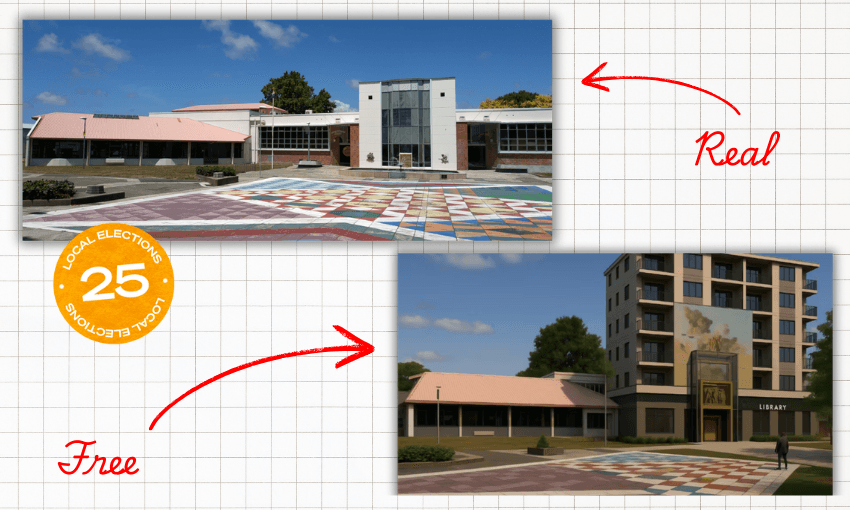



A Hastings mayoral candidate proposed a solution to one quake-prone library using AI illustration. Actual architect Mat Brown explains the many, many issues with it.
I’ve often found as an architect that many people don’t know what you do, but they know they can do it better.
This may have been the case when Hastings mayoral candidate Steve Gibson “did some research” and used AI to design an apartment building straddling the Hastings War Memorial Library as a proposal to fund its upgrade. A design, perhaps, to both protect a piece of national heritage and provide housing in the city.
Gibson admitted the image was crude, but boy was it cheap, cutting out the need to pay “$100,000 to a consultant to come up with the same thing”.
The ridiculousness of the proposal has quickly been pointed out. Failure to comply with council’s own planning constraints and the inevitable destruction of the very heritage the proposed development was supposed to be saving are just a couple of the points raised.
Now, I don’t really believe that Gibson thought his image was a solution for saving the library, but it does illustrate how some people understand and value design, even those who hope to run our cities.
One thing architects are good for is drawing. A construction project can only go so far when it’s an idea in someone’s head. People need to know what they’re striving for – what they’re building. Through drawing, architects are good at making those ideas come to life.

That’s because drawings can be compelling. By turning ideas and thoughts into an image it makes them in some way tangible. Gibson intuitively knew that by drawing his visions, albeit crudely, the vision becomes more shareable. Individual aspirations become collective and a common goal can be formed.
Perhaps what Gibson underestimated is that drawings can also be dangerous. Drawings set expectations. They need to be based on fact. If the drawing is flawed, then the vision loses its credibility.
Drawing a building carries a responsibility. Architects balance the brief, the budget, regulations, planning controls, as well as engineering and feasibility requirements, not to mention what it’s like to occupy the building, or its contribution to the built environment. And of course – what’s it like to look at?
These things never neatly add up to a building. Assumptions are tested, compromises are made, innovation is found and ultimately a design is determined, recorded through drawing. Those drawings record the outcome of a process. Drawing without thinking is dangerous.
It’s been said that when Sir Miles Warren, perhaps our most celebrated architect, prepared one of his watercolour paintings of a building, the design didn’t change, partly because watercolours are impossible to amend. The architect no longer monopolises the pen. Like so many other things in life, technology has democratised the production of compelling images. Anyone with “a little bit of research” can share their vision. That’s incredibly liberating, but fraught with risk.
Gibson has succeeded in generating debate. He’s raised the idea of developing the land the library sits on to offset the cost of preserving the country’s heritage. Perhaps as fast as he produced the image, it’s been found to be invalid, ultimately noise in an election year – the sort of distraction we increasingly find in western politics.
It highlights the issue though, that a bad idea communicated in a compelling way is still a bad idea. It’s not the images and drawings that we should be paying attention to, it’s the process. In this instance the process was flawed, laid bare, exposed and rejected. In other situations that transparency mightn’t be offered, even to the extent of concealment, with or without AI.
The democratisation of media has poured fuel on the rhetoric fire. In a noisy and fast media a loud and compelling argument can be successful in spite of its shortcomings. In this environment it’s never been more important to understand the provenance of the information being put forward. Where has it come from, who holds responsibility for it and how reliable is it?
In Gibson’s case the validity of his idea may never be known, discredited before it ever had a chance to be explored. His argument might have benefitted from taking advice from a consultant. Someone who deals with the sorts of issues that need to be solved to make his vision a reality and held to professional standards. Someone like an architect.