No matter who the next government is, Aotearoa is going solar

Three parties are going all-in on solar this election. (Getty Images/The Spinoff)
The energy election is ramping up, and for the first time, three parties are campaigning on getting more households powered by solar.
It’s election season and rooftop solar is becoming a kitchen-table issue. With both major parties offering solar installation loan schemes, Labour and National have merged into a political lane the Greens rode alone for years.
What was once thought of as niche climate policy is the new cost of living relief. Be it through Labour’s SolarSaver Scheme announced yesterday or the Home Energy Fund announced by the National Party in late June, New Zealand is going solar post-2026. Both promise long-term, low-interest loans to help households to install solar without the need for council consent. Both propose loans secured against applicants’ properties and paid back through rates, though Labour is also proposing financing through power bills.
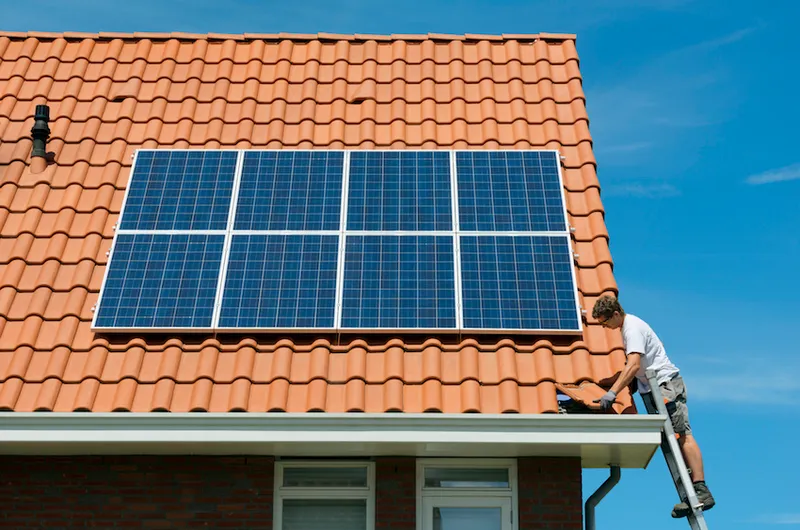
While the policies look similar at first glance, Labour’s policy is heftier. The party wants to offer a $3,000 kickstart for low to middle-income earners and plans to legalise the sale of plug-in solar (panels which sit on your balcony and can be connected to a wall outlet), which will help renters. National’s Simeon Brown says his party has similar plans – and work underway – for the latter, though it didn’t come as a part of the policy announcement in June.
While there will no doubt be arguments as to who stole who’s homework, but spare a thought for the Green Party. It got there first by announcing a solar subsidy in May, with its plans for a loan scheme to extend to marae and other community buildings. But yesterday co-leader Chlöe Swarbrick was quick to tell Labour and National that solar didn’t have to be an election issue: the framework used by both parties mirror the proposals Local Government NZ and Rewiring Aotearoa called for two months ago, through the establishment of the Ratepayers Assistant Scheme. If there are so many on board, just get on with it now, she said.
But how did the red, blue and green teams all find themselves seated at the same table? It’s because the idea has transcended ideology and become about the economics (although, the Greens might argue one doesn’t exist without the other). When the National Party turned its nose up at the suggestion of solar loans in the mid-2010s, solar installation costs were high and Aotearoa already generated a large amount of energy from renewable sources. The case for government intervention, in the eyes of the Nats, was null.
Since then, the price of going solar has fallen dramatically while our rising power bills have called for divine intervention. Between 2019 and 2025, the cost of solar installation fell by 33% while power bills rose by 23%, according to the Sustainable Energy Association of New Zealand (SEANZ). And somewhere along the way, parties realised solar is sexier when dressed up as a budgeting tool in a cost of living crisis than as a climate policy. And what better time to convince a very negative, wet, whiny and inward-looking public you’ll do something to help them with the bills than in winter?
For anyone paying attention to what’s happened in Australia, these new solar policies will seem late to the party. Across the ditch, a combination of rebates, feed-in tariffs and low-interest loans have led to one in three Australians homes adopting solar, giving the country the highest rate per capita of household solar adoption in the world.

Other countries are also going solar, no matter the type of home and no matter whether people rent or own. More than 500,000 extra German apartment dwellers adopted balcony solar a year after the government reformed plug-in systems regulations in 2024. That trend towards plug-in solar is being mimicked around Europe as well as the US – Labour and National can accuse each other of plagiarism all they like, but they’re still betting off of someone else’s playbook.
But not everyone’s on board. Act Party energy spokesperson Simon Court told RNZ in June that the party would not support solar subsidies, arguing that those who see value in solar would be willing to pay for it themselves. New Zealand First has yet to make clear its stance on this issue, but the National Party might find it hard to blame its coalition partners if it can’t get its solar policy into law. As Newsroom’s Marc Daalder points out, the party might have to look at itself – it has a track record of making climate and renewable-friendly energy promises and then failing to deliver.
Anyway, if we take our major parties at face value, the future of New Zealand is solar. Yesterday’s climate policy is today’s cost of living intervention. It’s funny how quickly the political forecast can change when the power bill arrives.

Lyric Waiwiri-Smith
Lyric is an award-nominated politics reporter at The Spinoff. She covers parliament from the press gallery, pens the weekly column One MP, One Pint and is endlessly curious about what makes our decision-makers tick. Off the clock, Lyric loves a live gig, a cold brew, and being a Wellingtonian (on a good day).


