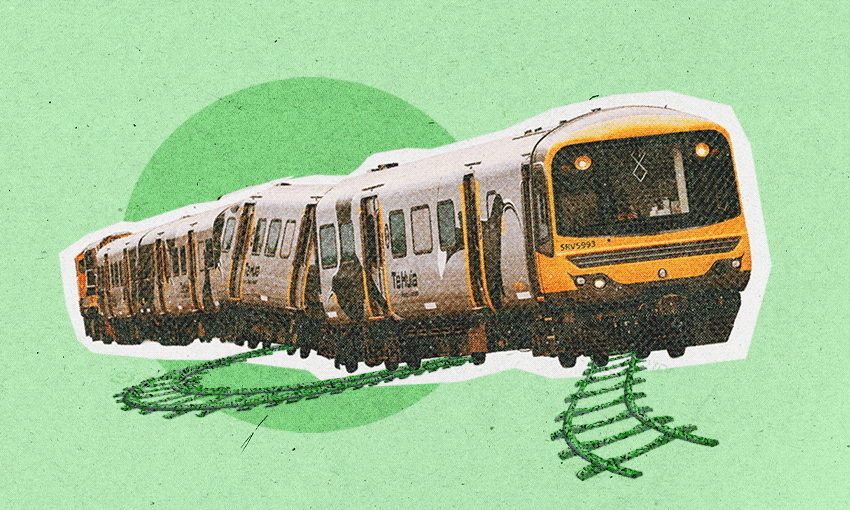



As Auckland’s rail network finally gets up and running, we’re at risk of losing the upper North Island’s only regional train service.
Since 2021, life has been pain for Auckland’s rail passengers. They’ve had to endure a plague of full and partial network shutdowns as KiwiRail has gone through a five-year effort to wrench the city’s train tracks into something approaching the 21st century. Rail replacement buses have become as much a part of Auckland’s identity as the Sky Tower or beach sewage overflows. Some people have given up on trains entirely. Others have taken to howling into the internet.
On January 29, rail minister Winston Peters, transport minister Chris Bishop and Auckland mayor Wayne Brown announced the suffering may be coming to an end. In a joint press release, the three politicians said the full network rebuild, carried out ahead of the City Rail Link’s opening this year, has been completed. Just as God sent Noah a rainbow to promise he would never again flood the world, Peters promised our entire rail system would no longer be shut down for weeks or months on end. “After five years of sustained, weeks-long disruptions, rail work will increasingly be delivered in short, targeted closures,” he said. KiwiRail’s metro manager Dave Gordon went further, telling 1News long shutdowns are now “dead and gone“.
Just three days after that good news filtered through, 300 people gathered at Frankton station in Hamilton to ask the government and its officials to please not kneecap the only regional rail service we have in the upper North Island. Te Huia, the train between Auckland and Hamilton, has been running since 2021 thanks to a $68m capital investment and $29m in operational funding set aside under the former Labour government. Though NZTA reduced its share of Te Huia’s funding under the current National-led coalition, it agreed to continue providing 60% of the cash for running the service following a public campaign to save it in 2024. This month, the agency will once again make an existential call on the train’s future, with its board scheduled to decide whether to extend its original five-year trial for an extra year. If it opts not to, it may signal the end of passenger rail between the country’s first and fourth largest cities.

Lindsey Horne, spokesperson for The Future is Rail, doesn’t think it’ll come to that. She notes National’s Hamilton West MP Tama Potaka and Hamilton East MP Ryan Hamilton attended the Stack the Station event her group organised at Frankton. Te Huia has hit its patronage target and its emissions target. It’s popular in Hamilton. Horne and her group are not only expecting the service to keep going, but are now asking the government to extend it by linking it to the third city in the so-called golden triangle, Tauranga. “It’s up to the NZTA,” she says. “But if they were not to keep up the funding, it would be a really strange decision and an unexpected one.”
Unexpected, maybe. Impossible, maybe not. Even if Potaka and Hamilton are all aboard, their boss hasn’t shown a lot of enthusiasm for Te Huia. Christopher Luxon has called the train a “white elephant”. Pressed for examples of wasteful, inflationary government spending in a 2022 interview on Q&A as opposition leader, his first port of call was what he described as its $100m investment in a “slow train from Hamilton”.

Chris Bishop is tight-lipped on whether Te Huia can expect a reprieve. His statement to The Spinoff says only that NZTA’s board will consider its future in the coming months. However, he adds the agency is also looking at transport links between Hamilton and Tauranga, and that will include the role of rail.
KiwiRail’s Dave Gordon says there’s no reason why Te Huia can’t keep running. The service has been built into the proposed timetable for the City Rail Link. There’s even room to enhance it by electrifying the train lines between Pukekohe and Hamilton, which would allow Te Huia to run through the new City Rail Link tunnels where diesel engines remain barred. “It’s just the cost, but these are not issues where you scratch your head and think ‘how would you do it?’” he says. “The real question is whether it’s a – and I mean this with a small n – national priority.”
Whether the government decides Te Huia is a national, or indeed National, priority, will depend on whether its focus is long-term investment or short-term savings. On that, Gordon’s explanation for Auckland’s five-year rail meltdown may be instructive. He says the hugely disruptive network upgrade was needed for the same reason we need to spend $180bn on water infrastructure or $5.5bn tacking a rail tunnel onto the dead end at the heart of our biggest city’s train system: past transport authorities didn’t invest enough when they should have. “We should, each year, have been doing about a 40th or a 50th of the network replacement work. Instead over a period of four years, we had to do about 15 to 20 years’ worth,” he says. “In a way, this is the curse of New Zealand infrastructure. We put it in the ground and forget about it.”
Together, Auckland, Hamilton and Tauranga are home to roughly half of New Zealand’s population. At the moment, the first two cities are serviced by a single diesel train running on a serviceable, but slightly infrequent, timetable. Horne argues we need to not only maintain but expand the service for a host of reasons, starting with network resilience. “I think lots of people just often think this is a service for commuters, but it’s so much more than that. We’re talking about a really growing elderly population that needs to access healthcare. They want to visit their friends and family. We talk to a lot of people that drive with young children, and they would much prefer to be on a safe train where they can walk around and have a bathroom,” she says.
Horne says it “just makes sense” to provide people with a range of transport options in our largest population centres. To keep those options available, transport authorities will need to buck a long-term trend and invest in infrastructure for future generations, rather than follow in their predecessors’ footsteps and let another service fall into disrepair. NZTA’s board meeting is scheduled for February 19.