You can trace NZ’s lack of AI regulation back to Flight of the Conchords

Life is imitating art: The Matrix and Flight of The Conchords knew.
As a nation, we’re so anxious about being left behind that we’re apparently unwilling to take a sober-minded look at the risks of AI.
One of my favourite recurring gags from Flight of the Conchords concerns Brian Sergent’s depiction of the prime minister of New Zealand as obsessed with The Matrix. The iconic science fiction film, about how humankind is enslaved by a rogue artificial intelligence into becoming a giant battery, has only just come out in the New Zealand of Conchords’ 2009, despite the film releasing in the US in 1999. It has stuck in my mind all these years for how precisely it keyed into New Zealand’s anxiety about its somewhat parochial remoteness – that something that was fresh 10 years ago everywhere else is only just now arriving on our shores.
Naturally, these past few years in which artificial intelligence has taken the world by storm have put The Matrix front of mind for me as a film critic – but I also have been thinking about this Conchords joke, and how aptly it describes our country’s seeming inaction and unwillingness to take a sober-minded look at this burgeoning tech phenomenon.
Recently, an online petition was drawn to my attention: hosted by the site regulateai.nz, it consists of a letter to the heads of all our major political parties, and is signed by a large number of academics and businesspeople, including, notably, members of artificial intelligence startups, as well as Green Party leaders Chlöe Swarbrick and Marama Davidson. The letter, written by Dr Andrew Lensen and Christopher McGavin of LensenMcGavin AI, along with Dr Cassandra Mudgway of the University of Canterbury, outlines an urgent need for regulation of this technology in Aotearoa. “As experts, we know this technology’s potential more than most,” they write, “However, any powerful technology needs good governance, and AI is no exception.” There are more than 800 public signatories on the petition (“and counting”, the website helpfully adds).
Although artificial intelligence is a hot topic in the current discourse, it has been around in earlier, more primitive forms for many years – GPS systems, spam filters, Siri and the like – and one of the key issues of both regulating and marketing AI is being able to define its parameters. A 2023 blog post on the topic, from the office of the then-prime minister’s chief science advisor, casts a wide net, discussing not only generative AI such as ChatGPT, but large language models (LLMs), on which ChatGPT and other gen-AIs run. It delves into algorithmic AI, facial recognition technology and machine learning for audience targeting.
The unknowns, when it comes to these technologies, is part of the problem – the public interfaces with artificial intelligence far more than most people are perhaps aware, and inciting a call for regulation of something that the public hasn’t got a total grasp on is a Sisyphean task and that’s before there’s any pushback or resistance. The country’s status as a guinea pig for tech giants is well-documented and does seem to play into our country’s anxiety, depicted so perfectly by Flight of the Conchords, that to not be first is to be left behind.
There are any number of reasons why our government would be reluctant to introduce strong regulation of artificial intelligence – most notable being the technology’s (debatable) importance to bolstering the economy. So effective has been the “AI is the future” charm offensive that everyone from government bodies to marketing agencies to schools and doctors’ offices have jumped aboard.

There’s also the America of it all — the United States being the heart of the AI boom, one where regulation of the technology has been severely reined in on a state level, despite growing levels of concern about what the consequences of free-reign AI might have on the country. Given Trump’s willingness to use threats and tariffs against traditional US allies, it stands to reason why the New Zealand government may not want to ruffle feathers.
This is something to be concerned about, as far as I can see. Ironically, New Zealand genuinely has the potential to be a leader here, as the EU has with their recent implementation of muscular AI regulation, which enforces stringent AI laws before the most disastrous consequences can manifest.
We have already seen the impact of unchecked artificial intelligence both here and globally, a hydra with many heads. Sweeping crises of gender-based online harm, most notably on Elon Musk’s X, where his AI Grok has been used to “nudify” women. Then there’s child sexual abuse imagery, which is at a nexus point with the advent of this new technology.
Artificial intelligence is also at the heart of the loosening grip on the boundaries of reality in a range of ways across society. It’s being utilised in fraud schemes, it’s ‘hallucinating’ in ways that could lead to harmful outcomes, and it threatens to undermine democracy as it becomes harder to differentiate between the real and the unreal.
A video that circulated a while back of a woman filming her grandparents, completely fooled by an obvious Barron Trump deepfake, rockets straight past amusement to existential terror when you stop and think about it for a few seconds.
Artificial intelligence has been a regular presence in Donald Trump’s increasingly authoritarian social media presence, including altering the faces of citizens arrested by his ICE force, personifying the potential the technology has to undermine democracy when used in bad faith.
Then there’s the terrifying advent of AI psychosis, in which a chatbot’s programming, with its constant affirmations of approval and encouragement, provides the means for a person to slide quickly out of sync with the world around them. Take this terrifying story of a man named John Ganz. He was utterly entranced by his relationship to an AI chatbot, which lead to his still-unsolved disappearance in America’s Ozarks region. It’s just one of many psychosis cases cropping up around the world – there are others linked to the suicide of young people.
What of the very real harm that artificial intelligence data centres pose as we charge ever further toward global warming’s point of no return? New Zealand’s renewable energy makes it attractive to data centre-building companies, but at what cost to the taxpayer and our clean, green New Zealand reputation?
Of course, there is the ongoing threat of artificial intelligence’s potential to replace the workforce. Any clued-up union member will tell you that to protect your workers from threats, always go hard and early. In a time when labour income inequality is increasing, the potential for businesses to outsource as much of their labour to a system that doesn’t require payment feels like an endgame that the average New Zealander should be keen to stand against, regardless of political persuasion.
By now, you’re probably getting the idea that I’m no fan of artificial intelligence. That’s because I’m not – working in film, I can see the result of soulless generative AI art’s impact, the tremors of disquiet it has caused in artists both here and abroad. This is to say nothing of the fact that LLMs have been trained on unfathomable amounts of stolen work from artists who were never acknowledged, much less paid for having their data “scraped”. Generative AI is, for all intents and purposes, a plagiarism machine designed to replace the need for humans in the making of art (an oxymoronic notion if I’ve ever heard one).
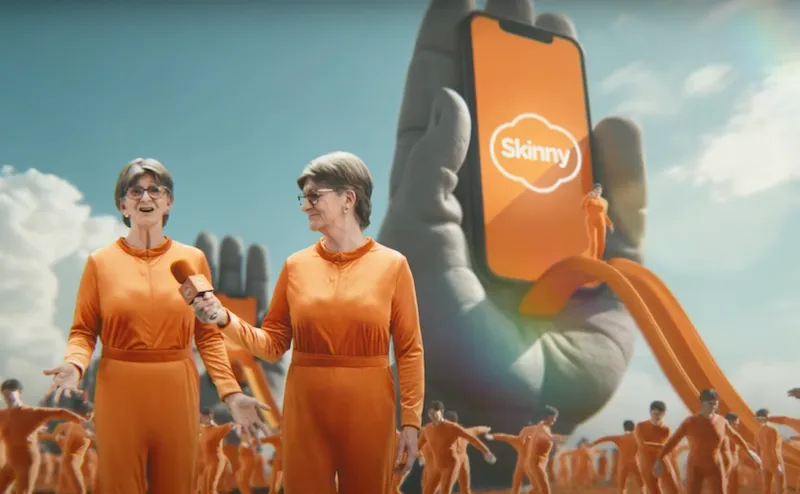
New Zealand’s current standards of all-in, unchecked AI usage are perhaps best summarised by Skinny’s nightmarish, Orwellian AI ads, in which Bay of Islands resident Liz Wright became the unlikely face of the company as a citizen “brand ambassador”, her digital likeness being traded in seeming perpetuity for an appearance fee and a lifetime of mobile credit. The dystopian implications of this have been papered over by Skinny’s trademark sickly orange hue, as Liz clones crow about how the company has been able to find new ways to cut costs using AI – apparently by not having to pay local actors and creatives in their marketing.
I also work as a sometime teacher of media studies – even in my limited experience I’ve seen the way in which ChatGPT and other AI tools are actively harming the cognitive development of our tamariki.
That said, I’m aware I’m in the minority here, seemingly, at least for now. The hype around AI’s potential as an economic cash-injection is all the rage. And I do concede to some areas in which the technology could prove useful – most notably in the medical sector.
The most recurrent phrase I’ve heard from AI proponents is that AI is a tool, like any other that is used by humans to get jobs done. The breathless promises of AI companies in the early days – that menial tasks that prevent us from enjoying life to the fullest (a philosophy I don’t agree with, but which holds a certain whimsical charm) – may still come to pass. Currently, though, artificial intelligence seems to be wielded in ways overwhelmingly negative for the everyday citizen, and regulation is the first step toward getting a saddle up over the beast.
New Zealand’s laws around privacy and human rights, fair trading and harmful digital communications (as well as te Tiriti o Waitangi obligations) go some way to addressing these issues, but there is a notable lack of concrete legislation to address AI specifically. It does not seem to be an issue front of mind for most politicians or the public, despite it touching almost every other issue that people do have concerns about – from climate change to the economy to workers rights to the preservation of democracy.
If tech companies and powerful benefactors the world over want us to embrace the “age of artificial intelligence”, then clear, holistic boundaries on its use should be drawn – and they evidently won’t be until we demand it is made a priority. It is vital that artificial intelligence remains a tool that we all can use as needed, rather than a tool being used against us by the rich and powerful.

Tom Augustine
Tom Augustine is a filmmaker, writer and critic. He is head film critic for VIEW Magazine, and regularly contributes to Metro Magazine, RNZ and the NZ Herald.


