Social media has become a corrupted shitscape and the tech giants just shrug

Warriors head coach Andrew Webster at an NRL training session. Photo: Phil Walter/Getty Images
Fake news about Warriors coach Andrew Webster is part of a griefbait slop epidemic.
It turns out that top of the list of our collective concerns about “possible threats to New Zealand’s vital interests” is not climate change or cyberattacks, not economic downturn or even military conflict, but fake news and misinformation.
A survey of more than 2,000 New Zealanders, published this week by the Asia NZ Foundation, found 39% of us reckon it’s a medium concern, and 51% say it’s a high concern.
It makes sense, when you think about it. Though misinformation may not be as severe a threat as, say, a missile strike, we are swimming in the stuff. In a time of AI-generated, algorithm-gamed content proliferation, scrolling social media has started to feel like snorkelling through bullshit.
If you follow sport on social media you can’t miss it. (Or, more worryingly, you do miss it.) It’s teeming with fabricated quotes from players and pundits, ranging from the just-plausible to the wildly inflammatory. Then there are the artificially generated videos, often for laughs, at other times more nefarious. The goal, at first at least, is “engagement”. Even if people are commenting “is this real” or “fake news”, it boosts the algorithmic juice.
Sometimes, it gets outright ghoulish and gross. Andrew Webster, the talismanic coach of the NZ Warriors, was asked at a press conference this week about a Facebook post by a bogus “news & media website” called “Rugged Titans NZ” which had falsely claimed his wife had died. To repeat: it claimed his wife had died.
The post, souped up with the assistance of AI-generated text and stolen photography, spouted the nonsense that “the world of New Zealand rugby league is quietly mourning the passing of Emma Webster, the devoted wife of New Zealand Warriors head coach Andrew Webster.”
Webster was visibly disgusted to learn about the post, and well he might be. “I’m not on social media, so I only hear about it from people like you today,” he said.
Rugged Titans – or Rugged Warriors, as it was briefly known when created in March – purports to be based in Sydney, lists a Melbourne contact number and is apparently operated out of Vietnam. It specialises in nonsense. A post earlier this week falsely announced Webster had been sacked. Another described him reading aloud Tova O’Brien’s autobiography – which, maybe one day? – to her on breakfast television. And it specialises in lying about death. Three other posts in the last six days announced people purportedly linked to the Warriors had just lost their lives.
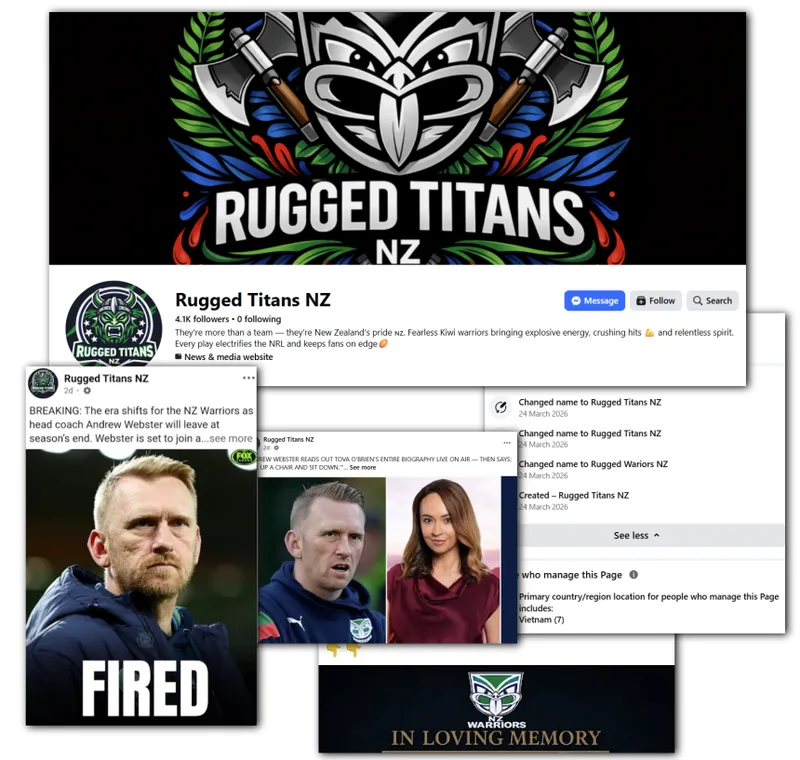
This is a drop in the ocean. A quick search of the language used in the hoax posts returned dozens of similar pages, variously listed as news or fan sites, with hundreds of thousands of followers. As 1News detailed this week, a number of New Zealand sportspeople, from Silver Ferns to All Blacks, have found themselves the subjects of mendacious Facebook stories suggesting they, among other things, had been diagnosed with terminal cancer.
Sure, this is hardly new – death hoaxing on social media is as old as social media. (It’s 15 years now, for example, since the inverse story surfaced claiming Tupac was alive and well in “a small-town resort in New Zealand”.) But it’s all got much faster and bigger and slicker since, and it’s now hyper-powered by AI tools into tsunami mode.
It is a griefbait epidemic, and this is just the tip of a shitberg that goes well beyond sport, in which bad actors generate engagement to build a follower base and gain algorithmic strength. To what end? Cash, naturally. The plan will be to monetise when it comes time to sell, or data harvest, scam, or phish, or some other variety of cybercrime, who knows.
It seems almost laughable to talk about media regulation in a world where social media has overtaken traditional providers, indifferent to borders. The existing tools are left looking as useful as sandbags in the surf on Wellington’s south coast.
It’s tempting to wave it all away as the wild west, but, in the case of Meta, at least, it’s really Mark Zuckerberg’s manor. And this is not coder-kids in hoodies in a garage chugging energy drinks and disrupting the old guard; it’s arguably the most powerful media empire in history. Spanning Facebook, WhatsApp and Instagram, Meta is one of the world’s 10 biggest companies, valued at around NZ $2.5 trillion – 10 times New Zealand’s gross domestic product.
Meta insists it is working hard to remove the criminal muck that seeps through the site, but it is hard not to be sceptical when you consider the pervasiveness of scam posts and the struggles people face in getting them removed – even when the complainants are some of the country’s biggest businesses. A Reuters report of 2025, meanwhile, revealed that “Meta internally projected late last year that it would earn about 10% of its overall annual revenue – or $16 billion – from running advertising for scams and banned goods”.
According to 1News, NZ Rugby says it’s “working through a process with Meta”. That’s encouraging. At the same time it’s true that the unambiguously malevolent “Rugged Titans” Facebook page remains, on Friday morning, serenely unperturbed and online, 60 hours after that RIP Webster post, despite any number of complaints and widespread publicity across the New Zealand media.
After learning about the post on Wednesday, Webster suggested that if “somebody has got enough technology to create something like that” then surely there was “enough technology to get rid of it, so that stuff never happens”.
Is he right? I’m no tech guru but surely it’s not beyond the cashed-up super-brains of Silicon Valley to, say, run a few checks – manual or automated – on the accounts that they host. To take, for example, the faceless, soulless spivs at “Rugged Titans”, they list, as they’re required to for such a Facebook page, their contact information.
The phone number is a bunkum placeholder (“1234567”). Click on their supposed website and you get …
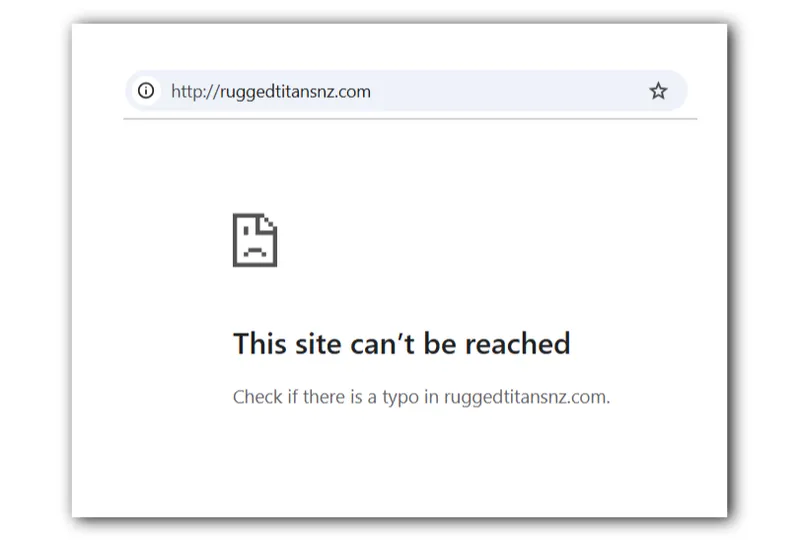
There is no record of any real site ever using that URL.
And if you try emailing them? You guessed it …
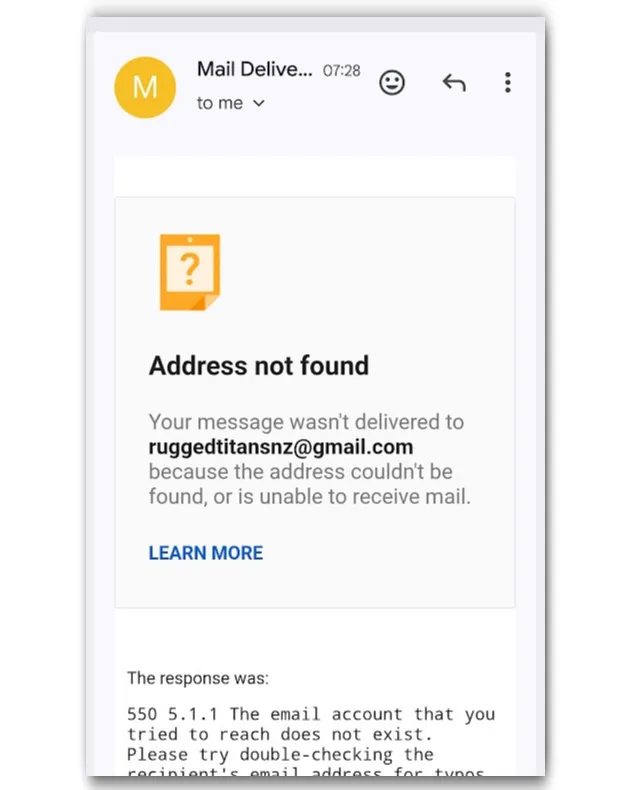
Facebook certainly knows how to suspend accounts. So why not this one?

Toby Manhire
Toby Manhire is editor-at-large at The Spinoff. He loves to cast a pod, whether it's Gone By Lunchtime, At Large or Juggernaut. He is a former editor of The Spinoff and has worked as a journalist in NZ and the UK since the last millennium.


