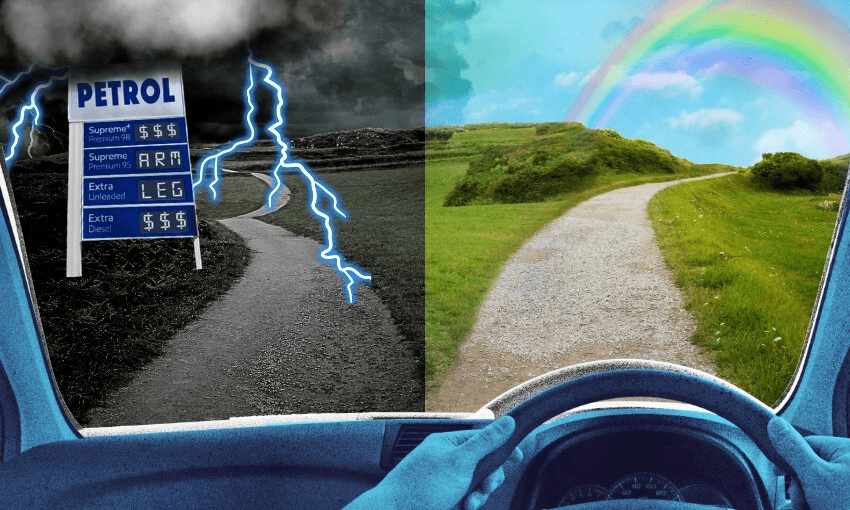



The government keeps telling us not to panic. On the other hand, maybe we should panic.
Matthew Hooton conjured visions of people roaming the desert in leather undies as he described the potential outcomes of the Iran fuel crisis. “Thought Covid was bad? If New Zealand runs out of diesel, Covid will look like the rehearsal,” wrote the Herald commentator in the tone-setting opening stanza for his March 27 column. He forecast a possible future beset by food shortages and disruptions to essential services; where rules give way to realpolitik and states use threats to secure fuel. “In a Mad Max world, it’s always a race to the bottom,” he said.

Hooton implored the government to implement immediate diesel restrictions to minimise the damage. His pessimism was such that the Herald editor who put the column online gave up entirely on civilisation surviving intact, venturing only that restrictions may delay social collapse.

As this was being published, the government was desperately trying to assure people that everything was going to be fine. “There is currently no need for fuel restrictions, the public can be assured that the government is planning carefully, acting early and making sure New Zealand is well positioned to respond, whatever the global environment brings,” said finance minister Nicola Willis in a joint statement with associate energy minister Shane Jones that day.
If anything, the messaging has become more chilled out in the weeks since. “I want people to carry on as per normal as much as possible,” said Luxon in an interview with Newstalk ZB’s Mike Hosking on April 10, adding “it’s not Covid – it’s not life and death”. He rejected the idea of pulling an Anthony Albanese and addressing the nation, saying he didn’t see any need for that.
Who’s right here? Nathan Surendran wouldn’t go as far as Hooton, insisting we aren’t in imminent danger of having to deal with Immortan Joe and his army of War Boys. But the engineer and sustainable energy advocate told The Spinoff he still didn’t think the government was taking the crisis seriously enough. “The government seems to be saying ‘the market will supply. It’s not a problem, there’s nothing to see here, move along’, and I don’t think that’s wise,” he said.
Roughly half the fuel our government is counting on is still on the water and Surendran just doesn’t trust it will arrive in the country. He noted that 30 to 40% of the Gulf’s oil refining capacity has been damaged or destroyed and restoring it could take three years. Making matters worse, much of the supply that’s got into New Zealand so far was ordered before the crisis began, meaning it’s possible some of its most severe effects still haven’t been felt. “This global shortage will worsen,” he said.
As it does, he suspects countries will flex their political or military muscle to secure their oil supplies, short-circuiting our government’s ability to source fuel on the market and sending us careering toward crisis. Economist Shamubeel Eaqub has echoed that assessment, describing our four-stage national fuel plan as “do nothing, do nothing, do nothing, and then, oh fuck”.
Those dangers might be alleviated by the US-Iran ceasefire, but Surendran is sceptical it will hold. He pointed out Israel has repeatedly bombed Lebanon, which is arguably in breach of the spirit of a ceasefire agreement. The US’s last negotiation with Iran ended with it killing many of the country’s senior leaders and the current one appears to have broken down, with the superpower now threatening its own blockade of the strait it spent the last month desperately trying to open.
Surendran sees a case for moving up our fuel alert levels and introducing diesel rationing, mainly because running out could result in some of the social breakdown forecast by Hooton, as supermarkets run out of stock and vital public services struggle to source the diesel they need to keep running. That’s not a risk worth taking, he said. “The downsides of not taking precautionary measures are so severe that we should be taking a precautionary approach. If we outright run out of diesel at some point for a period of time, it will be disastrous to New Zealand.”

The fuel industry doesn’t seem to share his concern. “Not for one second,” said Waitomo Group’s revenue manager Tim Beasant when asked if he was worried about securing enough oil to supply his stations. Beasant and his boss, Waitomo chief executive Simon Parham, have a lot more faith that fuel tankers will keep making their way to New Zealand even if the crisis worsens, they told The Spinoff.
Parham pointed out that it has been more than 50 days since the Iran war began and supply has remained steady, with the government continuing to secure shipments. He doesn’t see much risk of oil suppliers reneging on those deals as that would jeopardise the sustainability of their business. “Ships aren’t going to turn around, because then all of sudden they lose credibility,” he said. He pointed out the companies placing fuel orders are powerful and able to exert pressure of their own. “Those orders are getting placed by the sort of three majors here – Ampol [owner of Z Energy], BP and Exxon Mobil. So they’re committed to bringing those ships.”
Beasant said fuel was so important that countries would find workarounds even if the Strait of Hormuz remained under a double blockade. He noted there was enough crude oil to supply the world even without ships navigating the strait and local companies are already finding ways to source product from places like Angola, Nigeria, Colombia, Mexico, Canada and the US. “It’s a logistics issue to be solved. But at these prices, the world will solve it for long enough,” he said.
Parham said New Zealand’s fuel importers have already placed their next three months of orders and he’s confident they’ll come through. But that doesn’t mean the crisis will be easy to navigate for New Zealanders. Prices at the pump are going to stay high for the foreseeable future even as the petrol market goes through what he believes will be an abrupt rebalancing act. “It’s going to be a bumpy ride,” he said. “This isn’t ‘sweet, let’s all move on’. There’ll be ups and downs and twists. But I think the general direction now is hopefully the right direction.”
No matter which way you cut it, the future is going to come bearing pain. It may or may not come in the form of supermarkets running short on food or a leather-clad Australian shooting you with a grappling hook. But you’re certain to feel a world of hurt in the region of your wallet.