


Secondary students are at home today as their teachers walk off the job, while nurses around the country have been striking too. What’s not working out between these essential professions and the government?
Two groups of much-needed workers are at odds with the government after receiving what they consider less-than-ideal pay offers. After 36,000 nurses walked off the job for a 24-hour strike at the end of July, smaller local strikes have continued this week, with more to come in September, while secondary school teachers are striking today and also planning further action next month. The latest strike action comes two months after the government passed amendments to the Equal Pay Act that cancelled existing pay equity claims – including for nurses and secondary teachers – years in the making. The unions for these workers are among five taking legal action against the government in response to the controversial changes.
Wait, can we start at the beginning?
Sure, although it’ll probably take way too many hundreds of words to unpack the already long history of work stoppages by teachers and nurses even in the last decade, so let’s start with the latest headache. After its collective agreement expired last year, the New Zealand Nurses’ Organisation (NZNO) has been in negotiations with the government since September. The union has been trying to bargain for better pay and higher staffing levels, but hasn’t been able to see eye to eye with the government.
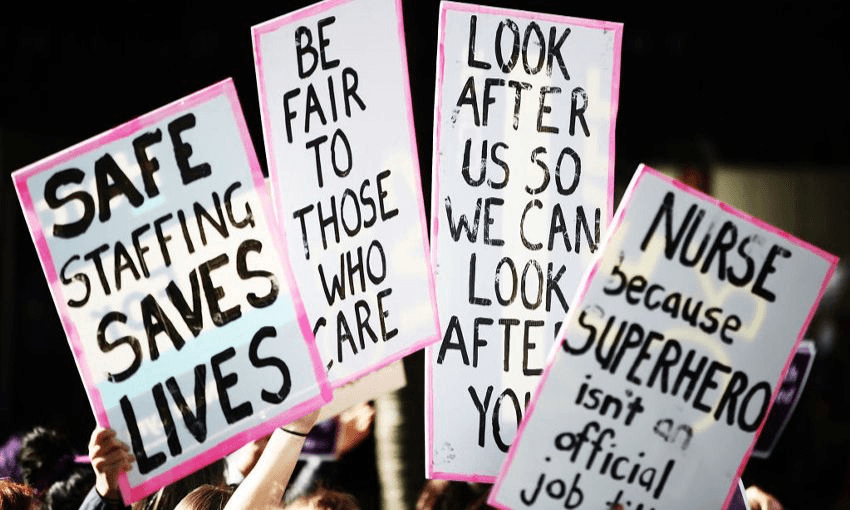
With inflation at 2.7%, nurses have been offered a 3% pay increase, rolled out over two years (with an immediate 2% pay rise followed by a 1% pay rise next year, alongside two lump sum payments of $350). But with a chronic shortage of nurses in Aotearoa for years (last year more than half of all day shifts in surgical wards were understaffed, according to the New Zealand Nurses’ Organisation), NZNO chief executive Paul Goulter said patients had been put at risk, and the impacts on the health system’s ability to deliver procedures and assessments has led to longer wait times. “Our members are exasperated by Te Whatu Ora’s refusal to address – or even acknowledge – their concerns for their patients who are being put at risk because of short-staffing,” Goulter said.
As for the teachers, they’ve been offered a 1% pay rise, which Post-Primary Teachers’ Association (PPTA) president Chris Abercrombie said was the “lowest in a generation”. The profession is also about 800 staff short, Abercrombie told RNZ.
But these people already get paid plenty… Right?
Compared to the median salary in New Zealand, yeah, sure – but there’s been a lot of confusion between governments and unions over who has got their numbers correct. While the Ministry of Education has put the average salary of a secondary school teacher at $100,933, the PPTA’s collective agreement shows that teachers at the highest level only earn $103,086. That latter figure is a big drop from the $140,000 salary supposedly earned by teachers with a decade’s worth of experience, as quoted by public service minister Judith Collins – the minister’s office later clarified that only 1.8% of teachers earned over $140k, while 60% of teachers earned more than $100,000. Collins later apologised for “mixing the message”.
In a statement, Abercrombie said the salary wasn’t enough to attract and retain teachers, especially in the face of a major overhaul to NCEA that required extra work of them. Claims made by the PPTA to address the need for greater recognition for curriculum leaders, more subject specialist advisers, teacher-led professional learning and development funding and more pastoral care time and funding were “completely ignored” by the government’s offer, said Abercrombie. Teachers were “witnessing increasing numbers of young people struggling with more complex needs such as mental health, emotional and societal issues that are not being met”, he added.
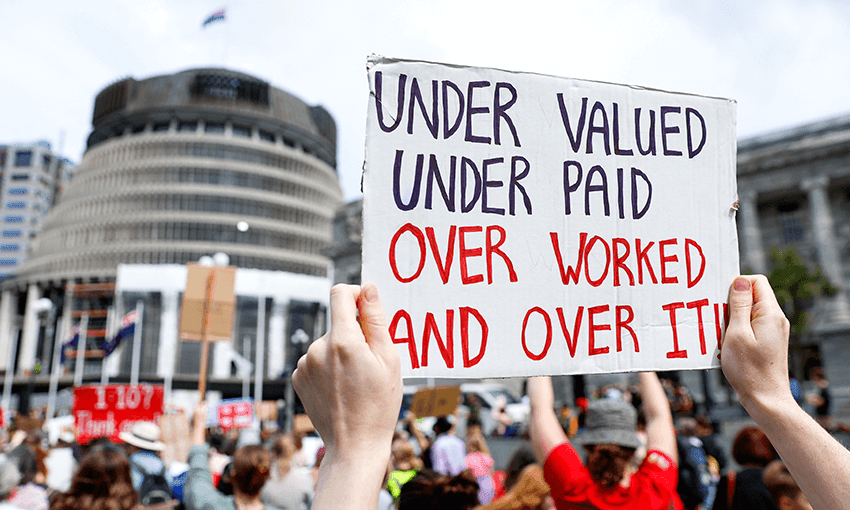
Meanwhile, there’s been plenty of chat about nurses’ pay too, with health minister Simeon Brown and Health NZ putting the average salary at $125,000 – but the NZNO says this figure isn’t quite on the money. Including overtime, penal rates and professional development and recognition programme allowances, senior and registered nurses earn an average annual salary of $125,662, but the base salary for a step 7 nurse (the most skilled level of nurse) is $106,739, according to NZNO and the Council of Trade Unions.
Health NZ has said the salary of nurses had increased by 73.9% since 2011, but the unions argue that once adjusted for inflation, that figure is actually 26.34%. And after removing the 25.82% pay equity increase from a 2022 settlement, nurses’ salaries have only increased by 0.5% in 14 years.
OK, fair enough then. So, remind me when the kids are off school again?
Today, so don’t be alarmed if you see teenagers roaming the streets. Rolling strike action has also been planned for a week next month, with teachers refusing to teach certain year groups on certain days: years 12 and 13 on September 15, year 11 on September 16, year 10 on September 17, and year 9 on September 18. Primary school teachers, meanwhile, earlier this month rejected a staggered 3% pay rise offer (1% a year over the next three years) and union meetings are being held this week to decide on next steps.
As for nurses, this week those working in the cardiothoracic and vascular intensive care units in Auckland City Hospital and the acute surgical services at Whangārei Hospital are carrying out a “redeployment strike”, where they refuse to be sent to short-staffed units (unless there is a genuine need for a life-preserving service) so they can focus on their own patients. North Shore district nurses, meanwhile, are carrying out a week-long “uniform strike”, wearing T-shirts that say “Not enough nurses” instead of their usual uniforms. Nurses are planning two further full-day nationwide strikes on Tuesday, September 2 and Thursday, September 4.
What’s the government’s POV?
Collins said the government was “extremely disappointed” in the strike action taken by teachers, which she labelled a “political stunt” – and later told Morning Report these strikes had become a “yearly attack”. Education minister Erica Stanford said the strikes were “deeply unfair” for parents and students, and accused the PPTA of “premeditation”. “I think parents expect their children to be at school, they expect that the unions are bargaining in good faith … they don’t expect their children to be used as bargaining chips,” Stanford said.
Health NZ/Te Whatu Ora has also expressed its disappointment, saying “continued strike action by NZNO members is impacting patients and delaying the surgeries and treatment many have already been waiting for too long”. Health minister Simeon Brown said that nurses were “playing politics with people’s lives, and it makes me furious”. He pointed to the “13,000 patients” who would have their care cancelled while nurses walked off the job in September: “They will see this as, frankly, them losing out on the care that they’ve already been waiting far too long for.”
On Monday, prime minister Christopher Luxon said the action taken by teachers and nurses wasn’t “fair” to students or the “lots of patients missing out on surgeries”. He encouraged unions to return to the bargaining table.