‘A clear warning sign’: The damning climate change report dividing parliament

Climate Change Commission chief executive Jo Hendy and prime minister Christopher Luxon. (Photos: Getty Images; supplied. Composite image: The Spinoff)
Luxon says NZ is on track to meet its carbon emissions targets. The Climate Change Commission says otherwise.
The reactions to New Zealand’s latest emissions monitoring report were vastly different depending who you heard it from. Prime minister Christopher Luxon was calm and confident, telling journalists New Zealand was on “on track” to deliver its next two emissions budgets, even suggesting that the country may reach net zero emissions “a few years earlier” than the official target date of 2050. That stood in stark contrast to Green co-leader Chloe Swarbrick, who, upon reading the same report as Luxon, concluded that “the government has absolutely screwed it”.
The Climate Change Commission, the independent Crown entity that authored the report, didn’t seem to share Luxon’s optimism either. Chief executive Jo Hendy said the report was “a clear warning sign”, and the government’s current plans and policies were “insufficient” to meet future budgets or the 2050 target.
“Emissions are gradually falling but progress stalled in 2024, and current policy settings are not delivering at the pace needed. Government choices in the next 12-24 months will be critical to getting the country back on track,” she said.
What are emissions budgets?
The emissions budgets are five-year targets which are intended to set the course towards the goal of zero net emissions by 2050, which New Zealand committed to through the Paris Agreement and Zero Carbon Act. The budgets are set as the maximum net emissions New Zealand can emit over a five-year period.
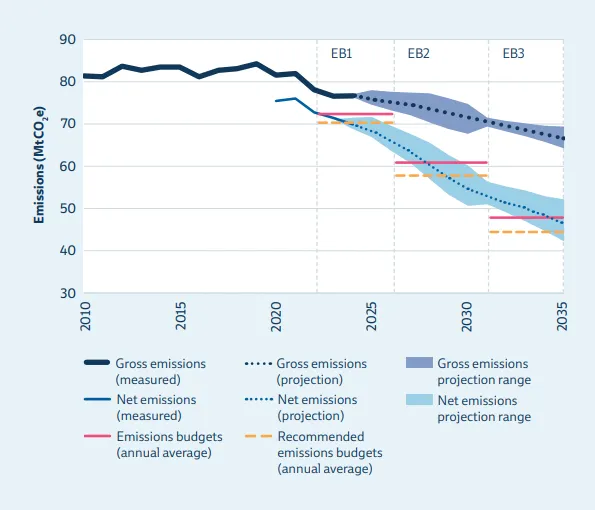
The first emissions budget, covering 2022-2025, called for an annual average of no more than 72.5 megatonnes of carbon dioxide equivalent (Mt CO2e) per year. The next budget period, set for 2026-2030 drops to an average of 61Mt per year, and the 2031-35 budget drops even further to 48Mt per year.
What has happened so far?
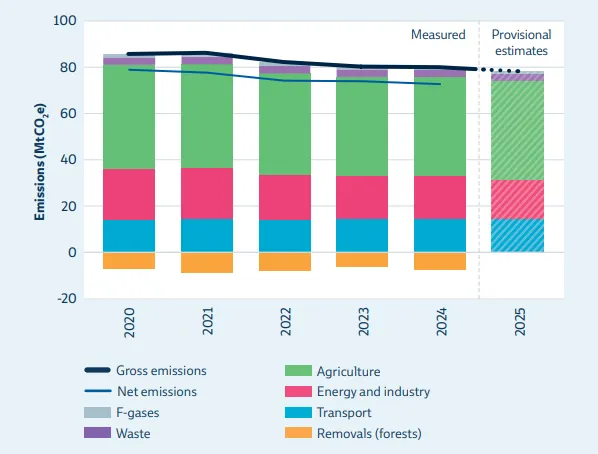
First, the good news: it looks like New Zealand will meet its first emissions budget. The data for 2025 hasn’t been fully finalised but the early projections in the report suggest that New Zealand will be under the cap with 7.7Mt to spare.
New Zealand’s net emissions in 2024 were 54.8 Mt CO2e, down from 61.5 Mt in 2019, a fall of 10.8%. Gross emissions were down 9.4% over the same period.
Significant risks ahead
The commission’s report warned that the second emissions budget covering 2026-2030 was “at significant risk, and that risk has increased in the last year”, and that the “current plans and policies are insufficient to meet the third budget or the 2050 target”.
It found that “most areas of emissions reductions are now at significant risk” and that New Zealand needed to “more than double” the current pace of decarbonisation to have any chance of reaching net zero by 2050.
Exactly what that would involve differs from sector to sector.
Electricity
Emissions from electricity have been gradually falling, with an exception in 2024. The report is positive about changes to the planning system, such as RMA reform, which should enable more construction of solar and wind farms. It warns that New Zealand still lacks low-emission electricity generation options to rely on during dry seasons and winter peaks, and says that long-term emissions reduction in electricity generation will require a long-term roadmap of renewable energy investment.
Transport
Transport emissions, which make up 18.1% of New Zealand’s gross emissions, have declined by 10% since peaking in 2018. However, the Climate Change Commission warned that some recent government policy decisions could lead to higher emissions, most notably the changes to and potential removal of the Clean Vehicle Standard and delays in installing EV charging ports.
Industry
Total industrial energy use has fallen by 27.3% since 2019, though this is largely due to lower production rather than widespread adoption of clean technology. But the report was more positive about this sector than any other. It suggested that industrial emissions would continue to fall due to support from the Government Investment in Decarbonising Industry Fund. Reaching the 2050 target would “depend heavily on policy credibility”, particularly the Emissions Trading Scheme, to incentivise action from large businesses.
Agriculture
Emissions from agriculture, primarily methane from livestock and manure, are not included in the net zero target. The government instead has a target for a 14% to 24% reduction in biogenic methane by 2050. This was lowered in 2025 from an initial target of a 24% to 47% reduction.
The report found that the 2030 biogenic methane target was no longer projected to be met. Even with these less ambitious settings, current policies were “insufficient” and there was a “significant risk” of missing other future targets.
The farming industry has long held up technological improvements such as new feed types as a panacea, but the commission warned that these solutions had a high degree of uncertainty. It suggested this risk could be managed by “strengthening the transition to high-value, low-emissions land uses and other mitigation options”.
Forestry
The amount of carbon emissions removed by forests has steadily increased after a concerted increase in planting. However, the report warned that “disproportionate reliance on forests” was a risk in itself. Additional planting would not help New Zealand reach its 2030 targets due to the low level of carbon absorption from young trees.
An urgent call for action
The commission’s report paints a fatalistic picture, and its authors are appropriately urgent with their recommendations. It calls for the government to take action within the next year to strengthen the Emissions Trading Scheme, scale up support measures for agriculture, and incentivise more electric vehicle and public transport use.
As for Luxon’s claims that New Zealand is “on track” to meet its targets, the report recommended that the government update its approach to emissions projections because “the assumptions underlying the projections do not appear to be driven by a realistic assessment of current policy”. Climate change minister Simon Watts said the government would formally respond to the report in October.

Joel MacManus
Joel MacManus is a senior writer for The Spinoff. He previously worked at RNZ and Stuff, and began his career at Critic Te Ārohi. His writing explores the political, economic and cultural systems that underpin modern New Zealand. He won the 2025 Voyager Media Award for Best Columnist, Opinion or Critique.


