Political curse: Winston Peters keeps voting for legislation he hates

Winston Peters appears to have been cursed. (Image: Tina Tiller)
There’s a common thread linking Winston Peters’ least favourite bits of recent legislation: NZ First voted them into law.
Winston Peters had harsh words for career politicians when NZME presenter Ryan Bridge asked him about the UK’s out-of-control prime ministerial turnover rate last Tuesday. “In the former era, where people came to politics later in their careers, they seemed to be far more dedicated to the country’s outcome than their own outcome,” said NZ First’s 81-year-old leader.
Some may have raised their eyebrows at Peters’ disdain for career politicians given he entered parliament in the 1970s and is on track to snatch Rex Mason’s record as New Zealand’s longest-serving MP midway through the next term. But dedicated Peters watchers would have seen a consistency in his stance. A curse has befallen the political veteran, which seems to be forcing him to keep occupying positions he disagrees with and voting for legislation he thinks is hurting the country and sometimes even killing people.
The ailment is long-standing but seems to be picking up steam. It’s hard to tell exactly when it first afflicted Peters and his party, but it started to blossom two terms of government ago with…
Vaccine mandates
If there’s one thing Peters dislikes more than Jack Tame, it’s vaccine mandates. He’s repeatedly accused Labour of taking away people’s freedom and promised hundreds of millions of dollars in compensation to those who lost their jobs due to the party’s vaccine mandate enforcement.
Peters may be aggrieved at what Jacinda Ardern did in 2021, but he’d have been absolutely ropeable if Winston Peters had got his way. In October that year, as Auckland sweated through a long lockdown, he advocated for what would have been some of the harshest vaccine mandates in the world. “We’ve been let down by this govt’s lethargy and a minority who refuse to get vaccinated,” he posted on social media. “Start with ‘no jab means no dole and no parole’.”
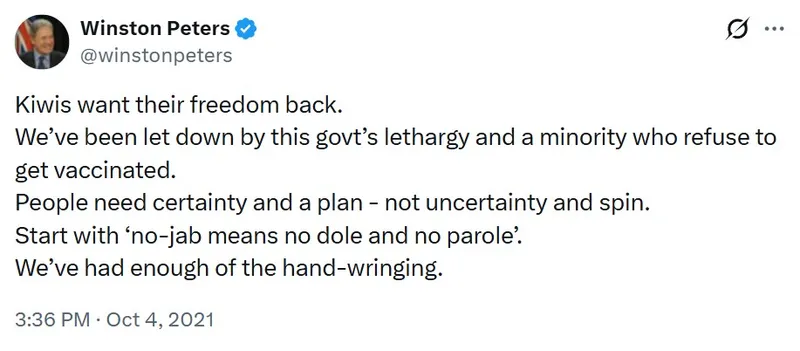
Peters quickly resiled from that position, but a seed had been planted, a curse had been laid.
Diversity and inclusion provisions
In March 2025, NZ First introduced a private members bill aimed at eliminating “left-wing social engineering and diversity targets in the public sector” which were established in part by NZ First.
The Public Service (Repeal of Diversity and Inclusiveness Requirements) Amendment Bill would have excised DEI aspects of the Public Service Act, which was passed by Labour, the Greens and NZ First in July 2020. “We are creating a modern, agile and adaptive public service,” said NZ First’s deputy Fletcher Tabuteau as his party commended the bill at the time.
Peters (2025) was distressed by the standards established with the help of Peters (2020). He said his party’s new bill would rid us of the wokeness that had infected our government departments through the transmission vector of NZ First. “The public service exists to serve New Zealanders – not to be a breeding ground for identity politics,” he said, in a tough rebuke of his former self.
Sadly it wasn’t the last vote from Winston Peters which would disappoint Winston Peters.
National’s tax cuts
In December 2025, Peters sat down with RNZ to diagnose the troubles ailing our country’s economy. He pointed to National’s tax cuts, enacted on July 31, 2024, as a factor behind our persistent doldrums, where both unemployment and inflation are somehow high at the same time and a block of butter costs at least five times the average household income. If the tax cuts had been delayed, “we would have been a year on from where we are now”, he said.
Peters could be disappointed with how those tax cuts passed into law. Though coalition parties are obliged to support government budgets, there were few qualms from NZ First’s MPs during the debate on the one that ushered the cuts through in 2024. “This bill is going to make a difference in the lives of many hard-working New Zealanders,” said NZ First’s Tanya Unkovich as she rose to support the Taxation (Budget Measures) bill at its third reading. “That is why I’m very happy to commend it to the house.” Peters was similarly complimentary toward the budget as a whole. “Today, our country has just changed gears – from reverse and backwards to forwards and progress,” he said, regarding the document he later blamed for keeping us in recession.
The Regulatory Standards Bill
“We were opposed to this from the word go,” said Winston Peters, about Act’s Regulatory Standards Bill. He vowed to repeal the law if he was in government after the next election.
Uncomfortably for him, he was also in a very meaningful sense supportive of the bill from the word go, with NZ First unanimously voting it through at first, second and third reading.
Political troughing
If Winston Peters has been a consistent critic of anything besides immigration, it’s public sector elites who abuse taxpayer funding. On June 4, he took aim at “Māori elitist troughers and bureaucratic separatists stuck to the teat of the taxpayer” in a blistering Facebook post.
More recently, he defended his deputy Shane Jones for keeping a private limo on standby at a cost of nearly $5,000 during a mining conference in Canada, despite his hotel seemingly being next to the venue.
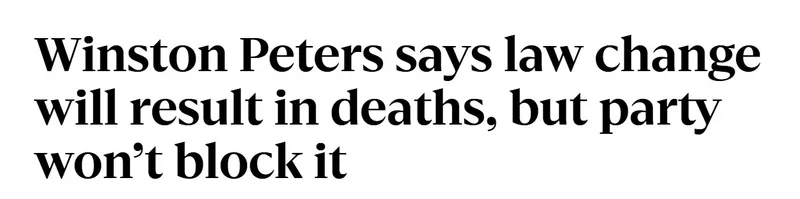
The Health and Safety at Work Amendment Bill
Tough penalties for misleading politicians
“Of course they should lose their job. They need to be put in prison as well, these are the consequences,” said Peters, when asked what should happen to the officials who allegedly misled immigration minister Erica Stanford about the failure of a $33 million biometrics border security project.
Frustratingly, his efforts to put lying officials in jail have been stymied in some part by NZ First, which joined a unanimous vote to restrict parliament’s power to imprison officials who mislead MPs in November last year.
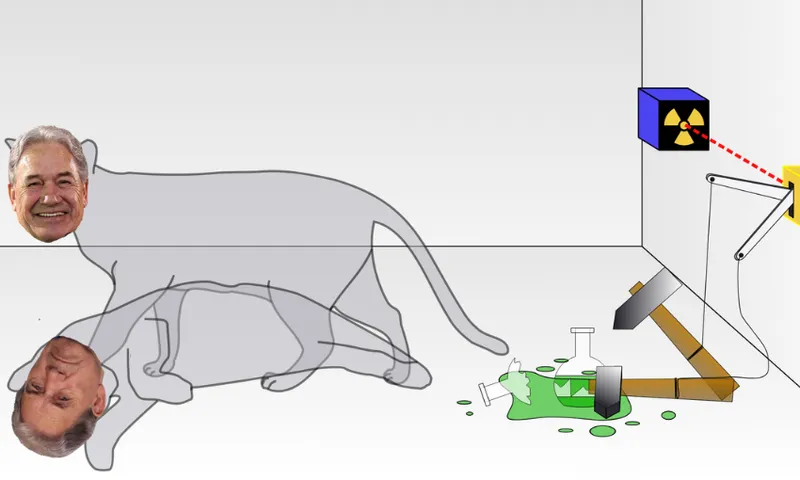
As Peters has said, part of the issue is just that being a minor party in a coalition requires you to swallow some dead legislative rats. But to gather such an accumulation of these incidents is rare, and speaks to a deeper issue. Peters has become the Schrödinger’s cat of politics, existing as a firebrand opponent to the government until observed, at which point he reverts to a government MP voting in lockstep with the parties he criticises. With 27 sitting days of parliament left this term, he’ll have a chance to vote in support of at least a few more bills before the house rises. Those votes should create a solid list of things for his party to oppose in the election campaign.

Hayden Donnell
Hayden Donnell is a senior writer for The Spinoff. He previously worked at RNZ, TVNZ and the New Zealand Herald, alongside other media companies that have since closed down or been renamed. His primary passions are local politics and the Big Fresh animatronic fruit and veggies.


