Economic miracle? We have both high inflation and shite growth

We did it folks.
Some thought it couldn’t be done. But New Zealand is finding a way to record negative economic growth, high unemployment and elevated inflation all at the same time.
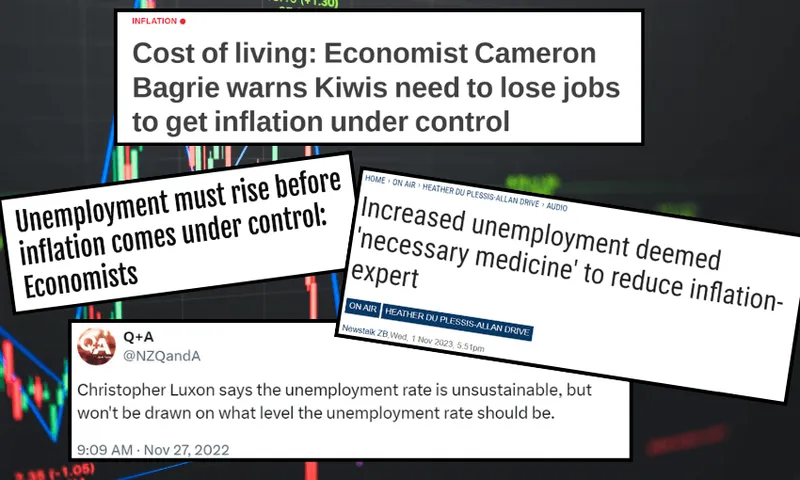
If there’s one consistent message from the sludge of economic commentary that’s oozed through the media’s gastric system in recent years, it’s that inflation stems from an overheated economy. “You’ve got to cause some pain. You’ve got to create some unemployment,” said the head of private wealth at Craigs Investment Partners, Mark Lister, as inflation rose to 7.2% in September, 2022. “We are way beyond maximum sustainable employment so, unfortunately, we are into that hard yards sort of story where to get inflation down, you’ve got to get the unemployment rate back up,” said independent economist Cameron Bagrie two months later.
Everywhere you looked, the diagnosis was the same: we all had too much money, it was sloshing against the walls and corners of our economy, and that was driving up the price of necessities like housing and Kiwi onion dip. The Reserve Bank duly responded, raising interest rates and pruning back the nation’s oversupply of optimism and economic security. Cut forward two years. Unemployment is now over 5%. Growth hit a whopping negative 0.9% in the June quarter. Nobody has enough money and everything is covered in a fug of mild depression.
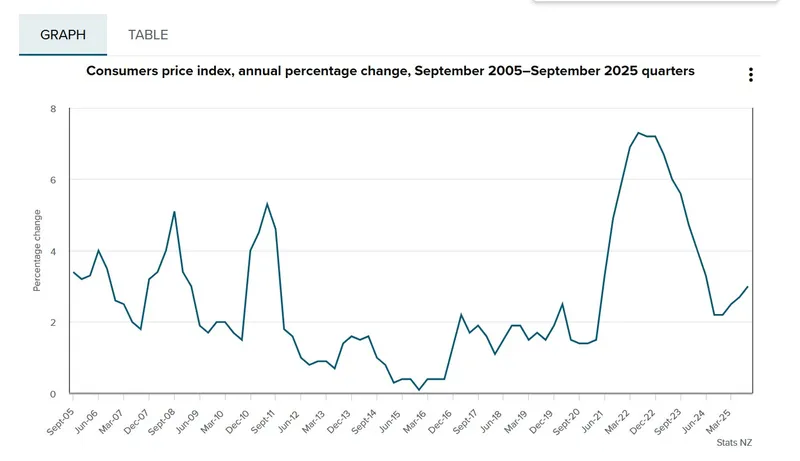
Given the deliberate decision to karate chop our economy in the face to quell inflation, it was slightly troubling to hear on Monday that inflation is, once again, on the rise. The Consumer Price Index was up 3.04% in the September 2025 quarter, its highest level since June 2024.
But how? Has our nation pulled off a monetary miracle? Have we developed Schrödinger’s economy, somehow both on the bones of its arse and rolling in inflationary surplus riches?
Not really, says Simplicity economist Shamubeel Eaqub. While the post-Covid inflation boom was mostly due to people getting drunk on low interest rates and bidding up the price of wages and two-bedroom bungalows, this time it’s driven by a cost shock. Stuff like electricity, rates, insurance and food is more expensive, and there’s not much interest rates can do about the global demand for cheese. “This kind of inflation can happen any time, but it’s particularly painful during recessions,” he says. “Because it erodes people’s spending power.”
Bagrie agrees, rattling off a list of stuff like tertiary education fees and gas prices, which have risen steeply in defiance of our interest rate settings. “Some parts of inflation are not economically sensitive.”
Economist Sam Warburton also argues our troubles are mainly down to Covid disruptions and Russia’s aggression in Ukraine causing the biggest supply contraction since the 70s oil shocks.
But that’s not to say our political authorities are completely innocent. Council of Trade Unions economist Craig Renney argues the price rise pain is exacerbated by the government refusing to intervene to take the edge off stuff like electricity or GP fees. “Rather than helping in those markets, it has chosen to pass on those costs to consumers. So many people are feeling it,” he says. “The problem is that for households with low incomes – they can’t avoid those cost rises.”
Simplicity economist Rosie Collins points out many of the most acute inflationary numbers can be traced back to years of underinvestment by governments, both local and central. Rates went up 8.8% in the latest quarterly figures and 12.2% over the same period last year, primarily because councils are trying to stop people getting intermittently poisoned by their taps or showered by the contents of exploding poo pipes. Power prices are up 11%, in part because of our failure to invest in new electricity generation. Communities are being exposed to costly damage because we haven’t spent enough on shoring up climate resilience gaps. “The inflation we’re seeing now is the result of years of not investing enough,” says Collins. “Eventually, when luck runs out and time catches up, we’re left with big bills for fixing what we’ve neglected.”
In Collins’ eyes, it’s not actually so amazing we have a shite economy and hot inflation when you consider our litany of errors over the course of multiple decades. “Grimly, not an economic miracle. Chickens coming home to roost,” she says. Thankfully, once we pay those overdue bills and shore up our cracking infrastructure, things should eventually calm down, provided we don’t have an election where we vote in hundreds of people promising to cut expenditure once again.

Ah well, nevertheless.

Hayden Donnell
Hayden Donnell is a senior writer for The Spinoff. He previously worked at RNZ, TVNZ and the New Zealand Herald, alongside other media companies that have since closed down or been renamed. His primary passions are local politics and the Big Fresh animatronic fruit and veggies.


