


The ad man on how he came up with the iconic 80s commercial and why he was surprised when it jumped the ditch to New Zealand.
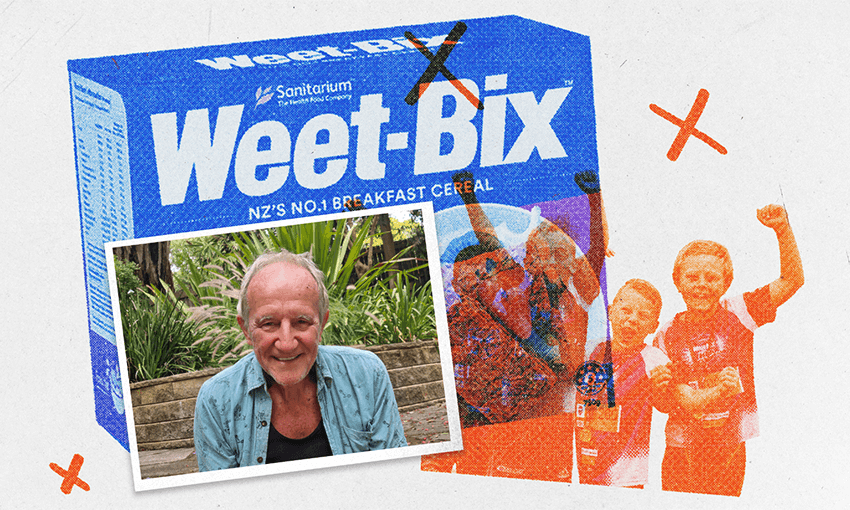
In 2018 I went down a rabbit hole for The Spinoff, trying to get to the bottom of who could really claim to be Weet-Bix kids. Was it Kiwi kids, or Aussie kids? While I uncovered the sad truth that the Aussies had the original claim, I still had some doubt, but accepted I’d never know the full story.
That was until a message arrived in my Facebook inbox…
“Now that I’m getting on I thought I should finally clear up the Weekbix misinformation provided by Sanitarium who basically don’t really give a hoot about who created the campaign which established their pre-eminence in the cereal market at a time (1985) when they were about to go out the door backwards. I was an experienced copywriter and I had been Australia’s youngest Creative Director at 21, a decade earlier…”
I was, to say the least, intrigued. I replied immediately, and began a slightly stilted exchange with short messages… but it wasn’t enough! I had to know more, and soon I was on a video call to Australia, talking with Ralph Hogan, as his wife Janet, a fellow advertising powerhouse, listened in and threw me extra information.

Hogan told me he developed the Weet-Bix campaign in the mid-1980s, as he tried to get back into the advertising industry after a break from the business.
He’d first entered advertising at age 20 and bounced around a number of agencies in creative roles impressive for his age, before going off to travel in Europe and then returning to set up a Sydney restaurant. He thought it would be a simple career but actually hospitality life was “a shit life, really – terrible hours” and he decided to get back to advertising.
But time had marched on and things had changed since his early glory days. “No one really knew who I was and I was on the wrong side of 30,” Hogan explains. He’d reached out around Sydney’s agency scene and wasn’t getting the red carpet re-introduction he’d hoped.
But his luck changed at Grey Advertising, which held Sanitarium’s Australian account. “They were on death’s door with Sanitarium. The client was about to put the account out to pitch, and that’s always when agencies just freak out completely,” Hogan says. “They were given a month or two to come up with something new and they said, ‘If you can crack this you can have whatever job, or work freelance, or part-time, whatever you like.”
Hogan’s first instinct was to pursue a traditional “rational benefits” campaign that would explain why household shoppers should choose Weet-Bix over the market leading Vita Brits. Actually, let’s be honest, back in the 80s, agencies and their clients wouldn’t have categorised these people as household shoppers but mums.
In more 80s-style sexism, Hogan remembers the brief he was given said the ad should be a real “womb twitcher”. It wasn’t a term he would have used but it did give him a direction. “That guided me a lot. It needed to be emotional – something that would knock mothers off their feet.”
Janet had recently entered the advertising world as the only woman creative at respected agency Mojo, and soon Hogan was relying on her as his sounding board.
“I had this vision of a sort of idealised Aussie childhood that I wanted to reflect in the pitch, and I found the main chorus quickly and then started to write the rest,” Hogan says. “I had this part about ‘all corners of our nation’, ultimately because I just wanted to use agency money to have a trip around the country, but Janet told me to just keep it simple, so I dropped that part.”
With the lyrics written, Ralph went to musician and jingle producer Pat Aulton and asked for a nursery rhyme feeling – a song that could be sung by kids in a playground like ‘London Bridge is Falling Down’ or ‘Ring a Ring a Ring o’ Roses’.
“Pat called me a few days later and played down this basic tune he’d come up with, just using this sort of whistle sound on his keyboard. It was perfect, it sounded familiar immediately even though it was original.”
“He said he’d get it all recorded with a bunch of guitars, and other instruments and all that, but I said, ‘No I think keep it simple and keep the whistle’.”

It was time to make the key 60-second TV commercial and Hogan wanted some very specific idealised Aussie childhood images; moments that were the antithesis of his own past. “I had a rough childhood. I went to boarding school when I was five years old and it was quite an unpleasant experience out in Western New South Wales with nuns, some of whom were evil, basically. In fact at one dinner I watched them shovelling vomit back into a child’s mouth.”
Janet interrupts Hogan’s recounting of his Roald Dahl-esque boarding school experience with a distillation: “I hadn’t thought of this before, but maybe Aussie Kids was really an encapsulation of the childhood you never had?”
Hogan agrees: “I was trying to find the beauty in nature and in people.”
A film crew from Ross Nichols Productions, led by director George Muskens, set out to capture these idealistic images of a range of Aussie kids at play, but when the footage came back, Hogan spotted something missing. He had asked for shots inspired by an image he’d seen of a young indigenous girl from Northern Australia splashing in a billabong surrounded by native water lilies. It wasn’t there.
Hogan says he was told they didn’t have the money, but he insisted he needed the shot, so a compromise was reached. The crew had one day up its sleeve to get extra shots and if Hogan could arrange a location and set dressing, they’d film his scene.
“So we called up a mate who had a spa pool,” Hogan recounts with a chuckle. “And I ‘borrowed’ a few water hyacinths from a local park, and we dressed up his spa and shot it there.”

In 1985, the ad hit TV screens and was an instant success. “It just rocketed Weet-Bix to number one,” Janet remembers.
“There was this sort of common wisdom that you can’t own a generic position in the market, but that’s bullshit,” Hogan says. “Of course you can, if you’re good enough and the work is good enough.”
Indeed, the Aussie Kids campaign effectively gave Weet-Bix ownership of the breakfast sector in Australia, not just burying its previously market-leading competitor Vita Brits, but also taking a big chunk out of the whole cereal market.
“I got a call from a friend at Kelloggs’ agency one day,” Hogan says. “He said they had every frame from the Weet-Bix ad printed out and up on a board and were trying to figure out what they could do to challenge it.”
Of course, it wasn’t just Aussie kids who identified themselves as Weet-Bix kids thanks to Hogan’s work. Kiwi kids were also chanting the Sanitarium jingle around school playgrounds.
So how did the campaign jump the ditch? “I honestly have no idea,” says Hogan. He only learned his ad was being adapted for New Zealand when musician Pat Aulton called and told him he’d been asked to remix the tune for Kiwi kids. Hogan didn’t like the idea. “I just thought it was lazy. Why not take the idea and make a truly local version, make it something that really reflects New Zealand?”
Hogan and Janet went on individually, and as a creative duo, to deliver more iconic advertising through until the early 2000s. They were responsible for an iconic Aussie banana jingle (“Make Those Bodies Sing”) and some very racy commercials for Voodoo stockings. They formed their own freelance agency and began an advertising co-operative, Oddfellows, before leaving advertising. But years later, their impact on Aussie and Kiwi culture lives on.
This article has been updated. It previously said the Hogans were responsible for a Meadowlea ad. This has been removed on Janet’s request as she contributed to later versions of the ad, but was not part of the original ad team.