


An impassioned plea from a concerned creative.
I woke up in Budapest, my head heavy, in the way one is after a record-breaking heat wave hit Europe, on the tail end of a seven-week tour opening for Aldous Harding across the EU and UK. It was a strange moment in the tour. We had all been receiving word from New Zealand that things were looking bleak. Our beloved festivals, record stores and venues were closing down, meanwhile an investigation by The Atlantic uncovered New Zealand musical works had been taken without consent, license or payment to feed into AI training data-sets. Between soundchecks and load ins and long drives, we would return to discussing the future of music. What would happen to this industry we had tethered ourselves to? Would touring even be viable in five years?
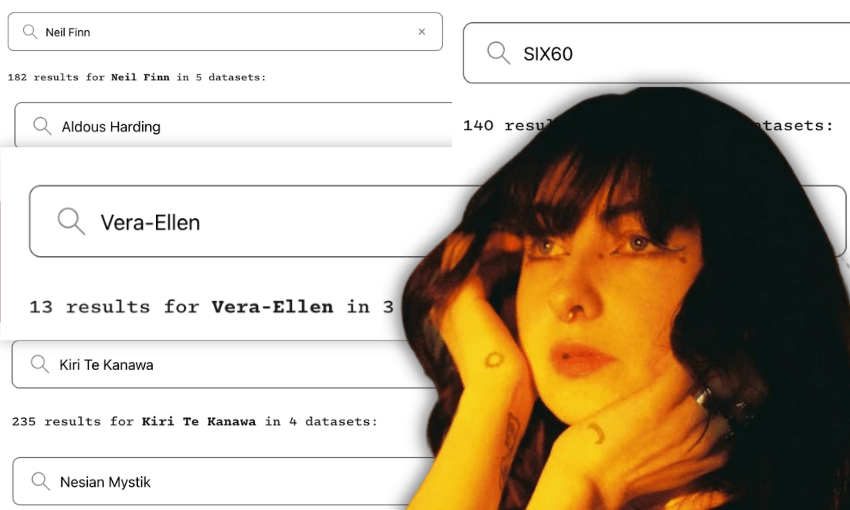
So when I opened my email to see the subject “Songs used in AI training”, my stomach dropped. It was sent to me by a concerned New Zealand journalist. She gently broke the news that using the Atlantic’s AI Watchdog tool, she found my songs (along with 128,000 of my peers’) included in a data set called “Sleeping-Disco 9M”. When I followed the link I found ‘Carpenter’ and ‘Broadway/Junction’ were among them. I had been performing Broadway/Junction every night on tour and reconnecting to the heavy themes in the song;
“I wanted to jump at Broadway/Junction, feel the tracks against my back. Wanted to know how precious life was. Must of forgot about that.”
Themes that resulted in tears and hugs over the merch table at the end of the evening. Themes no machine could comprehend. To think this song could be stripped of all its context, heart and used in any way to train AI, made me sick but also felt really irresponsible. A subject like that, without a careful approach and firsthand experience, could be dangerous. As put by Alex Reisner of The Atlantic;
“How, exactly, AI models are trained is hugely consequential—and not only because AI companies have trained their machines on an enormous number of copyrighted works without the consent of writers, musicians, podcasters, filmmakers, and others. (Many tech companies have been sued for doing this, and the legality of the practice remains an open question.) The works undergirding an AI’s behavior may also include misinformation, conspiracy theories, and material that some people may find objectionable: racist text, pornographic media, step-by-step instructions for committing acts of violence, and so on.”
What’s more terrifying is that they were able to do this in secret, and without this investigation, we the public would be none the wiser. That is intentional. AI companies want weakened copyright protections and exemptions for data mining. Let me scream it from the rooftops. They don’t care about us. They don’t care about our music, our culture, our history. Their only interest is to maximise profit. Looking ahead, one of the most disturbing consequences is the impact on Māori. This is where the New Zealand government has even more of a duty to protect and strengthen copyright laws. Dame Hinewehi Mohi (director of Māori membership at Apra Amcos) articulated it well. “The theft of our music strikes at the very heart of our identity and cultural heritage. Once taken, its integrity cannot truly be restored. Through the indiscriminate scraping of AI systems, our music is stripped of its context, distilled, diluted, and disconnected from its origins.”
In spite of this, I remain hopeful. It’s easy to slip into a hopelessness and forget what we are even fighting for. But off the back of the last couple of tours and heading into my next New Zealand one, let me remind you of the overwhelming majority of good, kind, generous people in the world, who adore music, who care about artists, who want to support and uplift each other. Whether they are musicians themselves, or showgoers, or vinyl collectors or stage hands or lighting techs, or car mechanics who fix a broken tour van for a bottle of whiskey and a CD.
There are good people all over the world. I’ve met them. Been held by them. Felt undeserving and been overwhelmed by their generosity. Don’t let these tech giants make you think for one second that there is no interest or money in this business any more. Or that people don’t care. They do. We do. And these periwinkles would not be sniffing around the rights to our music otherwise.
It feels scary but familiar. A big wave of new tech arrives and inevitably changes our industry. But I don’t care how things evolve, we should always have the rights to our own creations. We should always have the power to articulate who and who does not have permission to use our works. I understand my songs were only a few out of millions mined from around the world. It’s not about me. It’s about the principle. It’s about the future of music in Aotearoa.
We have an obligation to protect our children and their right to own and be compensated for the work they create. For their music and stories to not be stripped of context and used by overseas AI companies who have absolutely no interest beyond maximising profit for themselves. This is a moment to be principled and staunch. I reject a future where musicians and artists don’t have claim or control over their own works. We HAVE to strengthen our copyright laws and protect our creatives. If we don’t draw a line in the sand now, then when? I’m exhausted, I’m pissed off and I’m ready to fight. Now…who’s with me?