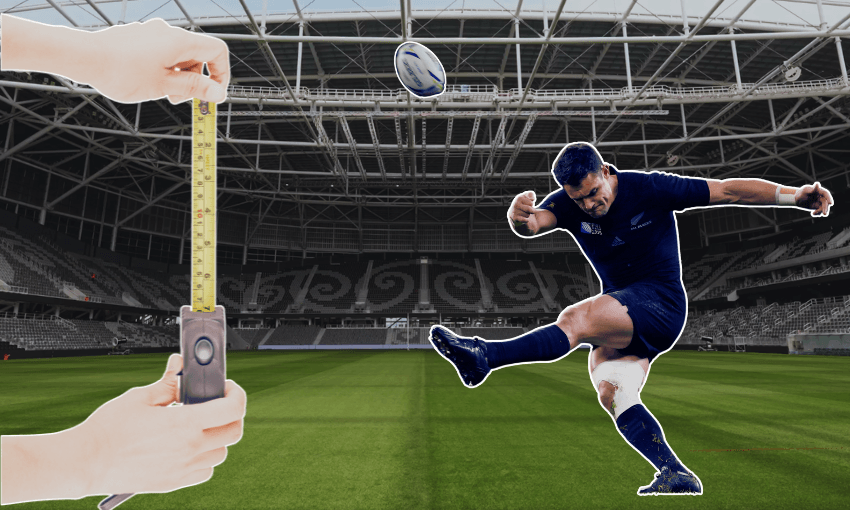



In photos, the steel beams above the pitch look tantalisingly kickable. We asked Dan Carter and a physics professor if they think it’s possible.
It’s the 80th minute of the Super Rugby final. Scores are tied between the Crusaders and Hurricanes. With the home side on the attack, Richie Mo’unga decides to defy all conventional rugby logic and kick a towering bomb. The 30,000-strong crowd at One New Zealand stadium holds its breath. The ball spirals high into the air. Up, up it goes, so high that it hits one of the big metal beams holding up the roof and bounces back to the ground.
What the… this has literally never happened before. What happens now? Nobody seems to know. Where is the referee? You are the referee. Oh god. The stadium feels like it’s closing in on you. The crowd is booing so loud you can feel it in your chest. You try to ask the TMO for assistance but all you can hear through your earpiece are panicked screams. You collapse to the ground near the 22 and close your eyes. The last thing you hear before you black out from stress is the voice of Grant Nisbett: “Babe,” he murmurs, “wake up…”
You were having that dream again, weren’t you? The one where the ball hits the roof of Christchurch’s new stadium?
That’s understandable. The roof has been one of the most commented upon features of One NZ Stadium ever since we got our first sneak peek inside. Of specific concern are the big steel beams that hold it up, and how they look – in photos, at least – way too low.

These images can leave the viewer with a sense of cognitive dissonance. On one hand, you have to assume the engineers and architects who designed the stadium thought about this and knew what they were doing. On the other… well, just look at it. Are we sure the ball won’t hit it any time someone does a big kick?
According to designers Mott MacDonald, One NZ Stadium’s trusses are 32 metres above the pitch level at their lowest point. Venues Ōtautahi has confirmed this number, adding a couple of decimal points to make it 32.29m. That’s actually two metres higher than the curved roof at Dunedin’s Forsyth Barr Stadium at its lowest point above the sidelines.
It doesn’t sound that far. Indeed, kicking a ball 32m downfield is more or less a piece of piss. But vertically it’s a different story. One way to conceptualise it is to picture the goal posts at an All Blacks or Super Rugby match. They typically stand around 17m tall. To hit the roof, then, you’d need to be able to kick approximately twice as high as the posts.
“It’s harder than it looks,” says Dan Carter, one person who seems uniquely qualified to answer this question. Not only is the former All Black a world-renowned expert in the art of kicking a rugby ball, he’s had a chance to gaze up at the One NZ Stadium roof in person. Speaking to The Spinoff, he admits it was “tempting” to have a go at hitting it during his visit couple of weeks ago, but he’s tried and failed to kick similar heights in the past.

The roof at Principality Stadium in Cardiff is 33m above the pitch at its lowest point, and has proven a tantalising target for past All Blacks teams playing Wales. “Pretty much as soon as the captain’s run finished we would just be out there trying to hit it,” Carter says. “It looks so close.” Despite his teammates’ best bombing efforts, he estimates they still came up four or five metres short.
Why is it so hard to kick a rugby ball over 30m in the air? In a word: gravity. For a more detailed explanation, University of Auckland physics professor and former club rugby referee Geoff Willmott recommends taking a “simple kinematic approach”. For the ball to go 32m high, he calculates, it would need to be travelling at 25m/s when it left the kicker’s boot. If you kicked downfield with the same speed, it’d travel around 64m on the full.
“That’s a big kick, but not impossible.”
Realistically, though, the air resistance factor means you’d probably need to kick it even harder than that. “Someone punting the ball downfield usually uses a spiral punt, which reduces the drag on the ball,” Willmott explains. “It’s really hard to do that if you’re kicking the ball straight upwards.”
While even the best kickers struggle to clear the 30m barrier, there is one exception: Matt Burton, who plays for the Bulldogs in the NRL, is a master of the “torpedo bomb” (aka the “Burto bomb”). In a 2024 game against the Eels, one of his kicks went so freakishly high it inspired the Sydney Morning Herald to solicit the services of scientists from the University of New South Wales, who measured it at 33.68m. Earlier this year, he produced a similarly monstrous punt to hit the roof of the Las Vegas Raiders’ NFL training facility, which measures 33.5m high.
“He’s the first person that sprung to mind,” says Carter. “If anyone’s gonna hit it, it’s him.” The Warriors are due to play the first NRL game at One NZ Stadium in June, but sadly it won’t be against the Bulldogs. “I’m gutted, because I know that when they did a walk through that’s exactly what he would be doing.”
In the unlikely event the ball does hit the roof in a rugby game, it’s covered by law 6.9f of the IRB’s rule book, which states that the ball is dead when it “hits anything above the playing area”. This law was invoked when the ball hit the spider cam in a test between England and the Springboks in 2022. The restart is a scrum to the team that last played (ie kicked) the ball.
Carter doubts there’s ever going to be a threat of that happening during a game at One NZ Stadium. But after the captain’s run? “[Beauden, Jordie] Barrett, [Damian] McKenzie… I just know they’ll be trying,” he says. “So I hope they report back.”
Additional reporting: Duncan Greive