Moana Pasifika: ‘We don’t just lose a team, we lose a village’

It looks like it’s goodbye to Moana Pasifika (Photo: Getty)
When Moana Pasifika goes, the relationship between Pacific communities and New Zealand Rugby will be strained.
Ardie Savea is crying. It’s July 2024 and World Rugby’s 2023 player of the year is sitting down reviewing video messages congratulating him on his decision to play for Moana Pasifika. When his mum comes on, followed by his wife and children, the floodgates finally open. There he is, the 70th All Blacks captain, soon to be All Blacks player of the year for the fifth time, quite possibly the greatest Pacific player of his generation, weeping on camera.
“What people don’t see is the quiet time and the struggle. I know in my heart it’s the right decision.”
The video is pinned at the top of Moana Pasifika’s Instagram account. The subtext is simple: if Savea is safe enough to be this vulnerable, then any player can be. It’s what the team wants you to know about it first; that it’s both a place for Pacific athletes to feel at home, and that it’s a place for Pacific community support to gather.
Remember, in New Zealand teams, over 40% of Super Rugby players are Pacific. Our representation on rugby boards and in front offices comes nowhere close to that. Moana Pasifika and the Fijian Drua are the obvious exceptions.
When Moana Pasifika debuted in 2022, it was more than a team for the Pacific diaspora, it was also a gateway for Pacific players directly from (primarily) Samoa and Tonga into professional sport that was somewhat closer than Europe, the UK, or Japan.
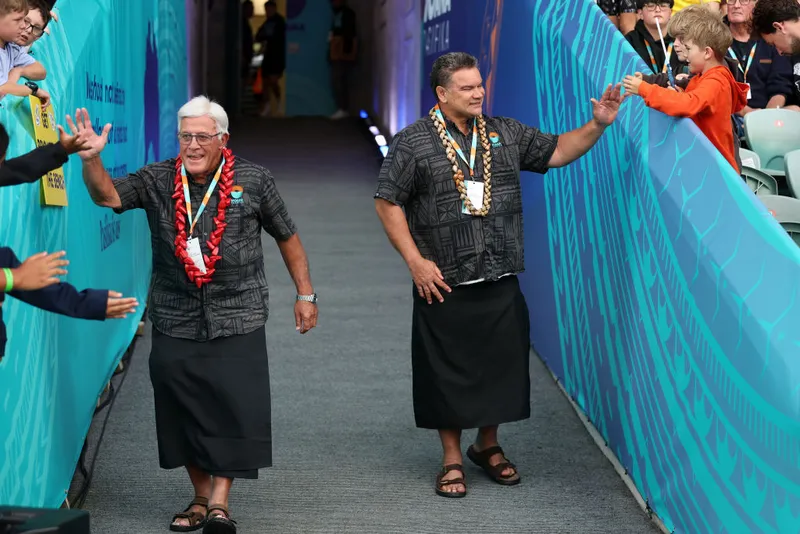
Moana lost its first match, but the team was given a pep talk by one of the club’s board members, New Zealand Rugby legend Sir Bryan Williams: “25, 26 years of heartache because Pasifika was left out of the mainstream rugby. And these guys have had 25, 26 years on us.”
I interviewed Williams back then for a series called Fair Game: Pacific Rugby Against the World, which looked at the infrastructure issues Pacific nations were facing.
“It’s not a fair game now because it’s obvious that, certainly, the island nations haven’t got any money.”
What we learned while making that podcast was that the driver for the inclusion of the Drua and Moana Pasifika in Super Rugby wasn’t so much a change in attitudes as a change in economics for New Zealand and Australian rugby, driven partly by the pandemic. Support funding from World Rugby was seen as helping to develop Pacific talent that would then feed back into its national teams, and help showcase rugby on the world stage.
As Bill Beaumont, former chairman of World Rugby, said in 2021: “The investment in the Fijian Drua team and the benefits that will bring, and Moana Pasifika, what’s happening there… all these things are major contributions to help the region and help rugby develop in the region because it is such an important area for us in the world game.”
This seemed to be paying off at the 2023 World Cup where, despite a lack of wins, the Samoan and Tongan teams produced competitive games far beyond what had been seen in recent times. Tonga gave eventual champions South Africa a gruelling 65 minutes (unfortunately in an 80-minute match), while Samoa, delightfully, had English fans in a panic.
With the next World Cup in Australia, there was genuine optimism that a Pacific rugby renaissance was on the cards, particularly in light of Fiji’s success, which was in no small way linked to the Drua’s participation in Super Rugby.
The fans still felt that optimism until the announcement this week that Moana Pasifika is to disband at the end of this season. There are now only a few weeks and scant matches left with the team.
Comedian and Moana Pasifika super fan Tofiga Fe’apuleai sums up the community feelings to The Spinoff: “We don’t just lose a team, we lose a village, a movement that brings our people together. Moana Pasifika is a team that allowed Pasifika players to express themselves as Pasifika unapologetically on and off the field.”
There is some small hope a funding angel could come to help, but it shrinks by the day. In the coming weeks, questions need to be asked, again, about this country’s relationship with Pacific rugby. The way in which Moana Pasifika was celebrated right up until it began drawing strong Pacific talent away from larger organisations (domestic and international) echoes the way in which Pacific teams were thrown together for tier one nations to have competition, only for those teams to be blown away and then chided patronisingly.
The relationship between Pacific communities and New Zealand Rugby will be strained by the demise of Moana Pasifika, especially with the Blues. They won’t have forgotten that Moana Pasifika coach Tana Umaga accused the Blues of undermining his club, indicating the Auckland team didn’t like having a second club based in the city. Some Auckland Moana fans might even end up Chiefs supporters for at least a year. It won’t help that Moana Pasifika is folding right as the Blues start seeking a new home – that timing is lost on no one.
That’s not to accuse the organisation, only to say that the Pacific community, in grief at the absence of Moana Pasifika might direct their feelings towards the Blues. Still, the Blues might want to make sure there’s no bad taste jokes at their Hall of Fame ceremony next month. Or at the very least call up some Pacific alumni to stand behind CEO Karl Budge next time he’s in front of media. Although maybe not Michael Jones… or Bryan Williams.

James Nokise
James Nokise is an award winning comedian, writer, and podcaster who watched too much unsupervised television and is a fan of obscure cartoons that somehow ended up broadcast in NZ in the late 80’s / early 90’s.


