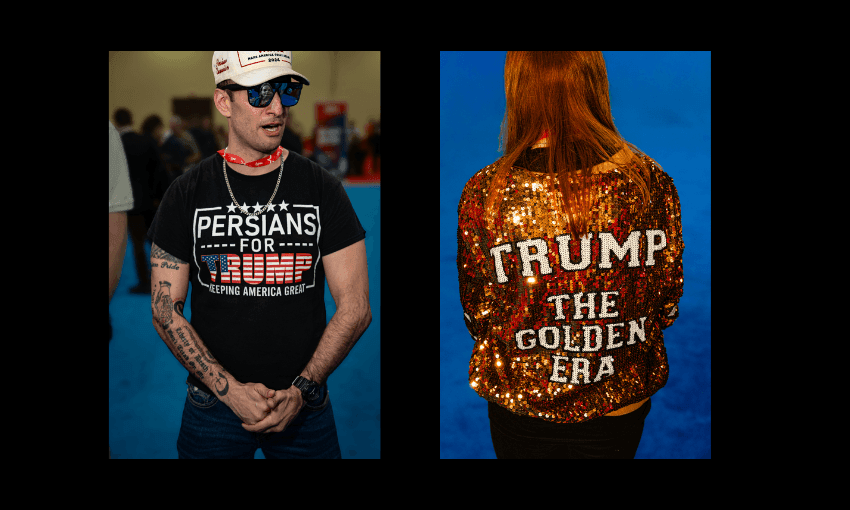

New Zealand photographer Craig Wright headed to Texas for a long-planned documentary project about red state culture. Then the US and Israel attacked Iran, and he found himself with a front row seat as conservatives responded to Donald Trump’s change of heart on war.
By day two of the Conservative Political Action Conference, I had had a gutsful. I hadn’t slept well and was working on an empty stomach. But more than that, the sky-is-falling, fear-mongering rhetoric espoused by the speakers was doing my head in. The socialists, Marxists, communists, Democrats, secularists, liberal media and Muslims were all to blame. The list rolled on like a script that didn’t need thinking, only repeating.
I left early and went to Walmart to buy my dinner. The exchange rate was killing me, so Walmart was becoming my go-to dining experience. A pre-made Caesar salad, a bag of hot and spicy beef jerky and a 24-ounce can of Mondelo.
I went back to my motel, watched NRL highlights on YouTube, popped a Zopiclone and went to bed. Peace.

My three-week trip in Texas, to photograph people of the red state, had come to a crescendo at the annual Conservative Political Action Conference (CPAC). CPAC is a gathering of conservative activists, elected officials and influencers discussing policy, sharing ideas and networking.
For the last few conventions pro-Trump influence had dominated, with themes around “woke” culture, border security, election integrity, and a broader sense of cultural conflict.
Putting it into a NZ context, it would be like the Easter Show meets Brian Tamaki, Liz Gunn, Billy Te Kahika, Family First, Sean Plunket, the Maxim Institute, Hobson’s Pledge and Peter Mortlock of City Impact Church. You get the idea.
The agenda included talks entitled MAGA vs Mullah madness, Cancelling Satan, Don’t Let Woke Marxists Raise Your Children, Walls Work, Defeating Communism, Breaking Stuff and Killing Bad Guys: The Case for Western Military Dominance and Don’t Sharia My Texas.

But there was unease at the convention. The US and Israel had launched a joint military attack on Iran: Operation Epic Fury. For a president who had campaigned on no more wars, the faithful attendees at CPAC were at a crossroads.
Steve Bannon, who served as Trump’s strategist during his first term, raised his doubts to the audience. “You have to be convinced that this is the right thing to do, particularly now that we’re on the eve of potentially the insertion of American combat troops,” Bannon said. “Your sons, daughters, granddaughters, grandsons, could be on Kharg Island or be holding a beachhead down by the Strait of Hormuz.”
He asked the audience how many of them would be willing to send their children, if there was a draft. Very few raised their hands. I looked around. Given the demographic of the room, he probably shouldn’t have talked of children but grandchildren.
If this was New Zealand, it was the kind of crowd who would have an issue with Te Reo.

Bannon pivoted on to domestic issues. “A bigger threat to this country right now, is in city hall in New York City and these mosques in North Texas.” He was talking about new democratic socialist mayor Zohran Mamdani. There was applause.
Just as Italians and Irish Catholics faced hostility in the 19th century, Muslims have become the latest immigrants to be targeted by certain sections of the community.
I saw an unease in America, a double-edged duality. There was a contrast between the foundational ideals of equality, opportunity and liberty (the “American dream”) and the reality of systemic injustice, inequality and exclusion.
The largest applause at the convention was for Reza Pahlavi, the son of the last Shah of Iran. The Iranian contingent at the convention was vocal, energetic and colourful. Without them, one could say, the convention was, well, slightly dull?
At certain times, during the day, you could hear them throughout the venue, chanting protest songs. They were desperate for regime change, grasping for any media attention.
Pahlavi has become the symbol of this contingent. For other Iranians, he is a trust fund kid, who represents a past regime that was just as corrupt as the present. After his father, the Shah Mohammed Reza Pahlavi fled in 1979, he, his family, and associates were accused of taking millions, if not billions, out of the country.
Pahlavi said Trump was the only US president to confront the Islamic regime head on. There was applause and the crowd chanted, “Thank you, Trump! Thank you, Trump!”
Pahlavi ended his speech with: “President Trump is making America great again… I intend to Make Iran Great Again.” Rapturous applause.

I talked to Dan, a local Texan. “We couldn’t let them have the A-bomb. Iran said death to America the entire time, and that is what they get. It’s not against the Iranian people, we want to get rid of that evil regime.”
“The Bible says when all the nations turn against Israel, that is when the end of the world is coming. The Bible is true. You can’t disprove it. I stand behind Trump 100%.”
Jayden Bennett, a 20-year-old Christian, left Turning Point USA after Charlie Kirk’s assassination. “Since Charlie’s death, they only care about money, metrics and numbers right now,” she told me.
“I’m very America first, so the whole war in Iran right now, I don’t really care at all about it. It’s not our problem.”
I talked to Barbara, a middle-aged women from Delaware. “I found the convention not as exciting and as detailed as in the past. They were all talking from the same script, speaking to us like we are in a rally/rah-rah-rah-cheerleading exercise as opposed to giving us solutions and plans and strategies for the future. It was easier for them to not prepare. I’m insulted.”
I kind of had to agree with her.
Five minutes later, I saw her being interviewed and asked about Iran. “Bomb the shit out of them and get out,” was her response.
When I checked in for my flight home, a Bangladeshi Muslim woman covered in a hijab served me. “As-salamu alaykum (peace be upon you),” I said. The standard Muslim greeting. A surprised smile spread across her face and she responded, “Wa alaykum s- salam (and upon you be peace)”. I asked about being Muslim in Texas and if she had encountered any problems. “No,” she said with warmth. “All good, no problems.”
I smiled and realised the vacuum I had been in the last few days was not representative. I would hate to think someone would try to describe New Zealand if they had only experienced, say, a Destiny Church march.