Stalking survivor Zeni Gibson on what happens when you speak up

Zeni Gibson in new documentary series Stalked. Image: Supplied
In 2024, Zeni Gibson detailed her harrowing account of stalking on The Spinoff. Today, she plays a key role in a new documentary series exploring the systemic failings that leave victims unprotected.
Content warning: this story contains graphic descriptions of threatened violence, including sexual violence. Please take care.
She was going to just post it as an Instagram story. It was 2023 and Zeni Gibson had been stalked for six years by a man named Greg, who began to persistently harass her after she rejected him at age 17. What began with anonymous letters and Facebook messages soon spiralled into obsessive memes and violent threats from burner accounts. By 2023, he had begun targeting her colleagues and friends. “It was spiralling out of control,” says Gibson. “I just felt like I was about to either explode or scream, and I needed to find an outlet.”
One afternoon, she remembers being “at breaking point” while sitting in the car with her friend Matahana. “I just said, ‘I’ve got to tell someone, I think I’m gonna post an Instagram story, say I’m being stalked, and for everyone to not trust these accounts’.” Her friend, who had been by her side through all the years of torment, looked at her. “Zeni, I don’t think it’s gonna fit in an Instagram story.”
Matahana was right. Over the next year, Gibson would work with The Spinoff’s then senior editor Madeleine Holden to tell her harrowing account of a near decade of violent harassment by a man she barely knew. It is a sickening, brutal read which charts the escalation from “pleading and lovesick” messages beginning in 2016 to “gruesomely violent” threats made towards her and her loved ones over the course of eight years. “Last chance to get back to me or your mum’s gonna find Lola’s head in her letterbox,” Greg wrote of Gibson’s family pet.
“One day when you think this is all over and you have a family of your own and I’m all alone I’m going to kill your child in front of you or your husband,” read another message.
As the messages became more graphic in nature, frequently detailing scenes of rape and torture, Gibson’s self-image plummeted. “My body dysmorphia became debilitating,” she said at the time. “I couldn’t take my clothes off without thinking about Greg promising to stab, slice and decapitate me.” She found it increasingly hard to leave the house and withdrew socially. “I started ignoring phone calls, cancelling plans and failing to reply to texts, and in person I’d be bad company, distracted each time my phone lit up with another reminder of Greg.”
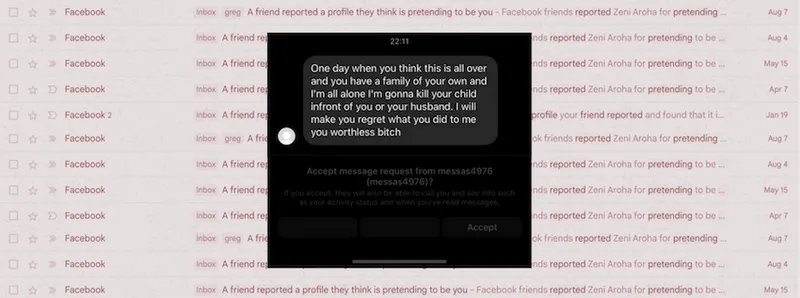
Gibson first reported Greg to the police in April 2022 after enduring weeks of particularly graphic harassment and he was soon served with a criminal harassment letter that prohibited him from contacting her. The communication stopped for months, until a flurry of notifications around that Christmas indicated that someone had been attempting to log in to her social media, while her inbox became inundated with hundreds of newsletter sign-ups under threatening user names. These included “Hi Cutyourthroat” and “Kia ora I need to slice your smile off your face.”
Returning from her summer holiday in January 2023, Gibson took a dossier of this new communication from Greg to the police. She would continue to forward them dozens of distressing screenshots for months to no avail: “aside from an acknowledgement of my emails and one update from an officer in April, I heard nothing from the police during this time.” Even when the harassment moved offline, with human faeces and expletive-ridden letters left in her mum’s letterbox, Gibson was told to contact 105 and speak with a new police officer every time.
“This meant that each time I reported something new that had shown up in my mum’s letterbox, I had to explain the whole story, again and again,” she said at the time. “I’d often get the impression officers weren’t taking my fear seriously.”
Greg was arrested in August 2023 after submitting a threat against Gibson’s old workplace using her name and contact details. He was charged with two counts of causing harm by posting digital communication and one count of criminal harassment, and sentenced to supervision for 12 months and community detention for six months. But just hours after leaving the courtroom, Gibson received another newsletter sign-up under a threatening name. One month later, Gibson’s mum received another aggressive handwritten letter at her address.
At the end of the article, originally published in November 2024, Gibson was continuing to report these communications to the police as they arrived, and Greg was continuing to harass her and her family. “For my entire adult life and much of my adolescence, he tormented me,” she said at the time. “Everything I set out to achieve (finishing high school, completing bachelor’s and honours degrees, embarking on my career) and every ordinary event I experienced (heartbreak, loss, illness, insecurity, family struggle) I did under the weight of Greg stalking me.”
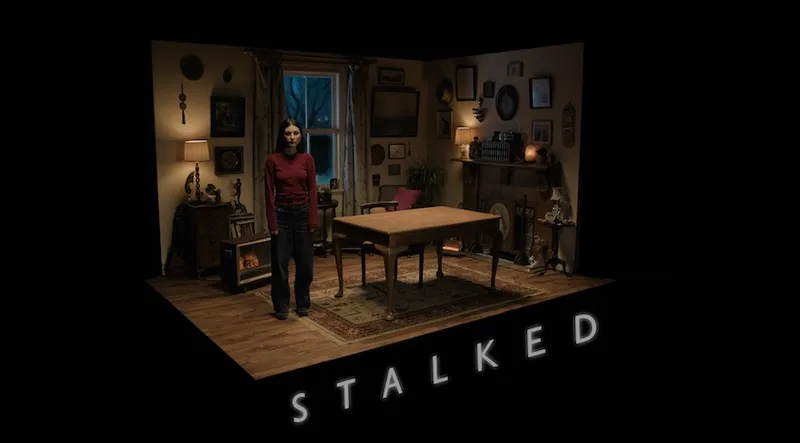
Speaking more than 18 months after first telling her story, Gibson says the response from readers was “unbelievable”. In fact, she’s still coming to terms with the way strangers and acquaintances reached out to share their own stories. “It became this mirror of other people’s experiences,” she says. It made speaking up feel the right thing to do. “I really wanted to show that there’s no shame in it,” she says. “I felt shame for so long that I knew I needed to go in head first and show other people that it’s okay to do it too.”
Following the publication of the article, Gibson also had a video call with senior representatives from police and corrections. “They said sorry and they offered me a single point of contact moving forward,” she says. “It wasn’t lost on me that the only reason that they were offering me this kind of good service was because of the bad press they’d got.” She didn’t accept the apology.
Gibson says she has continued to feel disheartened by a lack of communication and updates, and hasn’t been in touch with NZ Police since March 2025. “If the worst happens to me or my family, the police already have everything there to stop it,” she says. “I feel like I get nothing more out of saying the same things.”
Inspector Jason McCarthy, Wellington area prevention manager for NZ Police told The Spinoff last week that he acknowledges Gibson had to deal with several different officers, and accepts the difficulty she faced as a result. “Police have made changes to the way we assess and respond to these sorts of incidents,” he says. As for the time it took for any action to be taken, McCarthy says it is crucial that police are able to put a robust case before the court. “For a number of reasons, this can take time, including the time it takes to gather sufficient evidence and to ensure we are meeting the Solicitor General’s guidelines for prosecutions.”
“Victims deserve Police to be at their best, and it is a priority for us to ensure we deliver on this. We accept that in Ms Gibson’s case we did not always achieve this, and we have since made a private apology to Ms Gibson.”
Gibson isn’t done speaking up. She is now telling her staggering story in the new Sky three-part documentary Stalked. While she initially had reservations, advice from her dad encouraged her to do it. “He said ‘you have now told your story, so the element of releasing shame and regaining your power has already been done. Now it’s about what you can do with more exposure’.” It was a pivotal piece of advice. “I realised it’s now about using my experience and the platform that I’ve now gained to help other people.”
“I wish I’d had something like my article or Stalked when I was in the thick of it, and how much it would have meant to me to be able to see what I was going through from someone else,” she adds. “I can’t overstate this: it would have been life changing.”
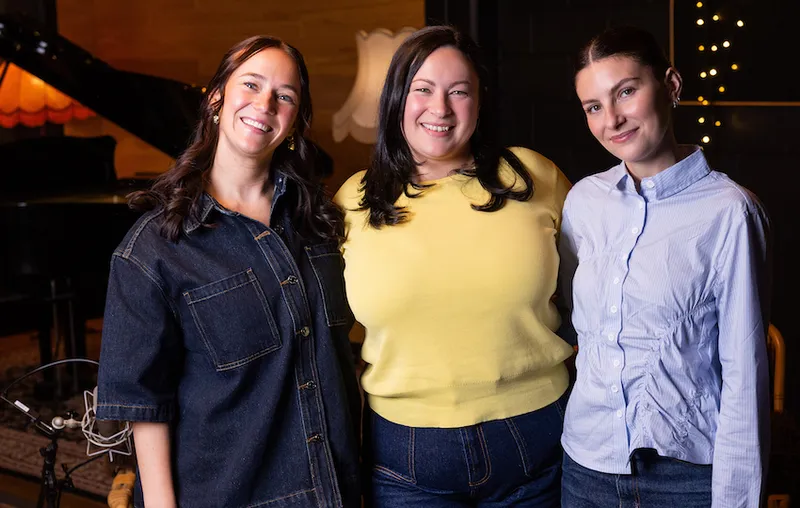
That also meant connecting with other stalking survivors Jazz Thornton and Nortessa Montgomerie, who also share their stories in the documentary. Mental health advocate Thornton experienced a chilling chapter in which one of her followers flew from the other side of the world and visited her home address, and Montgomerie became trapped in a coercive relationship that descended into domestic violence and kidnapping. The trio now share a group chat, and still talk regularly. “It was so beautiful, how instant the connection was between us,” says Gibson. “The more we spoke, the more we saw that we were all holding a mirror up to each other.”
While the documentary delves back into the darkest parts of Gibson’s story, it also charts her instrumental role in bringing about legislative change. After sharing her story publicly, Gibson was contacted by Green MP Tamatha Paul, who would go on to propose an amendment to the Crimes Act to make stalking a crime punishable by up to five years in prison. Gibson visited parliament to deliver an oral submission in early 2025 and in November 2025, a year after her article was published, the bill to criminalise stalking was passed into law. “I was elated,” says Gibson. “That was a moment where I was like, ‘holy shit, we have done something big’.”
With the law set to come into effect later this month, Gibson hopes that the public discussion around combatting stalking will only continue to gain momentum in Aotearoa. “I think that there’s a tendency for the conversation to slow down once legislation is passed and once something becomes a law,” she says. “I think it will help police response, but it does get my back up a bit to hear the conversation around ‘well now we can help’ because a lot of stalking does fall into other acts that were already there to protect people.”
Inspector Jason McCarthy says when the new stalking and harassment offence comes into effect on May 26 it will bring improvements. “This will provide greater clarity and new tools for Police and victims, ensuring we continue to have a clear focus on putting victims first.” Gibson remains cautious about how it will be implemented by police. “I’m interested to see how it plays out, to be honest, because there’s a lot of work to be done.”
Gibson says Greg continued to contact her and her family following the publication of her story. Over 10 years now since he first made contact, she says there’s been no resolution. “He was sentenced for the two emails but then it [the harassment] continued after that – I’m always just waiting for it to come back.” While he’s gone quiet, she says the silence can be just as scary. “The thing with stalking is that there’s no neat way to package up the traumatic event. It’s not something that just happens and then stops. It’s something that stops and starts and you never know what’s around the corner.”
Still, Gibson is rebuilding her life in the UK, where she feels as if “every single day I’m grateful to be slowly returning to myself.” She describes the effects of stalking as “aftershocks” which still come and go, but is embracing small wins, like starting to run in public again. “The more I’m coming to terms with the gravity of what has happened to me, the more I realise that I escaped something really scary. I am so lucky and grateful to be alive.” Her focus now is on qualifying to be a lawyer, where she plans to work in advocacy and policy change. “It feels like the start of a new chapter in this very long story,” she says.
“I’m really hoping that it’s a good one.”
Stalked begins 8.30pm May 4 on Sky Open, with all three episodes available to stream on NEON from today.
If you or someone you know is in need of support, get in touch:
TAUTOKO Suicide Crisis Helpline – 0508 828 865
1737 – Need to talk? Free call or text 1737 any time for support from a trained counsellor
Lifeline – 0800 543 354 – Free text 4357 (HELP)
Samaritans – 0800 726 666
Youthline – 0800 376 633, free text 234 or email talk@youthline.co.nz or online chat. Open 24/7.
Alex Casey
Alex Casey is a senior writer at The Spinoff with over a decade of experience writing about popular culture and social issues in Aotearoa. She lives in Ōtautahi and likes watching reality TV and walking the dog, occasionally at the same time.


