Oh crap: it really looks like India thinks we’re gonna invest $33 billion in their economy

Indian politicians really seem to think we’ve made a massive economic commitment. One small problem: we don’t have any money.
Indian prime minister Nahendra Modi’s X post about his country’s free trade agreement with New Zealand is celebratory. “Today marks a landmark moment in the India-New Zealand partnership!” it begins, before talking about our nations’ “deep trust” and “shared values” and listing the sectors that will benefit. So far, so good. But then, at the end, a bit of concerning rhetoric. “The investment commitment of (US)$20 billion by New Zealand will further strengthen our cooperation in agriculture, manufacturing, innovation and technology,” says Modi’s post.
Nice. Cool. Just one issue. The word “commitment”? That sounds pretty solid. Almost as if our businesses are actually on the hook for investing a sum that translates to NZ$33 billion into the Indian economy in the next 15 years. Trade minister Todd McClay has been clear that the so-called “commitment” is actually more of an “aspirational” thing, like a New Year’s resolution to stop drinking beer, rather than something we’re actually going to do, like continue drinking beer.
But it’s not just Modi using the terminology. “New Zealand has… committed to invest [US]$20bn,” India’s commerce and industry minister Piyush Goyal said after signing the free trade agreement, in language echoed in press releases and official statements. Indian media have repeatedly reported that New Zealand has made a $20bn investment commitment. Every indication emerging from India is that they really expect us to spend billions in the coming years.
The issue with us actually being on the hook to invest $33bn in India is that we are, to use the technical economic terminology, on the absolute bones of our arse. Asking a New Zealand business for cash right now will see them patting down their suit jacket and producing a half-eaten K-bar and several modestly sized bundles of lint. No-one in this country has money for Westgold butter, let alone India. It’s hard to see that turning around in the foreseeable future.
Even if it did, we’d still be in what economists call “deep shit”. Labour leader Chris Hipkins pointed out on RNZ’s Midday Report last week that New Zealand businesses only invested about $1.5bn into China during the first 15 years of our free trade agreement with that country. “The government is signing us up to a commitment that’s at least 20 times that,” he told Guyon Espiner. “There’s just no way that New Zealand businesses will be able to meet that.”
His scepticism has been echoed by economists including Cameron Bagrie, who likens the chance of New Zealand businesses investing $33bn into India to the chance of Italy winning the next Rugby World Cup. “It’s possible,” he says. “Long odds though.” In an article for BusinessDesk, Bagrie points out that the sum total of New Zealand’s foreign direct investment was $41bn in 2025, and the income on it was relatively paltry, with an average return of 1.5%.
Given that, he thinks it’s unlikely New Zealand will be pouring $33bn into the Indian market anytime soon. The good news is he doesn’t think we’ll have to. He points out that the FTA only says New Zealand will “promote [direct investment] from investors of New Zealand into India with the aim to increase such investment by US$20bn”. “There is wiggle room,” he says.
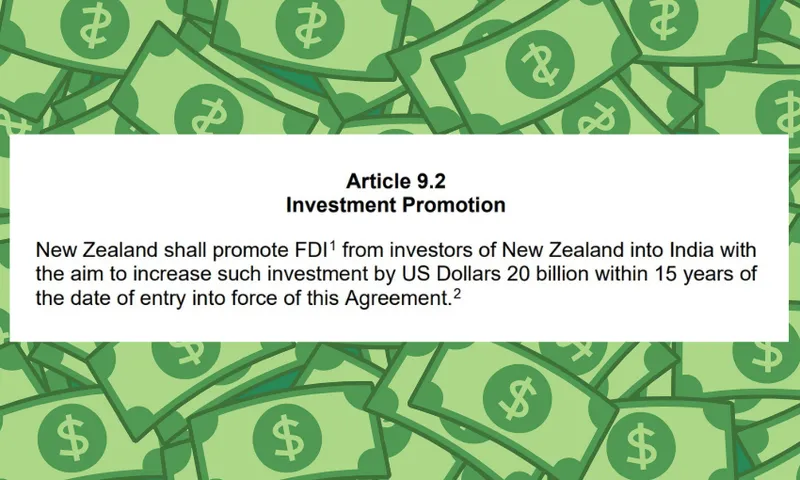
McClay obviously agrees, saying consequences could only come New Zealand’s way if the government doesn’t make a good effort to foster direct investment into India’s economy.
Labour isn’t so sure. In his interview with Midday Report, Hipkins said the wording of the agreement was unclear and there’s every chance India might turn around in 15 years and accuse New Zealand of failing to uphold its end of the bargain. If it does, it could send our exporters back to square one, he warned. “In the worst case scenario, New Zealand businesses could find themselves suddenly facing all the current restrictions they face as of today.”
That doesn’t seem like a complete impossibility, given everyone of importance in India really does seem to think New Zealand has made a firm commitment to invest a massive amount of money it both doesn’t have and seemingly has no intention of spending. On the other hand, McClay and Bagrie have a point that the wording of the agreement is vague enough to give lawyers room to argue. How much will that matter for a country with little leverage at the bottom of the world? Who’s right about the level of risk we’re actually facing? We’ll find out in 15 years.

Hayden Donnell
Hayden Donnell is a senior writer for The Spinoff. He previously worked at RNZ, TVNZ and the New Zealand Herald, alongside other media companies that have since closed down or been renamed. His primary passions are local politics and the Big Fresh animatronic fruit and veggies.


