Winston Peters has had it with your stupid question. Full blocs ahead for November

Image: Jason Stretch
The NZ First leader has never been less equivocal, paving the way for an intriguing election dynamic.
Among the irrefutable laws of New Zealand politics across four decades are (a) never write off Winston Peters and (b) Winston Peters is not being as definitive as you might think.
The plainest evidence for (b) is to be found in 1996, when the ousting of the Bolger government was promised, and 2005, when he renounced all interests in the “baubles of office”.
Accordingly, there has been a constant supply of close analysis of the words used by the New Zealand First leader over recent years. Has he really ruled out another coalition with Labour? By aiming his invective so directly at Chris Hipkins, is he leaving the door open to work with the party under a different leader? Might he coalesce with Labour under the banner of, say, we are in a national crisis and this is the only way to keep the extremists of the [insert party] from the levers of power?
It’s not just commentators who have wondered as much. “I’ll tell you what invites further instability,” railed Nicola Willis, deputy leader of the National Party, last week, in response to her coalition partner’s public derision of the decision by Christopher Luxon to call a confidence vote in himself. “A vote for Winston Peters that could result in a Labour-Te-Pāti-Māori-Green government.”
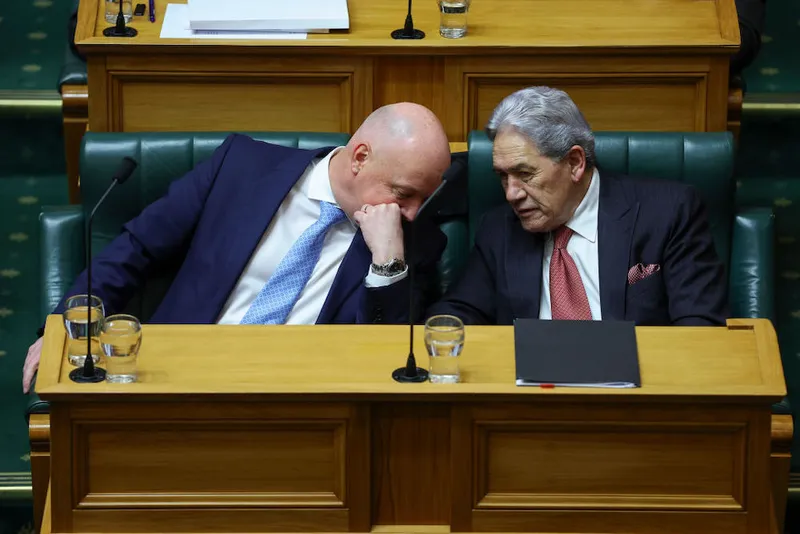
The trouble with New Zealand First, she later said, was that Peters will “always find a way” of going with the other lot. “You have seen him through the years, haven’t you? He will always find a way of saying, ‘No, no, no, what I meant at the time was …’”
In yet another interview she warned anyone thinking of voting New Zealand First to reinstall the current coalition to “be careful what you wish for, because you won’t always get what’s written on the tin”.
Irked by all of the above, Peters told Newstalk ZB it was quite different to the past. “I’ve been in more elections than anybody else in this country and I have never, apart from 2023, said who we’re going to rule out,” he said. “I have never done that before. Those are the facts.”
Next, he tap-tapped the social media microphone and delivered what looks a lot like a cast-iron undertaking. They had ruled out working with the Labour Party in 2022, what with the left being “full of woke self-confessed communists who would turn our country into a basket case”. And “nothing has changed”, he continued, except, of course, that “they are even worse”.
So, “No, we won’t do a deal with Labour or their Marxist and separatist mates.” Begone, he hollered, much like Thor repelling the giants at Midgard, with your “stupid question” and “mischief making”.
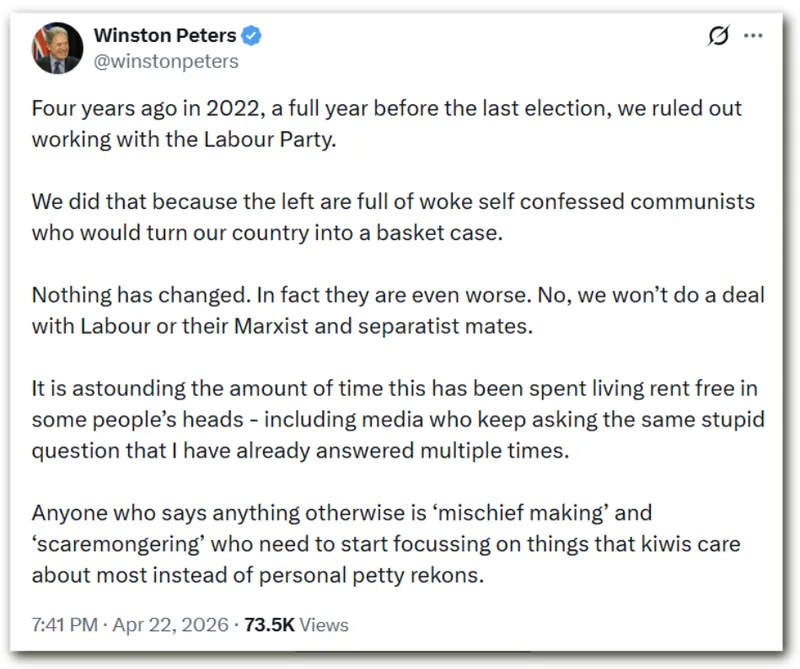
All of which, even the hardest, most cynical Winstonologist must surely accept, is pretty darn clear.
Which in turn means, most likely, we’re looking at a straight-up bloc versus bloc election. That might seem unremarkable, but it has not been the norm under MMP. If it stays that way, strap in for the extended mix of Your Chris-led coalition is more apocalyptic than mine.
What does the contest look like on a bloc basis?
The most recent Curia poll for the Taxpayers’ Union, undertaken at the start of the month, put the question directly. If there were two three-party coalitions on offer, which would you go for?
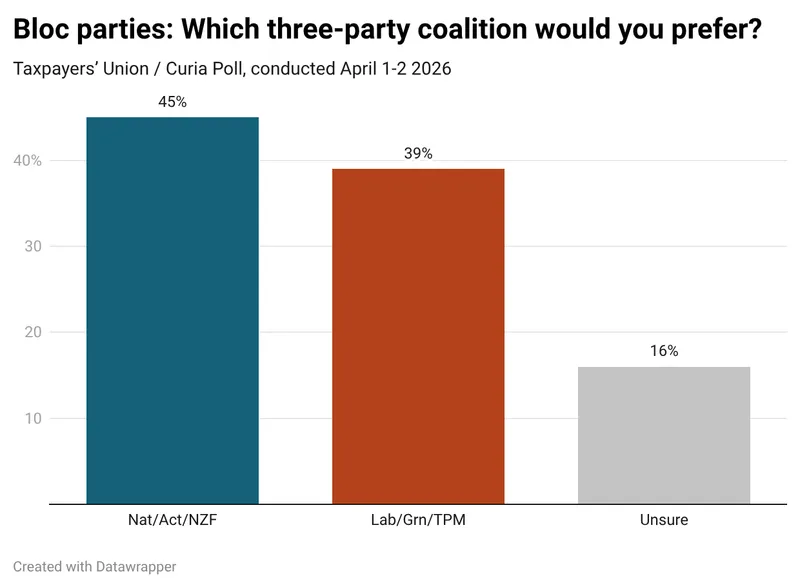
That’s a binary proposition, mind you. Other combinations are available. It is conceivable that a two-party coalition could form, should the numbers permit, with or without a third in support or on the cross benches. Labour has yet to say, what is more, whether or how it would work with Te Pāti Māori.
But the bloc numbers in the chart above nevertheless broadly mirror the aggregate backing in the same poll for the two sets of three parties, that is, their three percentage totals added together. On that score, the poll has National, Act and NZ First at a combined 52.4%, versus 43.8% for the left-inclined trio. If we were to remove the “unsure” contingent in the bloc question, it would extrapolate to 50.6% versus 43.8%.
Here’s how the blocs have tracked since the last election.
Look at those top two lines, each representing the combined support for three parties, and the upshot is: not a lot has changed. National Party supporters might shudder at the sight of the February 2024 result, when National’s 39.6% meant that, on its own, it was outpolling Labour, the Greens and TPM combined. They won’t thrill, either, at the party sitting more than eight points below its election night result. And yet, of the 32 Curia/TPU poll results plotted above, only five have the hypothetical Labour-led coalition out in front.
Opportunity knocks
If it’s as close as some of the polls suggest, an overhang could tip the balance. If, say, Te Pāti Māori were to win five electorates and a tiny party vote, that could deliver a proportionality-skewing advantage to the left.
And a final potential quirk: there’s still a chance the Opportunity Party could upset the two-bloc apple cart. Recent polls have Top, now approaching their fourth tilt at creating MMP history, hovering around 3%.
Under new leader Qiulae Wong, can they make a virtue of being the only serious party that would readily negotiate with either red or blue?

Toby Manhire
Toby Manhire is editor-at-large at The Spinoff. He loves to cast a pod, whether it's Gone By Lunchtime, At Large or Juggernaut. He is a former editor of The Spinoff and has worked as a journalist in NZ and the UK since the last millennium.


