
Ex-tropical cyclones like Vaianu are set to get wetter as the climate warms – but every bit we reduce emissions will help stem the wild weather.
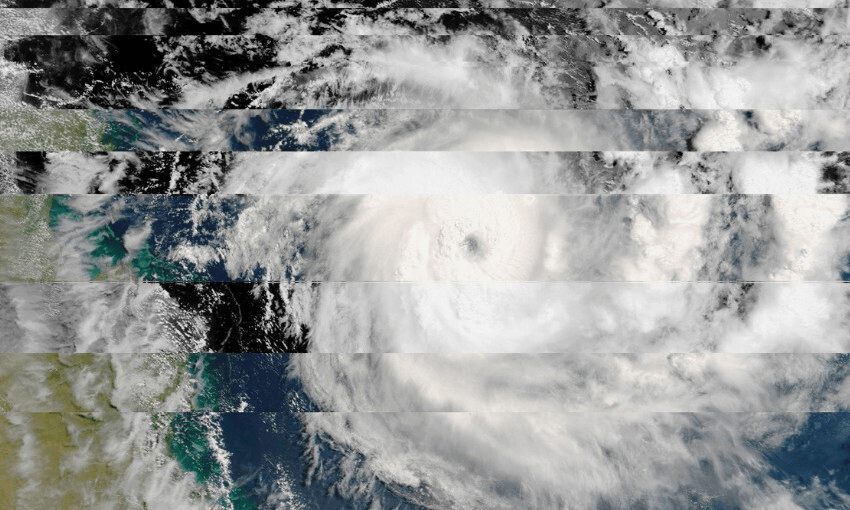
It’s been a weekend for hunkering down. After making landfall in Bay of Plenty on Sunday afternoon, Cyclone Vaianu has barreled across the North Island, delivering lashings of wind and rain, and whipping up storm anxiety. States of emergency declared, families evacuated, coastlines inundated.
It’s a lot to absorb. But science predicts that future cyclones are likely to get wilder still.
By the end of the century, if we continue to pump greenhouse gases into the atmosphere unchecked, we could be looking at cyclones with up to 35% more extreme rainfall. That’s according to a study published last year, investigating how tropical cyclones might unfold in our corner of the South Pacific as the climate warms.
Peter Gibson, a climate scientist at Earth Sciences New Zealand, led the study, which used supercomputers to model more than 10,000 storms – analysing rainfall, wind speeds, paths and frequency.
The 35% increase in extreme rainfall, he explains, means more total millilitres dumped over the course of a whole cyclone event. But we can also expect an intensification of torrential downpours – instead of buckets, think tanks. “That increase we expect to be larger for those short bursts of rainfall,” he says. “The kind that can cause flash flooding.” Too much water, too quickly, with nowhere to go.
The physics behind this extreme rainfall increase is well established: the warmer the air is, the more water it can hold. If you increase the temperature by 1°C, the atmosphere can hold 7% more water vapour, Gibson says. So as fossil fuels heat the planet, there’s more water hanging around. And cyclones are very efficient at converting this vapour into rainfall – what’s called “precipitation efficiency”. This ability to turn vapour into rain is also turbocharged by global warming.

Just how much the extreme rainfall ramps up is dose-dependent. The 10,000-storm modelling considered three different scenarios with low, medium and high emissions, representing 1, 2 and 3°C of warming (compared to a 1995-2014 baseline) respectively.
Even if we don’t reach the worst case, “every half a degree we push out will likely relate to bigger downpours,” Gibson says. Put another way: limit greenhouse gas emissions, and “every degree of warming we can shave off will lower the impacts of tropical cyclones”. Cyclone winds might also get more extreme, with speeds notching up 3-8%, the simulations revealed.
The paths of cyclones across the Pacific, on the other hand, are unlikely to shift much in future, and we can expect roughly the same frequency going forward. On average, one to two ex-tropical cyclones make landfall in Aotearoa each year between November and April. “Some of our biggest events tend to happen in the later half of the season – so February to April,” Gibson says.
There was Giselle in April 1968, which resulted in the sinking of the Wahine that claimed 51 lives. In March 1988, Bola unleashed downpours equivalent to half a year’s total in some places, and killed seven people. And most recently, Gabrielle battered the North Island across a February weekend three years ago, resulting in the loss of 11 lives. Gabrielle, when combined with the preceding Auckland Anniversary weekend floods, cost an estimated $14.5 billion – the costliest storm sequence in New Zealand history. So far.
It’s these big, damaging events where we will really experience the brunt of more extreme rainfall, Gibson reckons. “Infrastructure is designed to withstand the historical climate – and we already know it often doesn’t, right? We see infrastructure fail all the time. And so, when you push further out into the extremes is when you can see more and more devastation.”
We’re already beginning to experience the impacts of climate-cranked cyclones.
We know, thanks to the emerging science of “event attribution”, that Cyclone Gabrielle was dialled up by climate change. It featured 10% more rainfall due to the warming from human-caused fossil fuel emissions, according to a 2024 analysis led by Gibson’s Earth Sciences New Zealand colleagues. And intense rainfall peaks were about 20% heavier, too.
Another Gabrielle analysis, from World Weather Attribution, zoomed in on the catastrophic deluges that bombarded Tairāwhiti and Hawke’s Bay. Here, the maximum rainfall was about 30% more intense than it would have been if we had not already warmed the atmosphere by 1.2ºC.
As we say haere rā to Vaianu, floodwaters recede and communities clean up, scientists will start to dissect the data. Maybe they will begin to pick apart how much of the deluge can be chalked up to all the planet-heating fossil fuels we’ve pumped into the atmosphere. “I hope that every storm we learn a little bit more – in terms of the scientific understanding of the world. And, also, how we respond to them,” Gibson says.
One big takeaway message is clear: reduce emissions, reduce warming, and curb the worst weather impacts. The storms to come are still, to some degree, up to us.