All the systems that failed in the police’s non-systemic failure

Police commissioner Richard Chambers and police minister Mark Mitchell. (Photo: Mark Mitchell /New Zealand Herald via Getty Images)
The police commissioner says the handling of sexual assault complaints against Jevon McSkimming wasn’t a ‘systemic failure’. That doesn’t explain all the systems that failed.
Police commissioner Richard Chambers was resolute in his interview with RNZ yesterday on what has been described as an “atrocious”, “appalling”, “disgusting”, “damning” and “scathing” Independent Police Complaints Authority report into how his organisation handled sexual assault complaints against its former deputy commissioner Jevon McSkimming. He agreed the way those complaints were handled was a “disgrace”. But he refused to accept interviewer Corin Dann’s contention that it could be viewed as some kind of problem with police as a whole. “It’s not a systemic failure for New Zealand police,” he said. Instead it was a failure of some of its top officers. “New Zealanders need to have trust and confidence in their police – and they can. But this behaviour by a small group of former leaders of New Zealand police is a disgrace.”
Chambers’ contention that there hasn’t been a systemic failure in police meshes uncomfortably with the dozens of systems failures detailed in the IPCA’s report. Those start with McSkimmings’ recruitment to the role of deputy commissioner in October 2020. By that stage, he’d told several colleagues, including his supervisor and new police commissioner Andrew Coster, that he’d had a consensual affair with a younger woman that had ended badly in 2017, and she was now harassing him via email. He didn’t disclose that she became a police employee, after he recommended her for a job.
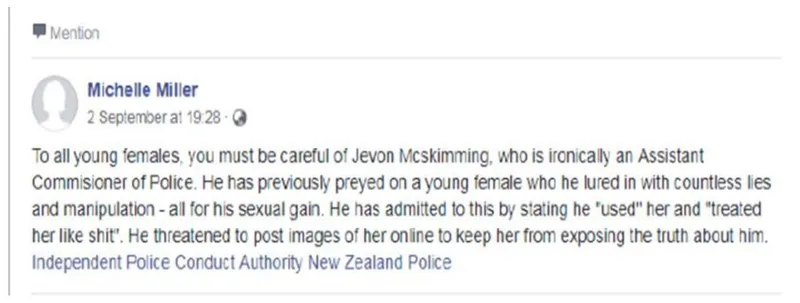
An anonymous 2018 Facebook post from someone going by “Michelle Miller” gave a different version of events, accusing McSkimming of preying on a young woman and threatening to post images of her online to stop her exposing the truth about him.
Integrity checks
None of this seemed to limit McSkimming in his quest for a promotion. An independent vetting process, during which he didn’t disclose the affair, failed to uncover any concerns about his suitability for the role of (non-statutory) deputy commissioner. Despite the Facebook post tagging in police and the IPCA, it wasn’t flagged and no action was taken.
The pattern continued as McSkimming ascended through the ranks to become a statutory deputy commissioner (the selection and appointment process for which is managed by the Public Service Commission) in 2023. Potential misconduct was routinely minimised or ignored entirely, even as serious allegations were made by his accuser.
After Coster finished his term as police commissioner early and the Public Service Commission was looking to appoint McSkimming as interim commissioner while the recruitment process was completed, a police executive director known as Ms G was asked whether she had concerns about his integrity, conduct or behaviour. By that stage, she knew he had been the subject of sexual assault allegations and was being investigated. Her answer: no. During the same process, Coster euphemistically referred to a previous relationship that had escalated in an “unpleasant manner” but said police had investigated and the matter was closed.
These are notable examples, but they weren’t the only ones who failed to raise concerns about their colleague when confronted with integrity checks. The issue is noted so many times in the report, it can seem almost like a cultural issue.
Complaints escalation
If Ms G didn’t think the complaints against McSkimming were worth taking seriously, she’d have some precedent to fall back on. Police failed to act on allegations sent via email and on social media by McSkimmings’ accuser, known in the IPCA report as Ms Z, for years, instead unquestioningly buying into his narrative that she was a jilted ex-lover or “woman scorned”.
Most egregiously, police badly mishandled multiple complaints sent by Ms Z through the 105 online reporting portal between December 2023 and June 2024. At first those reports were, rightly, forwarded to the police integrity and conduct division for further investigation.
But that’s where they died. The complaints were never entered into the division’s database or forwarded to the IPCA. Instead at the request of a senior officer, they were sent to a team investigating Ms Z, which labelled them “false 105 report”. Soon after, she was charged with harassing McSkimming under the Harmful Digital Communications Act. “In short, Ms Z’s complaints were used as evidence against her in criminal proceedings, without any investigation into their veracity,” the IPCA notes.
The police website says all 105 reports should be followed up. They weren’t. It wasn’t the only time where standard processes were deliberately bypassed. Altogether the report details a cascade of botched procedure from officers across several divisions, not just a few bad apples.
Internal concern escalation
When one police agency did take Ms Z’s allegations seriously, it was ignored. “Owing to the number and nature of emails and concern for the welfare of Deputy Commissioner McSkimming”, her complaints were sent to the Fixated Threat Assessment Centre (FTAC) for assessment in January 2024. It came back with a report flagging that some of the accusations were “certainly plausible” in terms of, at the very least, breaches of the police code of conduct by McSkimming, and urging police to refer the matter to the IPCA. Those concerns were reiterated during in-person conversations with top officers. Once again, police only used the report’s contents to bolster their Harmful Digital Communications Act case against Ms Z. Perhaps an in-house analysis pointing to potential serious offending by a top officer should have triggered more alarm bells inside the organisation. It didn’t. The system for flagging misconduct by senior officers failed.
Investigation policies and structure
When police finally did agree to check out whether Ms Z might be telling the truth in mid-2024, its investigations were structurally unsound and compromised by interference from bosses. According to the IPCA, the terms of reference for “Operation Herb” were set with protecting McSkimming’s career as their “foremost consideration”. They didn’t require officers to actually talk to Ms Z, while also asserting that her relationship with McSkimming was consensual, none of which the alleged victim agreed with, and all of which ran contrary to the police policies meant to govern sexual assault investigations.
Some officers did raise concerns about the egregious breaches of policy. But Operation Herb was closed prematurely and McSkimming wasn’t charged.
The watchdog system
Even the IPCA doesn’t come out of its own report unscathed. It acknowledges it should have considered launching an investigation after it saw Linkedin posts by Ms Z detailing serious allegations against McSkimming in 2023.
The report it has produced more than two years later is a disturbing read. Chambers is right: it details top officers’ egregious efforts to squash serious allegations against one of their senior colleagues. But all throughout, those officers are enabled by a dearth of checks and balances and a system that seems incapable of enforcing its own policies even when they’re breached blatantly and repeatedly. There are some bad apples involved. But reading the report’s 135 pages, it can seem like the tree itself is rotten.

Hayden Donnell
Hayden Donnell is a senior writer for The Spinoff. He previously worked at RNZ, TVNZ and the New Zealand Herald, alongside other media companies that have since closed down or been renamed. His primary passions are local politics and the Big Fresh animatronic fruit and veggies.


