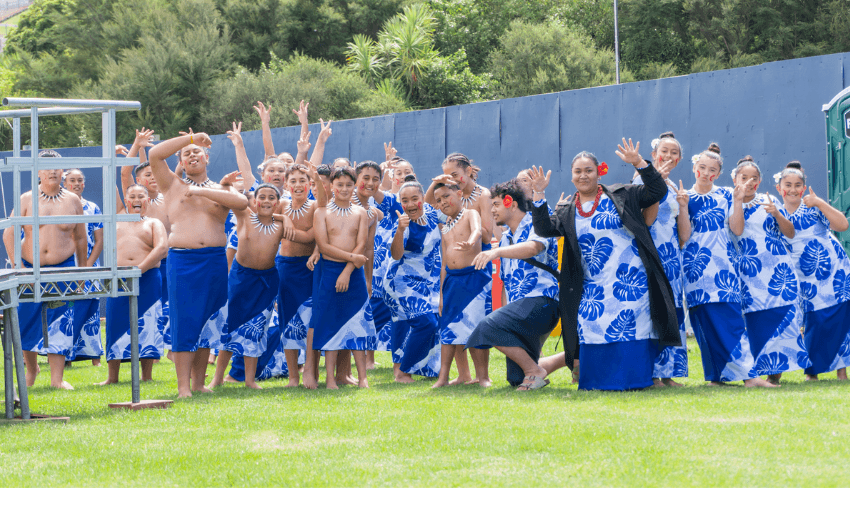

From ‘otai to Cook Islands drumming, there was plenty to love at Auckland’s Pasifika Festival.
Many people across Tāmaki Makaurau likely went to sleep on Friday, unsure whether they would attend the Pasifika Festival, with rain forecast across the city. In typical Auckland fashion, however, the weather u-turned and the weekend felt like summer.
Just as well, because the 33rd Pasifika Festival, at Western Springs, was ready to go big, with 20,000 visitors, eight villages, 11 nations showcasing cultural performances, artists, indigenous crafts and, for many, the biggest drawcard of all: the food.
Here’s eight things we loved at the the two-day festival, put on by the Auckland Council.
Party at the Cook Islands
If you entered the festival from the Zoo car park, the sound of drums drew you to the Cook Islands stage.
Many of the groups that perform at functions across Aotearoa use Pasifika to showcase new dances for the year, while also doing the crowd-favourite “around the worlds”, inviting members of the public on stage to try Cook Islands dancing for themselves – a highlight for first-time festivalgoers.
If the drums didn’t draw you in, the intermission live band likely did. Led by Cook Islands singer Jarome Pare, the group performed village songs while remixing pop culture classics with the ukulele.
Cook Islands singer-songwriter Marion Faleafa, performing with singing troupe Oceania Storm, said they like to perform at the festival because it’s where their people are. “I believe it’s the biggest Pacific cultural festival in Australasia, so if we want our music to be heard, our culture to be seen, then this is the place to be.”
Everybody gets an ‘otai

“You get an ‘otai, you get an ‘otai, everybody gets an ‘otai.” Walking through the festival almost felt like that old-school Oprah Winfrey car giveaway, because everyone seemed to be clutching the same thing – a cup of the Tongan drink ‘otai.
It’s a traditional, chilled drink made with fruit – often watermelon, mango or passionfruit – mixed with coconut milk, water and sugar.
Straight outta Hologa

Two weeks before the festival, 13 groups representing the villages of Niue – each with more than 60 performers – took part in dance festival Hologa Niue at The Trusts Arena in West Auckland. They were all on stage again for the Pasifika festival. You did have to figure out where to find the Niue stage though – it’s been moved and is now next to the Cook Islands stage.
Vagahau Niue (the Niuean language) is considered vulnerable in terms of the number of speakers globally, according to UNESCO, but you wouldn’t have known it at the Niue stage.
As MC Mone Lakatani said, “Niueaen Language Week doesn’t just have to be in October, it’s every day. It’s a good thing to be reminded about Niue music, Niue dance, and especially in front of our matua. It’s a blessing and we’re trying our best to keep the momentum going, so that our parents can see our children are showing interest in our culture.”
Lakatani said some of the performances allowed three generations of Niuean families to take the stage together.
The rise of Tuvalu

The Tuvaluan community came out in force to support the stalls and performers. And what performances they were. It felt like watching one generation passing gifts to the next – grandparents and parents sat on stage singing, chanting and drumming while children performed on the grass out in front.
Tuvalu is hugely impacted by climate change, and more people are leaving the country and moving to Aotearoa, to escape rising sea levels. You could feel their growing presence through the many traditional craft and food stalls.
A family day out

The Pasifika Festival kicked off in 1993, and for the first 10-15 years the attendees were mainly of Pacific Island descent, and the festival was a chance for Pacific communities to come together once a year outside of Polyfest. As the festival has evolved, it now draws a mix of cultures, with non-Pacific visitors and international tourists joining Pacific communities in celebrating all things Pasifika.
Melba Campinoti from Tahiti came with her family to watch both her daughter and mother perform at the Fale Pasifika stage. “It’s just a really nice day, just to be able to see other cultures, like our cousins from the Pacific. It’s always really nice to encourage them [my daughter and mother] as well and support them.”
Food on demand
If there’s one thing the Pasifika Festival is known for, it’s the abundance of food. Uber Eats drivers near Western Springs may have noticed fewer orders over the weekend as crowds lined up to get a taste of the Pacific.
For some visitors, it’s also their chance to try out the dishes of some of the food businesses and vendors they’ve spent weeks – sometimes months – watching on TikTok.
Red, white and brass

There were church groups and bands, including the historic Ikuna Youth Band from Grey Lynn, performing across many of the stages.
Ikuna, a brass band, started in 1997 to give Tongan youth something to do – or, as band member Aihaosea Ahokovi put it, “to keep them off the streets” – with rehearsals held every Friday night. They brought their red, white and brass sound to both the Tongan and Fale Pasifika stages.
Ahokovi said they loved performing at the festival because they could play not only Tongan music, but music from across the Pacific, bringing cultures together. “It’s us glorifying God through our talents that he’s given us, but also highlighting and showcasing our talents through brass and different cultures.”
Fale Pasifika

The Fale Pasifika stage is always a standout, spotlighting Pacific nations that don’t have their own festival village yet. Tokelau, Hawai‘i, Kiribati and Tahiti all had artists and groups performing, highlighting just how diverse the Pacific population is across Tāmaki Makaurau and Aotearoa.
For many, performing on the stage is a step towards one day seeing their country hosting their own full programme of performances at the festival.