


Afghan biscuits have attracted controversy over claims the name has racist origins. The real history is more complicated.
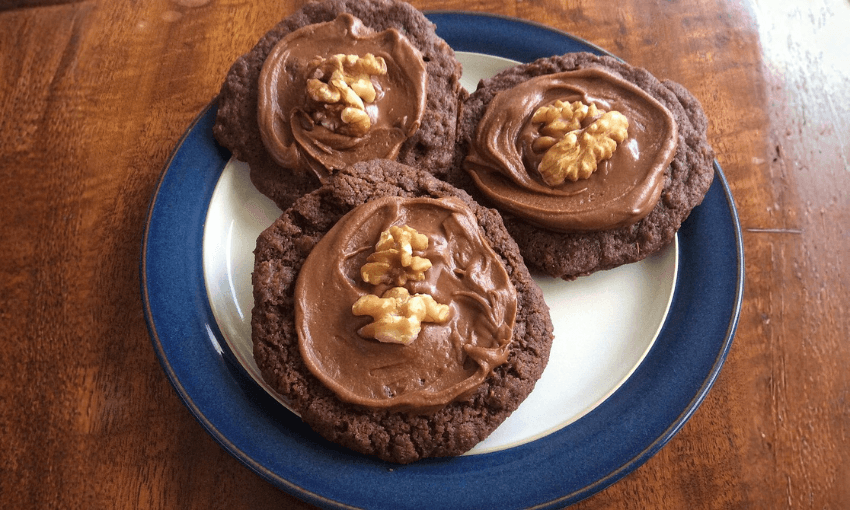
The Afghan biscuit is one of New Zealand’s greatest sweet treats. A chocolate and cornflake biscuit that is simultaneously crunchy and incredibly soft, smothered in a thick layer of chocolate icing, topped with half a shelled walnut. It’s a nationwide staple of bakeries and school tuck shops.
However, the biscuit has copped a bad rap in recent years over concerns that its name may be racist. Amid the George Floyd protests in 2020 and subsequent racial justice reckoning, many brands reconsidered their outdated product names. Uncle Ben’s rice, with a grey-haired, smiling black man on the packaging, became Ben’s Original, Eskimo lollies became Explorers, and Allen’s Red Skins became Red Rippers.
The Afghan biscuit was caught up in this wave. Today, Afghan is most often a national identifier of the citizens of Afghanistan, though historically the term often referred to the Pashtun ethnic group. In 2021, a Christchurch cafe made headlines when it changed the name of its Afghan biscuit to the “1908 biscuit”. The cafe manager told Stuff the world was “changing continuously” and the new name “may make people feel less uncomfortable”.
At the same time, Griffin’s changed the name of their milk chocolate Afghans to milk chocolate roughs. A company spokesperson told Stuff at the time that the name could be a reference to the 19th century Afghan wars, although acknowledged “there are other theories in circulation”.

There was a lot of well-meaning concern. It’s highly likely that the Afghan biscuit could have inspired racially motivated insults at some point in its history. But as for the actual origin of the name, no one seemed too sure.
The late food historian Helen Leach suggested the biscuit was named for Afghan people who drove camels in the Australian Outback from the 1860s to the 1930s. “The most reasonable answer to why they are named Afghans was there were Afghans running the camels in Australia,” she told Stuff.
One of the more troubling theories suggest the biscuit is a reference to dark-coloured skin. Others have posited that the walnut looks like a turban or that the craggly texture resembles Afghanistan’s mountainous terrain.
While there are plenty of ideas circulating, no one seems to know for sure. So, in the interest of journalism, The Spinoff appointed its most mediocre white man (me) to dig through the historical archives and determine whether this chocolate biscuit is racist.
The first recipe for something which could be described as an Afghan biscuit comes from the Timaru Herald in 1933. The recipe for “chocolate cornflake” biscuits is essentially identical to the modern form, including chocolate icing and a walnut.

The following year, in 1934, Aulsebrook & Co began advertising an “Afghan biscuit”. The company, which merged with Arnott’s in the 1960s, was behind many of New Zealand’s most iconic biscuits including gingernuts and iced animals. The first full recipe under the name “Afghan biscuits” was published in the Hawke’s Bay Tribune in March 1935. It was another year before it first reached the pages of an Australian newspaper.
What could have inspired someone in 1930s New Zealand to give a chocolate-cornflake cookie creation the name “Afghan”? The answer appears to lie in the Twentieth Annual Drapery, Textiles and Women’s Wear Exhibition held at the Royal Agricultural Hall in London in 1928.
A writeup of the event in the Daily Express said: “‘Lido blue’ and ‘Afghan brown,’ according to the models seen at the Drapery Exhibition, are to be the favourite colours of the season. The Afghan brown has a copper glint.”

The models at the exhibition were right. Afghan brown took the fashion world by storm. By October that year, fabric and clothing stores in New Zealand were advertising Afghan brown fabrics for the first time. Throughout the late 1920s and 1930s, several fashion columns mention women wearing Afghan brown outfits to social events.
There is little explanation for why the colour was named Afghan. One British article, which was republished by New Zealand newspapers, said the colour was a “delicate compliment to the visit of King Amanullah”. Amanullah Khan, the king of Afghanistan, visited the UK in March 1928.

A New Zealand women’s columnist, writing under the name Hinemoa in 1929, used this brief reference to draw the conclusion that the colour was in reference to his skin. “The visiting Royalties entertained last year in England are responsible for the new shade known as ‘Afghan Brown’”, she wrote. “We are afraid they might not take it as a compliment if they were aware that the tint is supposed to duplicate that of their complexions.”
Many shades of brown in the 1930s were named after the skin complexions of various ethnicities. The 1928 drapery exhibition also debuted a shade of brown called “Pawnee”, in reference to the native American tribal group. Several advertisements in New Zealand listed Afghan brown alongside a colour named after the N-word.
The problem with the skin colour theory is that Amanullah Khan, like most Pashtun people, had rather fair skin. If the colour were named for skin tone, whoever named them had never actually looked at an Afghani person.
In 1976, the US National Bureau of Standards produced Color: Universal Language and Dictionary of Names, an attempt to standardise colour naming conventions. It listed Afghan as the “same as Chippendale” and Afghan red as identical to checkerberry or hypermic Red.

While most British people would have had little contact with Afghan people (other than the soldiers who had served there in previous wars) they were familiar with Afghan export goods. This is where the connection to the 1928 drapery exhibition is important, because Afghanistan was a major exporter of luxury fabric products.
One of the most famous was the Bokhara rug, which appears to be the inspiration for Afghan red. The traditional hand-woven carpet is dyed a rich red using the crushed roots of the madder plant and patterned with intricate brown detailing. The rugs are traditionally made from the wool of the adult Karakul sheep.
The pelts of young Karakul lambs were highly prized for coats, hand warmers, and the traditional Karakul hat. Karakul pelt clothing came in a range of colours but was most commonly a reddish brown shade that matches the description of Afghan brown. The tight curls of the pelts create a ripple effect which is reminiscent of a walnut or the craggly texture of the biscuit.

The exact etymology of the Afghan biscuit may be lost to time, but based on the historical sources it seems the most likely explanation is this:
After the chocolate cornflake biscuit was popularised in the 1930s, someone – possibly a marketing manager at Aulsebrook & Co – decided it needed a catchier name. They chose “Afghan” because it was a trendy term that accurately described the reddish-brown colour of the un-iced biscuit. The texture of the biscuit and/or the walnut may have added additional meaning due to the resemblance to Karakul pelts – which was likely also the inspiration for the colour’s name.