What ‘unsubstantiated’ reports of Soundsplash ‘needle spiking’ say about teenagers, facts and fiction

Photos: Supplied
The rumour mill was in overdrive at a Raglan music festival last weekend.
Stories about “mass needle spiking” circulated last weekend at Soundsplash, an all-ages festival in Raglan popular with teenagers, as attendees warned one another of people being forcibly injected with ketamine and fentanyl. The claims, including the alleged hospitalisation of 20 people, spread via word of mouth. The rumour picked up enough steam to warrant reporting by the Herald on Sunday, which sought comment from Soundsplash and the police, both of whom called the reports unsubstantiated. Many festival-goers are also now doubting the truth of what they heard. How did this happen? Could an incident like this actually happen? And what can we learn from the spread of these stories? Let’s take a look.
So there was a ‘needle spiking’ panic?
That’s the gist. Festival-goer Rose*, 17, first heard it from strangers in the mosh pit. “There were girls telling you to pass it on, that there were people in the front of the mosh stabbing you with needles.” She stayed where she was. “Everyone was looking around. No one was really freaking out but if you felt something on you you looked around real quick to make sure there wasn’t a needle being poked into you.” The story continued spreading for the whole night. “Everyone was talking about it.”
“Most people at the festival knew about it,” said Sasha*, aged 16. She was notified from a text message sent to one of her friends. “We started asking around to understand, and that’s when we started to hear the rumours. We were in this communal tent at around 1am and I remember everyone was talking about it.”
The festival organisers heard them too. “Event personnel became aware that commentary relating to needle spiking was increasing on Saturday, with a peak late on Saturday evening into Sunday,” a representative for Soundsplash said in a statement to The Spinoff. “Soundsplash monitors attendee feedback and online commentary in real time across the weekend.”
Attendee health, safety and wellbeing were taken “very seriously” and the spokesperson said there were robust systems in place to identify, assess and respond to any concerns that arose during the event. “Any claim that may pose a health, safety or wellbeing risk is treated seriously and reviewed by the Soundsplash kaitiaki wellbeing team, whose priority is the immediate safety and care of attendees, in conjunction with onsite harm-reduction providers and event medical and security teams. Matters are escalated to New Zealand Police where appropriate.”

But it was all just unfounded rumours?
It appears so. Soundsplash medics had found “no evidence of any attendees being injected” at the event.
“Overall, the festival was well managed from a health and safety perspective,” said the festival spokesperson. The event’s medical team “confirmed there is no evidence of any attendees being injected at the festival”. Independent drug-checking service Know Your Stuff also advised Soundsplash there was “no evidence of needle use, and no high-risk substances were identified that required escalation or an emergency response”. Police had confirmed claims of needle spiking at the festival were “unsubstantiated”.
Attendees who presented with symptoms of intoxication were monitored closely by medics. “The issues observed were consistent with excessive consumption, not injection, and did not indicate any unusual or suspicious pattern. There was no evidence that substances were being administered without consent, and no indication that something out of the ordinary was occurring.”
(Police told the Herald that one person had been treated for a suspected overdose. Soundsplash said that “from time to time” medics managed cases of intoxication “arising from excessive consumption of contraband, despite clear conditions of entry stating that alcohol and drugs are prohibited”.)
Hmm, it must have felt pretty scary at the time for teenagers though?
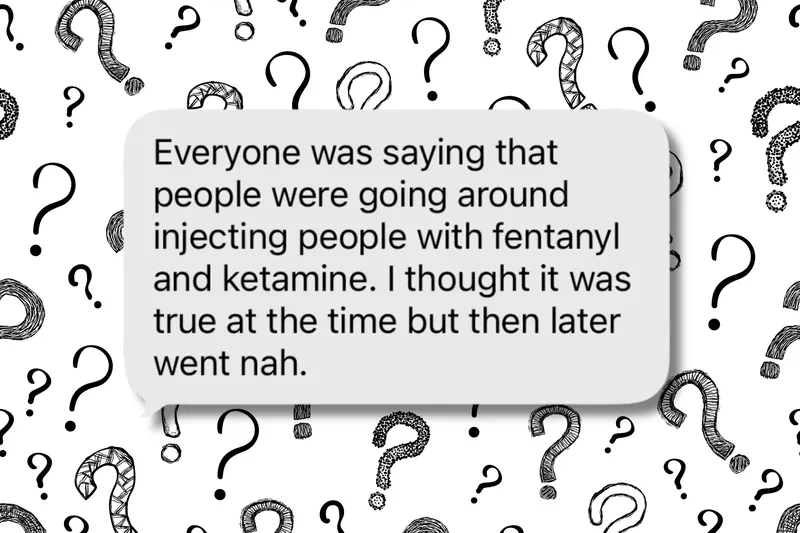
Festival-goer Benjamin* initially took the story as fact. “Everyone was saying that people were going around injecting people with fentanyl and ketamine. I thought it was true at the time but then later went nah.”
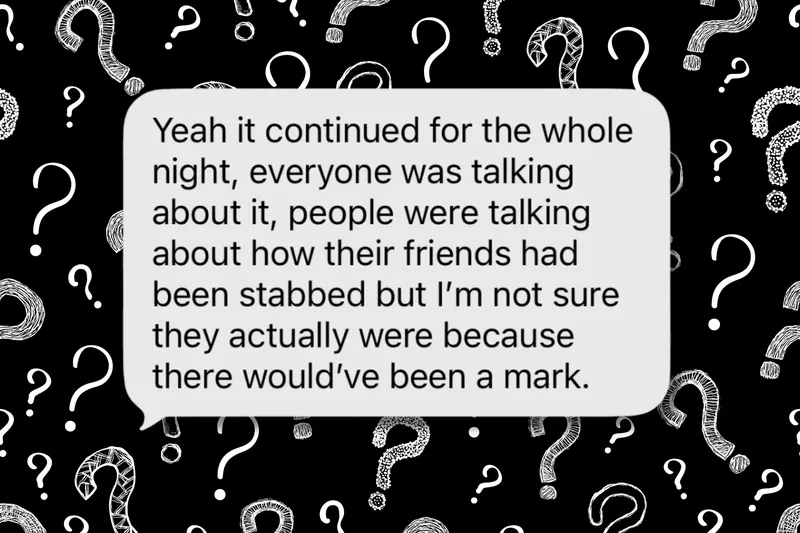
While Rose heard people saying that it happened to their friends, now she’s not so sure. “Because there would’ve been a mark.” She now thinks all the people going to the medical tent “were probably just drunk or dehydrated or something, but at the time everyone thought it was because they’d been stabbed”.
Sasha said that while she and her friends knew to be sceptical of word-of-mouth rumours, especially given there had been no confirmation by festival organisers, “some part of us still believed it”. They were all scared. “And we felt so sad for this poor girl, thinking it could’ve been any of us,” she said. “After that we made sure to stick together and make sure everyone else was safe and didn’t talk to strangers.”
It’s not the first time these stories have surfaced at the festival. “Rumours about so-called ‘needle spiking’ have circulated in relation to Soundsplash in previous years, reflecting a broader pattern of similar claims that have emerged at music festivals internationally in recent times,” the representative said.
This does sound familiar…
That’s because it is. In 2021 there was a wave of reports about an injection “epidemic” that was “sweeping” the UK. Victims’ stories were shared widely on social media and between May 2022 and April 2023 police received 957 reports of needle spiking. A parliamentary inquiry followed.
The “French Needle Panic of 2025” saw 145 alleged cases at the festival Fête de la Musique, but after being investigated by authorities, none were substantiated. Experts called it an example of “social panic”, noting warnings of “syringe attacks” on social media prior to the festival “appear to have primed the public”.
In 1989 the New York Times reported a spate of “needle attacks” on Manhattan’s West Side. Stories of Americans being stuck by HIV-infected needles spread by email and fax during the late 1990s, but the CDC (the United States’ national public health agency) found “the majority of these reports and warnings appear to have no foundation in fact”. In 2019, chain messages falsely claimed Isis terrorists were knocking on doors and injecting people with HIV.
So is needle spiking real?
Yes, but it is very rare. There have been some confirmed cases overseas. In 2023 two Australian women reported being “needle spiked” and sexually assaulted in Greece and Hawaii (both victims said they found “an obvious injection site” the next day) and the Australian government has acknowledged it can happen. Of 12 UK cases reported to police in Sheffield, one was confirmed by a medical professional.
“As far as we can tell, there is no evidence to suggest there have been confirmed needle spiking incidents in New Zealand,” said New Zealand Drug Foundation executive director Sarah Helm. “International research indicates that needle spiking is very, very rare.”
Injecting a passerby during a music festival would be noticeable. “If you’ve ever had blood drawn for a test intravenously, you know it’s not always easy for the nurse to find the vein. It’s highly unlikely someone could be injected intravenously without their knowledge or consent, unless they were restrained in some way,” Helm said. “Intramuscular injections are often painful (think of getting a vaccine) and leave a small mark or bruising. Again, it would be very difficult for someone to do this without you noticing. In both methods, it would take several seconds to inject the drug.”
The NZ Drug Foundation first heard this rumour around 2021. “It can be frustrating when rumours like this [needle spiking] take hold, because they can obscure actual good harm reduction information about drugs. If anyone believes they have been spiked, however, that needs to be taken seriously, and we’d encourage them to get help.”
Drink spiking, of which there are relatively few confirmed reports in New Zealand each year, can often be “devastating and destabilising” for victims. Some face barriers in reporting a crime or seeking help. Symptoms – which include sudden dizziness, confusion, nausea or vomiting, feeling very hot or sweaty and having blurry vision – can be hard to distinguish from alcohol intoxication. “Keep an eye out for things like suddenly feeling more intoxicated than you expect,” advised Helm. “Keep an eye on your drinks, stick with your mates and have a safe way to get home.”
Yikes!
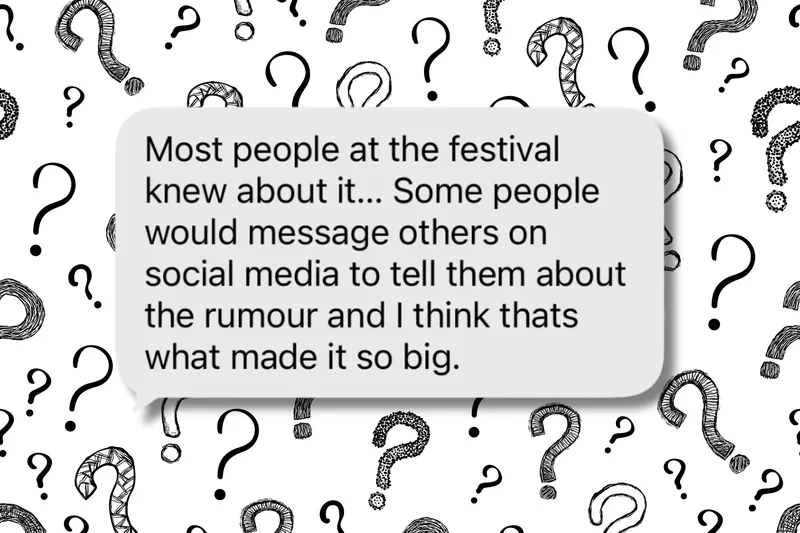
Hearing a worrying allegation like needle spiking at a music festival is valid cause for concern – especially if you’re at one. At Soundsplash, online channels helped spread the rumours at pace and scale. “Some people would message others on social media to tell them about that rumour and I think that’s what made it so big,” Sasha said. (The main platforms they saw the rumours shared on were Instagram and Snapchat.)
Michael Daubs, a senior lecturer in the media, film and communication programme at the University of Otago, said teenagers rely on social media and messaging apps more than others. People of all ages also more readily believe information when it’s received from someone they know. “So any news that comes through social media, or comes from family or friends, tends to get picked up, believed more and spread on.” This is particularly true if it evokes a strong emotion like fear or concern.
Efficient and frictionless digital platforms facilitate speed. “Social media and direct messaging apps just make it that much easier to spread to a larger audience,” Daubs said. “There’s no time in the design of the interface built in to make people consider what they’re doing.”
And sharing the story might feel like the right thing to do?
Teenagers heard rumours of needle spiking and shared them with friends out of concern and group safety. Daubs says that’s a common motivation. “The top two reasons why teenagers share stuff is, number one, because it’s funny, and number two, because they think they’re doing some sort of public service or public good by sharing that information.” The social dynamics affecting young women – a group that regularly encounters harassment, objectification and safety concerns – contribute to the “hint of plausibility” and make it more likely to be shared.
Information networks and digital connections also play a legitimate role in providing a sense of safety, particularly for young people. “One of the important things to take away from this is that it’s not the tool itself that is inherently bad. Cell phones do a lot of good,” says Daubs. “That sort of instant connectivity to a parent or a trusted friend can make you feel safe if you’re in a situation where you feel unsafe. It also means you have instant connectivity to people who are going to be sharing information, either purposefully or accidentally, that may or may not be factually correct.”
So should we all think twice when we hear word-of-mouth news?
When encountering shocking information, particularly online, experts advise critical thinking. “It sounds so obvious, but slow down and think: information is not just something that we read, it makes us feel certain ways and elicits certain responses,” advises Daniel Whelan-Shamy, who researches online communication at the Queensland University of Technology. “Ask yourself how something squares with your own preexisting beliefs, think about why you may or may not agree with something and try to think about how one small piece of information sits within a wider narrative. Words bring ideas and sentiments into being: they are contagious.”
Drug checking services are free, legal and confidential. The New Zealand Drug Foundation also has advice on what to do if you think your drink has been spiked here. It also advises that if you believe you’ve been injured by a needle or other sharp object, you should seek medical help right away.
* Names have been changed for anonymity.

Emma Gleason
Emma Gleason is a staff writer at The Spinoff and an award-winning fashion journalist. But it’s not just clothes that interest her, you’ll find her exploring tasty cheese, influenza outbreaks and more important things right here. She has experience with some of the country’s leading media outlets as well as the toaster in our kitchen.


