Breaking: New racecourse to look like penis

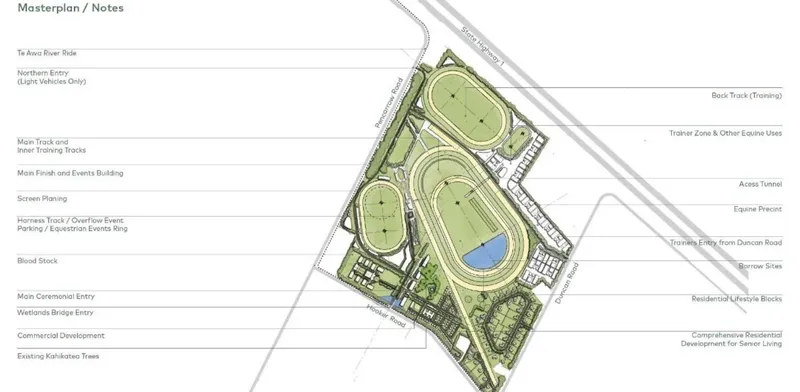
A concept plan for the new racecourse complex.
The main track will act as the shaft, while the back track and harness track will be the testicles.
Concept drawings have been released for a new 164ha Waikato racecourse complex which is set to transform a quiet area between Hamilton and Cambridge into a landmark destination.
The complex, planned by Waikato Thoroughbred Racing for a greenfields site in Tamahere, will include a retirement village, a commercial precinct and a residential lifestyle block.
But its most significant architectural feature will be its three racing tracks.
A training track is set to sit on the northern end of the complex. The southern end will feature a harness racing track, while the main racecourse stretches out in a southeasterly direction.
Together, the three courses resemble two testicles and one penis.
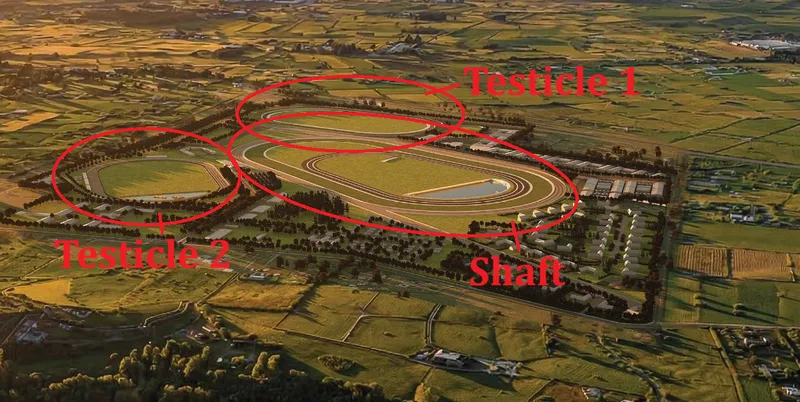
In the drawings released to the Waikato Times by Waikato Thoroughbred Racing, the smaller oval of the northern “back track” acts as the first testicle, or ball.
The southern harness racing track is the second ball, sitting at an off-kilter angle familiar to men whose underwear is prone to scrunching up.
Predictably, the larger main course acts as the shaft or phallus, with its more elongated shape stretching downward between the two smaller ovals.
Other famous New Zealand penises include the Waitangi dildo, which protester Josie Butler tossed into the jowls of then-National minister Steven Joyce a decade ago.
Though commonly misidentified as a working dildo, that phallus was a novelty nine inch squeaky pecker with a face on it, which would be more appropriately used as a dog toy.
The Waikato racecourse is set to be substantially larger, though less appealing to dogs.
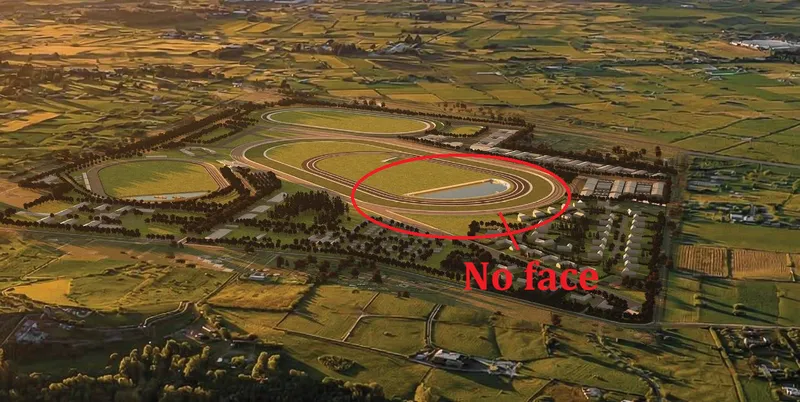
In another notable dissimilarity to the squeaky pecker, it is unlikely to have a face engraved on the tip of its shaft.
Instead the concept drawings show a water feature in the location that would usually be occupied by a foreskin.
The Waitangi dildo isn’t alone. In 2015, New Lynn locals spoke out about a $200,000 sculpture which they said resembled a “cock and balls”.
More recently, a phallic shape appeared on the lawn at an upmarket Upper Hutt estate.

The practice of etching penises in public spaces dates back millennia, with phallic graffiti located in historic landmarks including Pompeii in Italy and Hadrian’s Wall in Britain.
Human societies also tend to create phallus-esque monuments, with skyscrapers such as the Sky Tower sometimes referred to as “needle dicks”.
However, few human-made penises occupy as much real estate as the one Waikato Thoroughbred Racing is proposing for a greenfields site just south of Hamilton.
If approved in its current form, it will be a major landmark for the area, opening up new frontiers for both the Waikato horse racing community and people with a passion for aerial photography.
Waikato Thoroughbred Racing has indicated it will apply for fast track consent for its project.
Construction is expected to take eight to 10 years, by which point the racecourse could be approaching puberty.

Hayden Donnell
Hayden Donnell is a senior writer for The Spinoff. He previously worked at RNZ, TVNZ and the New Zealand Herald, alongside other media companies that have since closed down or been renamed. His primary passions are local politics and the Big Fresh animatronic fruit and veggies.


