Kicking off the demons in the shadow of the City Rail Link


Photos: Supplied; design by The Spinoff
Life in Sarah Daniell’s new urban neighbourhood is characterised by dust, noise and chaos, as disembodied voices deliver messages to no one, machinery grinds and hydraulics hiss. But, she writes, there’s a weird kind of beauty to it, too.
I’m walking up Karangahape Road when Ed*, rail-thin, heavily inked, stops me. “Hey, see what I’ve done,” he says, pulling out two canvases. “This is my girlfriend, she’s 70.”
That’s awesome, I love the colours, I tell him. The other is more abstract, blue circles on white. He walks off, ecstatic, and I yell after him, “Happy New Year.”
“Aw fuck off,” he replies, then, with a thumbs up, “Have a good one, girl.”
He has theories, sometimes delivered poetically. One afternoon walking up Pitt Street I scuff the toes of my slides, nearly tripping. “You know what that means sista?” he says with evangelical fervour. “It means you’re kicking the demons off. Yeah!” He swaggers down Pitt Street with a wild grin.
This is my new neighbourhood. A lot’s been going on.
“We have activated the alarm. Please evacuate the station.”
A fire alarm sounds. Disembodied voices delivering messages but no one’s there. They are AI-calm and anodyne in the style of the “others” in the dystopian series Pluribus. But these are real people delivering test messages in real time, says Auckland Transport.
I’m at No.7 cafe in Beresford Square, having a long black and watching the workers who are behind construction cages and forbidden to comment to an inquisitive observer. Everyone’s on script. At No. 7 they’re playing ‘No Sudden Changes’ by Billie Marten. “I’m the tugging at your sleeve … I am begging to believe.” Same.
First, the karanga in te reo, then English.
“This is a six-carriage train.”
“Testing, testing one, two, three.”
Testing times. If Auckland public transport is a desert, the CRL is a mirage.
The opening was scheduled for early 2025, just after I was set to move into an apartment across the road from one of the key entry points on Pitt Street. It’s now tipped for the second half of 2026, which means it’s probably the end of next year. Maybe. At least the platform announcements will be minted by then.
Progress isn’t a sprint. It’s a marathon to a soundtrack of wheezing, grinding machinery, hissing hydraulics and discordant beeps of trucks in reverse.
Sometimes it sounds like an army hauling hundreds of metal spades up a gravel road in an endless mission with no perceivable victory line. Sometimes there’s a truce, a sweet brief moment of nothing, and you open the doors to see a gull catching a zephyr.
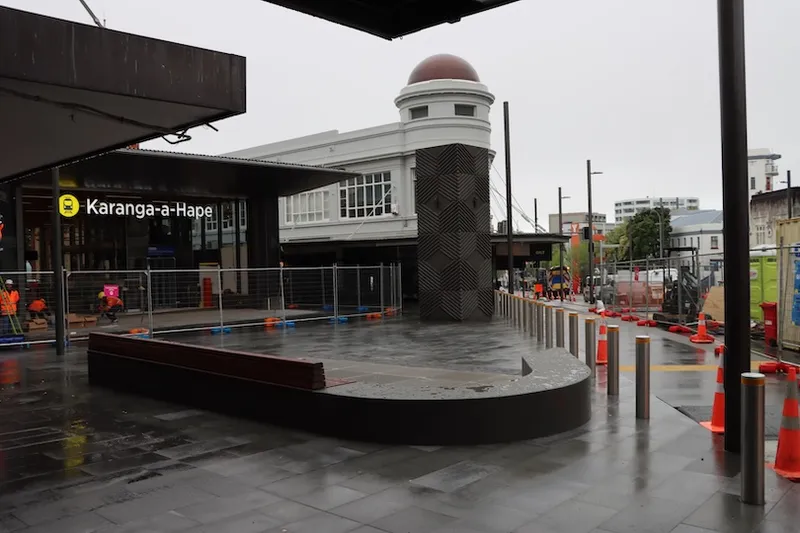
It’s early January 2025 when we arrive in this neighbourhood, but we have to wait to move into our new home, an apartment a few floors up in a building with a classic facade. For two weeks my 20-year-olds and I rent a furnished place for $1,000 a week. It has no working appliances, but it does have black mould on the curtains and stains on the furniture. It’s a depressing entry to a new life and in those first few weeks I wonder wtf I’ve done.
One morning we wake to the sound of a computer monitor crashing on to the road outside our window, hurled from a floor above us. There’s shouting, crying. Later that morning, a woman outside is gingerly gathering pieces of shattered metal and glass from the road. I want to ask if she’s OK but she’s turned in on herself, fortified by invisible but impenetrable barriers. Months later, I’m heading out and she’s standing outside the main doors of the apartment block having a smoke. “Oh, you look nice,” she says. “So do you,” I say. Sometimes life is a battle, dodging missiles not meant for flying. Sometimes it’s a quiet smoke outside on a sunny day.
“For your safety, always stand behind the yellow lines.”
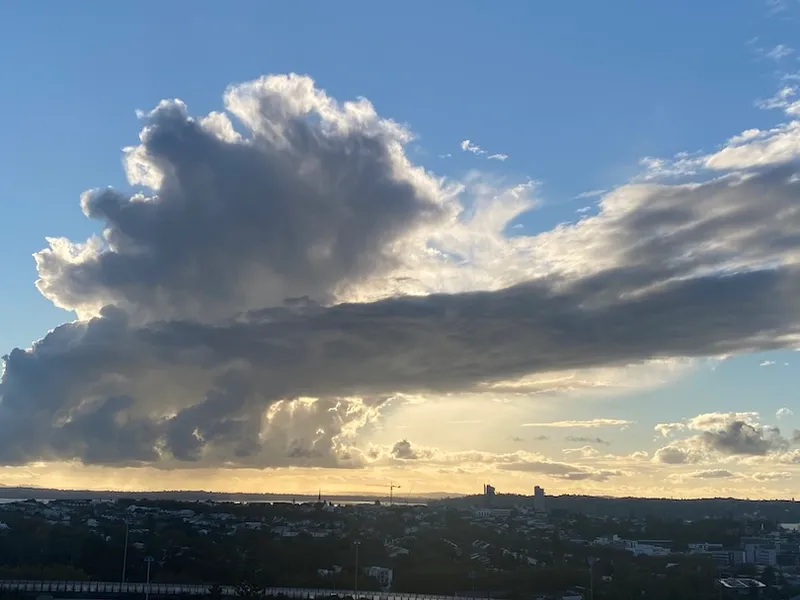
Soon it will happen. Soon we will move up to the new home a few floors up, with views of the towering sky and the endlessly shapeshifting clouds; below, the restless city as it transitions from day to night.
But, like the CRL, we’re not there yet.
“The next line leaving on Platform 2 is a Western line service to Waitematā. This is a two-carriage waka.”
There are much longer journeys. Hape (Tainui) travelled on the Tainui waka from Hawaiki to Aotearoa when his relatives denied him passage. After a karanga to his kaitiaki, a stingray, he journeyed with it to Aotearoa ahead of the waka. These days the karanga to all points of the compass comes from the CRL.
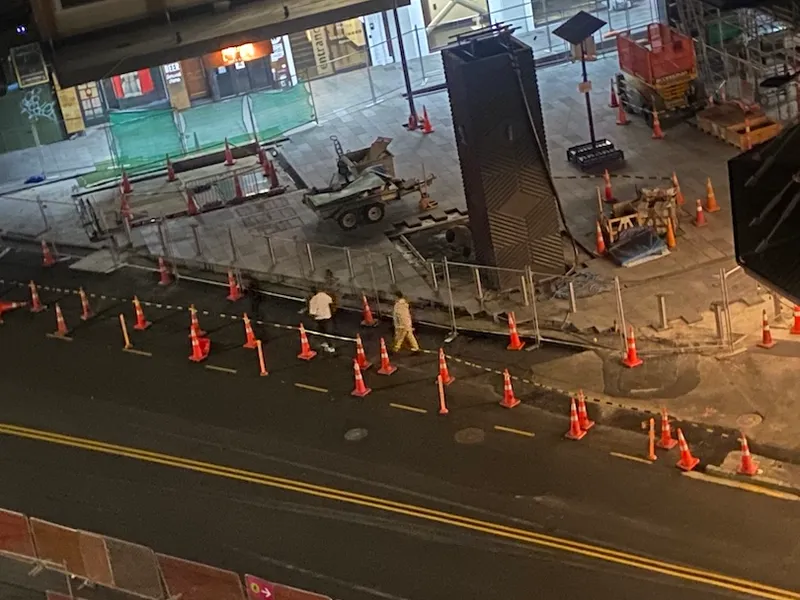
We move into the new home in January 2025. The empty space takes on the shape of us, our plants, records, and boxes of books and photos. There’s furniture that won’t fit in the lift and has to be sold online. An outside table that requires six people to carry it up six flights of stairs.
We get used to the sirens from the firetrucks and the ambulances. I try to be sanguine about the other noises, the machinery building the CRL and the surrounding roads. Soon, it’ll happen, I repeat silently, like a lame mantra.
Outside, all day and sometimes all night, kanga hammers batter and torture the tarseal to make way for the new, with fresh markings and kerbside gardens where native grasses and nikau palms will grow. I chat with the workers most days. They, dressed head-to-toe in protective layers, stand in the unforgiving elements, doing their thing for the thing that seems to have no end. One night when I can’t sleep I film them road marking and the process is complex, artful, like crane choreography. There is a kind of weird beauty, if you choose to look at it this way and sometimes you have no choice but to, because the alternative is to go loco.
I get to know other neighbours out on the street, the shop owners, the people sleeping rough. Malosi, who often takes shelter under the awning of a nearby church, is tall, handsome, Samoan. Possibly in his 60s. Hard to tell exactly. We often talk and I often wonder but don’t ask: what happened? I stop one day and ask how he’s doing and he replies, “Each day, Sarah, I try to be better.” Aren’t we all?
His setup is immaculate. A mattress and bedding tidily arranged. A small table. One day I leave a pastry in a paper bag on that table because he’s fast asleep. Later, when I’m heading out I pass him and he’s surrounded by a small group of friends, like a block party.
“Hey Malosi, did you get the croissant?”
“Was that you?”
His friend cracks up then whispers, “She stood over you while you slept and stroked your head and said ‘there, there, darling, sleep’, and she sang you a lullaby.”
There are times I don’t see him for days and I wonder if he’s OK.
My neighbours are friendly, tough, and struggling. They are tired, funny, and sometimes they are mad. They ask for money, they flirt. They wrestle silently and hurl injustices at the towering, godless sky. “You fucken don’t understand,” comes a cry from the street below. “Can’t argue with that,” says a friend, leaning over the balcony.
Niki* asks for spare change. She hasn’t seen her kids in years, but she can call them any time. They live with their grandparents. Turns out we come from the same town, went to the same high school, but she’s younger than me. She’s got over her addiction, she says, from her seat on the ground outside the Auckland City Mission op shop.
They sleep in a concrete cradle and walk among the dust and chaos every day.
“Please mind the gap.”
The dust, noise and chaos never seems to move on. For months it takes hold and clings. Neighbourhood cafes, bars and shops cling too, at the edges of battle lines defined by orange cones, cranes and machinery. Signs and messages outside shops and cafe chalkboards are heavy on optimism, announcing “we are still open!”, or, “come inside!”
“The next train to Maungawhau is leaving on Platform 2. This carriage is in service.”
It’s not, actually.
The station buildings are magnificent, with detail and designs, says the CRL website, “to reflect the identity of Tāmaki Makaurau”. Dappled paving across the square represents Tāne Mahuta.
An Edwardian public toilet that became a late 90s “supper club” where clubbers on benders would go on the munt in the early hours has been destroyed, its bacchanalian heritage pulverised into another identity, as part of the CRL forecourt.
Some nights when it’s impossible to sleep it’s not always because the road works. It’s a helicopter hovering right outside my bedroom window. It’s 2am and I pull back the curtains and it’s so surreal and so loud it feels as if my windows will shatter. I watch as a shadowy figure rappels from the hovering metal beast onto the roof of a neighbouring building. The Air Force NH90 doing “exercises”, says a neighbour in the lift the next day.
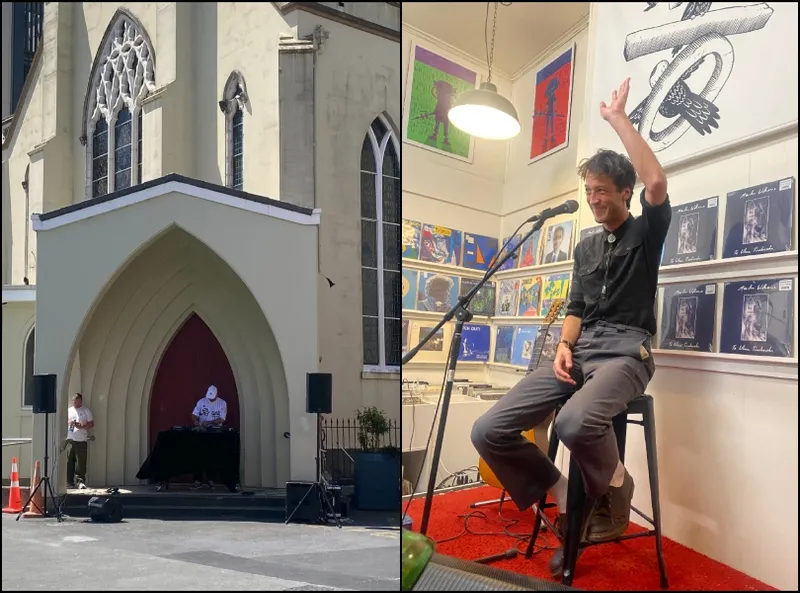
Some days it’s like heaven. On the pavement outside Flying Out records, musicians play to passersby sitting kerbside. The Green Dolphin bookshop has secondhand treasures. At the Lebanese Grocer, jars of pickles line the shelves, and they make labneh, garlic toum and kebabs. Buana Satu has been on K Rd for nearly 35 years. It’s one of the oldest shops on the strip, along with Verona cafe and the recently closed Sri Penang. At Merge, there’s food for street whānau but anyone can show up.
Living here means there’s always noise of some kind, but there is always something happening, too. An urgency and a pulse. There are quiet moments, staring at the painted sky.
“Malosi” means strength and power in Samoan. He’s sitting outside the church, watching the world go by. It’s a beautiful windless day.
“Yeah,” he says, wistfully, looking skyward. “It is. I feel like I’m back in Samoa.”
Testing, testing, cries the disembodied voice.
*Some names have been changed to protect identities.


