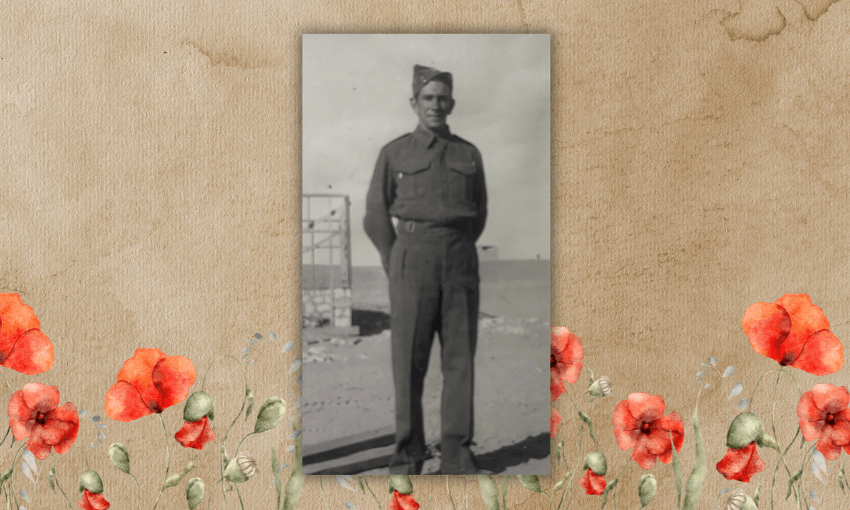

On Anzac Day, Maureen Sinton remembers her father, Corporal George Sinton, an enlisted soldier and prisoner of war during World War II.
“You mark my word, Cappy. When the bastards do come, we’ll be caught with our pants down.” – Corporal George Sinton, talking to his Officer Commanding (Battle for Crete. The Official History of New Zealand in the Second World War 1939-1945)
Two large, tomato-red hardcover books sat on the family bookshelves when I was growing up. I never saw anyone reading them, but their presence told its own story. They were two volumes of the 50-volume collection: The Official History of New Zealand in the Second World War 1939-1945. Our volumes were Divisional Signals and Prisoners of War.
Family legend has it that in September 1939, as a linesman for the county, Dad was up a power pole in the Hokianga when he received two bits of news. One, his next job would be- (here, family recollections differ, let’s just agree it was not enough to attract Dad). Because the second piece of news was that Aotearoa was at war with Germany. Dad was proud that he was the first bloke to enlist at the Rawene Post Office.
Decades later, my parents, but especially my mother, could still name the men in Whangārei who had delayed enlisting, or worse, avoided call up altogether. If one of those names came up in conversation, she’d say, a tad sniffily: “Him! You know he didn’t go.” Some must have wondered where, or why, he didn’t go. A medical problem perhaps?
Dad’s war took him to Greece, Crete and north Africa. He told me that the three years from late 1939 to July 1942 were some of the best days of his life. Not that he gave that impression to his fellow soldiers.
“His usual preoccupation was one of dejected and comical meditation punctuated by exclamations of foreboding about the unhappy lot of signal men in general and those in particular who were unfortunately marooned on the island of Crete. Most things fell under George’s disapproval – rations, the unpredictable ways of the brigade staff, shortage of equipment and and the lack of something to do” – Battle for Crete, The Official History of New Zealand in the Second World War 1939-1945
The Second World War informed my childhood. Names like Tripoli, Cairo and Tobruk were as familiar to me as any local place names. We took it for granted that if a car backfired in Dad’s hearing, he would jump in fright. We would be roundly chastised if we got home after school and said, like a hundred other kids, “I’m starving”.
If he was slicing a loaf of bread, we didn’t dare accuse him of size-ism because he would say quietly, “I know how to cut a loaf of bread so that everyone gets exactly the same”. The only films Dad went to were British-made war films. The only books: war books (and Spike Milligan). Many things made him grumpy.

“George was a tall lanky customer who was always growling, except when things were really bad. If George was ever cheerful, you could bet your boots that you were in a tough spot.” – Fights and Furloughs in the Middle East by Arthur Helm
Dad got into a tough spot on July 15, 1942. From what I understand he was captured while working alone in the desert. He’d told his men to head back to base and he would finish up. They wouldn’t see him again until after the war. He would spend the next two and a half years in Stalag VIIIB, a prisoner of war camp in Lamsdorf, Eastern Germany.
Because he was on his own when captured, there was no news of him and the worst was assumed. Back home in Whangārei, the dreaded telegram was received: missing, presumed dead. However, eventually, Dad’s name made it on to a list of arrivals in Stalag VIIIB, and the news he had survived got back to his parents Lucy and Tony. Neighbours noted the smile on Tony’s weathered face, a reminder of his gum digger past, as he made his way up the road on that good-news day, safe in the knowledge that his son was alive, albeit a prisoner.
Stories from Dad’s time as a POW were few. Here are two.
The first was told to me by my sister who had been told by Mum, who had heard it firsthand from Dad. As a POW, one of the German guards invited Dad to his home for a meal. The guard’s young son approached Dad and spoke to him in German; Dad asked the parent for a translation. “He wants to know if it is alright with you if he goes outside to play.” The poignancy and absurdity of war wrapped up in a simple tale.
Dad told me that the first time he heard the music from Oklahoma! (released in 1943) was in camp. On what analogous platform? Singing? Radio? I don’t know, but ‘Oh, What a Beautiful Mornin’ must have taken on a farcical tone. Apart from this seemingly frivolous interest in musicals, prison life was no Hogan’s Heroes. (Mum loved that show. Dad hated it.)
In January 1984, I was home in Whangārei for a summer holiday. I recall that we were watching the news. Maybe the date prompted him. Out of the blue he said: “39 years ago I was marching through knee-deep snow.” He didn’t say anything else and (foolishly) I didn’t ask. But I had a sense it was important. I wrote down his words and filed the piece of paper away. But it would be years before I knew what he was referring to.
A Google search of: “prisoners of war march across Europe 1945” throws up a number of titles including The Prisoner of War March, The Long March to Freedom, The Long March or simply The March.
In the severe northern hemisphere winter of 1945, nearly three years after Dad was captured, he and his fellow inmates of Stalag VIIIB (and other camps) were told to pack up, only take what they could carry and wear what they could. Under guard they began to trudge westward. These were men who had been living on meagre rations for years, so were in no condition to survive an arduous tramp. In the book The Last Escape: The Untold Story of Allied Prisoners of War in Germany 1944-1945, a (British) War Office memo from that time reads: “The distances involved are in some cases as much as 350 to 400 miles. Stalag VIIIB is reported to be destined for Nuremberg.”
Food was a priority. My father would often say that a raw onion could keep you alive for days.
I don’t know where in Europe my father was liberated, or when. There is a letter addressed to his mother from the director general of the Post and Telegraph Department expressing: “the pleasure we feel at the news that your son … has now been repatriated and is safe …” It is dated May 8, 1945 (VE Day) so freedom seems likely to have occurred sometime in April 1945, making his journey on foot approximately three months long. I do know that he had a short stay in a London hospital where he was treated for malnutrition before being moved to the care of family friends.

While in the UK in 1988, I visited the now elderly family friends who looked after him. Dad had told them some of what he’d been through on the march. Each day, he said, they would look for shelter for the night, such as a barn. If the barn was across two or more levels, there would be a rush to get to the top level. This to avoid being the unlucky recipient of the bowel motions of sick, malnourished men during the night.
A lighter story they told me suggests that by the beginning of June, Dad was returning to his grumpy and therefore happier self. Sunbathing in the courtyard of their Surrey home, he cursed at not being able to go to the Epsom Derby; he could hear the cheering, but he wasn’t yet up to moving far.
Dad had left a pre-war girlfriend behind in Aotearoa and disembarked in Wellington with a wedding veil for her in his luggage. As soon as he got off the ship, he rang her number and found that his sweetheart was now another’s. She hadn’t wanted to dampen his spirits with a Dear John letter. His sister, Aunty Wynnie, said he went out and got horribly drunk. No news on what happened to the veil.
Mum, meanwhile, had heard about her neighbour’s son who was returning home. She gathered up a friend and went down to the railway station “to see what this George Sinton looks like”. It was a short engagement leading to an Easter wedding and six children.
In the early 1960s Dad took leave from his desk job in the P&T. I was told he was going on holiday to Christchurch. As a wee child, it seemed an odd thing for my father to be doing outside of summer holidays and without Mum and us kids. But reasons didn’t matter, only the presents that he brought back: pretty wooden rulers with pictures of the garden city running down the middle. It was years later that my sisters and a cousin told me that he had been in Christchurch recovering from a breakdown.
My father had had a hard life. Poor immigrant parents from Derbyshire, and what would become Croatia, a father with a thick accent, this strangeness making his son a target for bullies, the war, the POW camp, a coal mine collapse, the march, his breakdown and a lifetime of smoking. He died in November 1984 aged 71.
There was another, much smaller, book on our shelves, next to the Official Histories. This one was called Fights and Furloughs in the Middle East, a wartime memoir written by Dad’s army buddy Arthur Helm. He had been one of those back at base that day in July 1942, wondering why George had not returned.
“George … abused me to my face, more than any other man I have ever met, yet behind my back he would say I wasn’t a bad chap. He and I worked a good deal together during both Greece and Crete and he was one of the bravest men I ever met.” –Arthur Helm
Our mokos will never meet their lanky, grumpy, funny Koro, but they will be able to read about him, thanks to the Official Histories and Arthur. And now this.