No, the fatal Mount Maunganui landslide was not AI

As distressing scenes unfolded at Mt Maunganui, TikTok users assumed footage of the disaster was AI.
Last week taught us that even in our most distressing moments, there is now no certainty. How do you know if there’s a tragic event unfolding, or if someone’s been using AI?
By now, most of New Zealand has seen the footage. Harrowing screams can be heard as a large tree, sitting atop hundreds of tonnes of moving earth, slides off the side of Mauao in Mount Maunganui. Within seconds, campervans have been swept along like sea debris and frantic yelling can be heard from a shower block now entirely buried in dirt.
A rescue operation would be launched in search of six people unaccounted for in the campground. On Saturday, two days after the slip, the police announced that they would be moving to a recovery phase, with all missing six believed to be dead.
Tauranga mayor Mahe Drysdale confirmed an independent review would be launched by the city council into the events leading up to the landslide. The scope of the review has not been decided but, with lives lost, it will be an investigation of national significance for future processes in extreme weather events. The tragedy has been not just a national story but a global news event.
On Thursday night New Zealand time, BBC news posted a compilation of three clips of the landslide to its TikTok account (11.1 million followers). The expected responses filtered through in the comments: sympathy for those impacted and callous scolding of those recording or watching on for “not helping”. But there was also a third type of comment, one that has grown exponentially in the past two years and hints at a future where even in our most distressing moments, where basic human instincts are needed, there will be doubt: “It’s AI.”
In short, the clips were not AI. There were three: two credited as being from TVNZ, one from a witness named Greg Holmes. A spokesperson for TVNZ told The Spinoff that while credited, the footage posted by BBC was not filmed by TVNZ crew, who were not on site at the time of the landslide. Instead it was footage that had been sent in from witnesses at the scene.
Such footage – phone recordings of flooding, earthquakes and other natural disasters from those in the thick of it – has been commonly used by news organisations for years. It’s called “user generated content” (UGC) and represents a large portion of news footage in the immediate aftermath of a disaster, as journalists and camera crews make their way to the location.
TVNZ confirmed that it had “provided the BBC with our own material and then supplied contacts for people who sent us User Generated Content so they could seek their own permissions if they wished to use that video”. The same footage seen in the BBC’s TikTok clip was used on 1News that evening. “Newsroom staff assessed the video and then sought permission from the creators to use it before it aired,” said the spokesperson.
In the case of the BBC’s TikTok, New Zealanders were quick to correct those claiming it was AI. “It’s not AI, my whānau live there [and] all evacuated out of the landslide zone,” said one user in response to the comment, “People are not looking or running it’s AI”. A few early comments scolding the BBC for “sharing AI” appear to have been deleted.
An early claim, in all caps, that the video was AI was inundated with responses showing otherwise. Soon, the commenter added a similarly capped correction: “OMG I JUST LEARNT ITS REAL SORRY FOR THE WRONG INFO.”
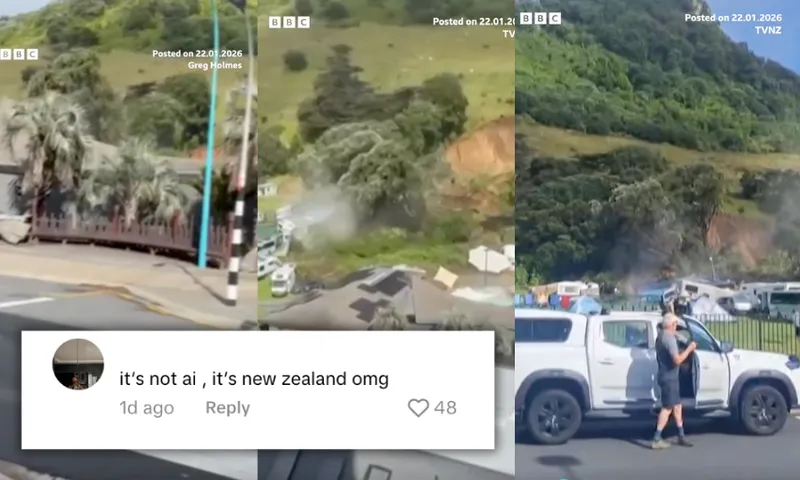
Visual misinformation is not new. Deepfakes – clips that present a real person saying or doing things they have not said or done – were first raised as a serious political concern during the 2020 US election. Last year, the BBC analysed an “astonishing” amount of visual misinformation from both sides of the Iran-Israel conflict – fabricated videos boasting military power and recycled footage with false captions.
While not so politically motivated, fake weather videos continue to spread on every social platform. Most are easy enough to spot as fake; an eerily smooth dog swimming in bright blue floodwaters, for example. Or a clipped, robotic voiceover that mispronounces every 10th word. In the race to virality, compilation TikTok profiles may post edited footage from an earlier, more severe storm and claim it’s just happened. Or, as generative AI continues to develop, multiple clips of different weather events may be merged to create a wholly new, and fake, storm. All for clicks and engagement.
So what happens when there’s real footage of a real tragedy? People hesitate, and look for the telltale AI signs, lest they be tricked again. Or, rather paradoxically, they develop the mindset that shocking and unusual footage showing human responses to disaster must only be the result of generative AI. In the case of a landslide burying a campground structure, “The tree is moving too smoothly to be real!” Or “People are not looking or running it’s AI”. Or “How was that [person] in the truck so calm for trees crashing down a campsite? AI?”
It’s a double edged sword, where real footage is accused of being fake, while fake footage fools millions around the world every day. And, with the increasing use of generative AI, it’s only a matter of time before everyone is able to “create” footage of extreme weather in New Zealand and either post it themselves or send it to news outlets for publication.
In the real world, such ability – and the news scepticism that it encourages – is yet another factor for emergency services to consider when communicating with New Zealanders during a real emergency. A spokesperson for the National Emergency Management Agency (Nema), told The Spinoff the agency is “aware of the growing use of AI-generated images” and the mis- and disinformation they contain, particularly in emergencies. “In an emergency, our primary channel to get information out to the public is the media,” they said. “We work closely with NZ media to ensure they provide verified, credible information to the public.”
Nema did not confirm whether AI footage or suspicions of it had become a live issue in the past, and didn’t share any guardrails in place for verifying footage in future, but wanted to “encourage New Zealanders to call out suspicious images when they see them, or report them if there is a suitable way to do this”.
Today, the recovery operation at Mount Maunganui remains stalled after a council worker spotted new instability and staff were evacuated. Six anguished families desperately hoping for some semblance of closure must keep waiting. The clean-up at other towns across the North Island continues, as the very real effects of the climate continue to devastate communities, no matter what the social media commenters choose to believe.

Madeleine Chapman
Madeleine Chapman is a contributing editor. She was editor of The Spinoff 2022-2025.


