It’s time to accept that New Zealand’s weather stinks

An accurate weather map for New Zealand.
It’s a hard truth, but one we have to acknowledge if we’re going to move forward as a country, writes Hayden Donnell.
In the second month of spring, half the trees in the South Island blew over. In Wellington, the gales physically transported a person into the path of oncoming traffic. When the winds died down, it started snowing. Why? Apparently there was an unfortunate interaction between a low pressure system in the south and a high pressure system in the north, exacerbated by sudden stratospheric warming in Antarctica etc etc – you can read more about it here. But on a wider and arguably more meaningful level it happened because New Zealand’s weather is totally rooted.
The media dutifully broke out the live blogs and the “wild weather” headlines for last week’s multi-pronged storm, but it shouldn’t have come as a surprise. Despite being traditionally illustrated with a montage of frolicking lambs and blossoming wildflowers, spring is reliably our worst season, arriving in a cacophony of surprise-attack showers and rude gales. It’s not just spring though. Borked weather is a year-round phenomenon for much of New Zealand. Wellington is notoriously the windiest capital city in the world. But don’t let that distract you from the fact it’s also extremely cold and wet. Auckland has four seasons in one day, and at least three of them are shit. The West Coast spends most of its time underwater. Only Nelson is OK.
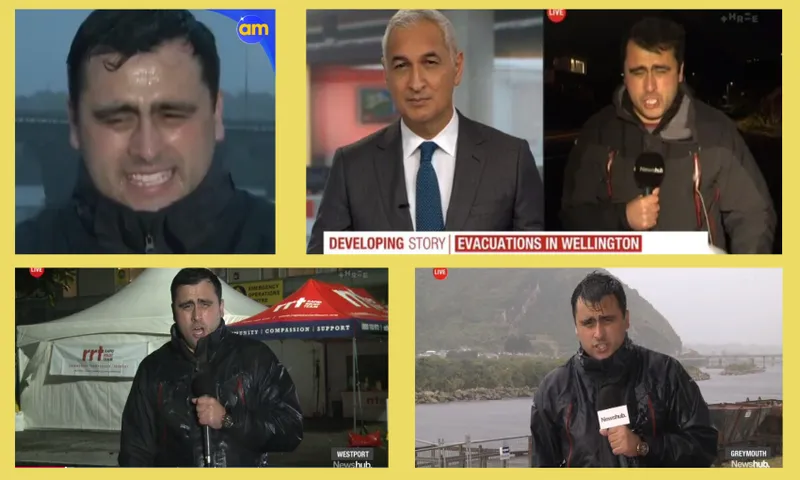
Variety, as they say, is the spice of life, and happily these daily ordeals are broken up by devastating storms. The country has been beset by roughly 26 one-in-100-year extreme weather events in the last 10 years. Back when Newshub was on the air, they had a guy whose entire job it was to go into the middle of the nearest cyclone and tell people how bad it was.
None of this would be quite so galling if it wasn’t for the fact that many of us still labour under the delusion that this is some kind of temperate South Pacific paradise. It’s not just the sun-soaked images of people jumping off wharves and touring Hobbiton in the 100% Pure ads. Our hallucinations have been going on for nearly 200 years. Back in the mid-1800s, Charles Heaphy returned to England after his time touring the country as a draughtsman for the New Zealand Company, where he proceeded to write glowingly about our five-month summers and two-month winters.
The settlers who fell for the PR were soon smattering their letters home with complaints about the nation’s incessant winds and changeable weather. But the lie took root. It’s written across the face of our cities, in the form of a draughty, uninsulated housing stock better suited for the dry season in Tahiti than the eclectic array of cold snaps, floods and storms that dot our winters.
Our refusal to come to terms with reality adds an extra note of bitterness to every bad weather event. We like to say London is wet and grey. Maybe, but at least you know what you’re getting. It’s not going to fake people out with a few rays of sunshine then ambush them with a lashing of horizontal sleet. A Canadian winter won’t suddenly turn into a torture chamber made of pure humidity. Siberia may have it worse than us, but at least the residents there aren’t trying to make it through the winter while wearing shorts in the dining room of a weatherboard shack.
There’s evidence to back up the terrible weather allegations. Back in the 1990s, Niwa meteorologist Mark Sinclair put out a study showing the Tasman Sea is one of the most important areas in the Southern Hemisphere for forming and ramping up the depressions that cause storms. It was controversial, clashing with not only our collective national delusion but existing science that pointed to more southern latitudes as the source of most bad weather.
But Sinclair was right. As Metservice meteorologist John Law acknowledges, this country is constantly being buffeted by low pressure systems shunted our way by the bastard continent to our west. “Off the coast of Australia, we tend to find those areas of low pressure forming. And it’s the movement of those low pressures which bring the weather towards us,” he says.
Even when the Tasman Sea lows aren’t drowning our biggest city in floodwaters, we’re getting northwestern gales in Canterbury or cyclones from the Pacific. Law says he likes the variety. It makes his job interesting. “It all comes down to where we are in the world and our extremely rugged and interesting topography,” he says. “It all plays a part in very varied weather here.”
But it’s not for everyone. Sinclair left Niwa in the late 90s. He’s been in Arizona since 1998, where he’s worked as a professor at Embry-Riddle Aeronautical University. In an email, he reiterates his scientific finding that New Zealand’s climate “stinks”. “That’s why I’m now living in 300+ days-a-year sunshine,” he says. Good move. Maybe the rest of us should get smart and boost it for a warmer and more settled climate as well. I hear Australia is popular at the moment.

Hayden Donnell
Hayden Donnell is a senior writer for The Spinoff. He previously worked at RNZ, TVNZ and the New Zealand Herald, alongside other media companies that have since closed down or been renamed. His primary passions are local politics and the Big Fresh animatronic fruit and veggies.


