


The focus on who wasn’t playing on Saturday was redundant in an era in which player depth is critical.
The brave new world of All Blacks rugby we’ve been promised began with a win that was uncomfortably close, if not quite “the nearest run thing you ever saw in your life,” as the Duke of Wellington said of the Battle of Waterloo, another tight tussle in which the French came up short.
Beforehand the French team was routinely described and sometimes dismissed as “under-strength”, the implication being that anything less than a convincing win would be a deflating start for new coach Dave Rennie. France’s match day 23 didn’t include any players from the clubs that contested the final of their domestic competition nor a handful of stars who’ve been given the summer off.
But it was a significantly stronger and more experienced French team than that which the All Blacks laboured to overcome in their first hit-out last year. Rennie promised his team would be bold and indeed they were. Execution didn’t always match ambition – six knock-ons in the French 22 were costly – but, overall, it was a vibrant performance. Vibrancy isn’t an attribute that rugby historians will associate with the tenure of Rennie’s predecessor, Scott Robertson.

The focus on absentees was a bit beside the point in an era in which player depth is critical.
Eddie Jones, whose circuitous, at times quixotic, journey has taken him back to Japan, said recently that “as a test coach you learn one thing very quickly: it’s rare that you ever get to pick your best 15, let alone your best 23. You spend your life managing injuries, managing unavailabilities and picking a side a long way short of your optimal one. South Africa and France have shown where the modern game has gone: depth wins. This is a sport about 40 top quality players now.”
France has 30 fully professional teams across the first division Top 14 and second division Pro D2. The latter has a promotion-relegation relationship with a third league, the semi-professional Nationale.
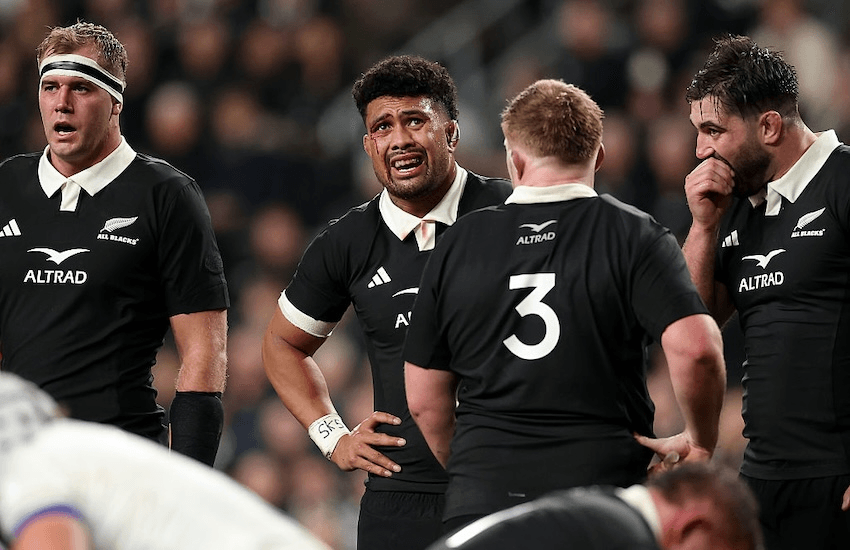
Meanwhile the All Blacks, selected from five Super Rugby franchises, had their own unavailabilities: the trio of locks who played – Sam Darry, Jamie Hannah and Josh Lord – wouldn’t have made the original squad if not for injury. Add the absences of Leicester Fainga‘anuku, Richie Mo‘unga and Tamaiti Williams and you could argue the All Blacks were 25% short of their optimal 23.
In 2016 businessman Eric Watson, then owner of the New Zealand Warriors, said, “When the All Blacks play we pretty much know what’s going to happen. Which is nice and fun but we also know it’s bullshit. That’s not real sport.”
Watson had a point but his timing was off: the All Blacks were almost at the end of a long, golden run. In the years since, not many All Black fans would’ve got “tired of winning” as Donald Trump predicted Americans would become. Another sweeping statement from 2016 that hasn’t aged well.
(Watson no longer owns the Warriors and, in recent years, has devoted his energies to staying one step ahead of the Inland Revenue Department, the US Securities and Exchange Commission and his former partner Sir Owen Glenn. His various addresses throughout this protracted game of global hide and seek include London’s Pentonville Prison.)
International rugby has never been so competitive. For much of the professional era there was a clear-cut top five: Australia, England, France, New Zealand and South Africa. The Springboks have supplanted the All Blacks as first among equals and, despite winning two World Cups, the Wallabies have dropped out.
Sport, like nature, abhors a vacuum and Australia’s decline has coincided with the rise of Argentina, Ireland and Scotland. Ireland hadn’t beaten the All Blacks in 111 years of trying; since 2016 they’ve won five of the 11 meetings, including a series win here. (The rivalry resumes at Eden Park on July 18.)
In recent years Argentina have beaten all the tier one nations en route to becoming the fifth-ranked team in the world. Scotland have won five of their last six games against England, the exception being a one-point loss. Between 2009 and 2020 the Scots prevailed once.
The All Blacks mostly played well on Saturday night yet could easily have lost. Given the improvements of what not so long ago were tier two nations and the way the game is currently played and refereed, fine margins are likely to be the norm when the leading teams meet.
The challenge for Rennie and his coaching group is two-fold: to instil the self-belief, mental toughness and tactical awareness that equip a team to get the job done under intense scoreboard pressure while boosting skill levels, innovation and physical prowess to the point that the All Blacks could once again break away from the pack.
As the saying goes: “If you’re not the lead dog, the view never changes.”