

Sometimes it’s less about attack and more about letting your opponent grind themselves to a halt.
All Black captain Ardie Savea likened the first test of the Greatest Rivalry series to a boxing match.
Former Springbok captain Jean de Villiers was more specific, evoking perhaps the greatest sporting event of the 20th century: the Rumble in the Jungle, the 1974 world heavyweight title fight between Muhammad Ali and George Foreman in Kinshasa, a riotous agglomeration of gladiatorial combat, celebrity happening to be seen at and PR extravaganza designed to burnish the image of Zaire’s president Mobutu Sese Seko, as the kleptocrat stuffed a Swiss bank account with international aid money and CIA retainers.
Beforehand there were genuine fears for Ali’s safety, a sense that, at 32 and no longer the athletic phenomenon he once was, he could be pulverised by the hulking, glowering, frighteningly destructive 25-year-old Foreman.
Writer Hunter S Thompson was in Zaire on what Rolling Stone publisher Jann Wenner called “the biggest, fucked-up journalistic adventure in the history of journalism”. However, Thompson chose not to attend the fight, the ostensible reason for him being in Africa on lavish expenses, supposedly because he feared his friend Ali would be taken apart. A counter-narrative was that he’d sold the Rolling Stone media contingent’s tickets to buy drugs. When the fight took place Thompson was drifting around the hotel swimming pool on a lilo, severely under the influence.
In fact, Ali de-powered Foreman with his rope-a-dope strategy: leaning back on the ropes, which his corner men may have surreptitiously loosened for the purpose, inviting Foreman to punch himself out. Accustomed to opponents laser focused on damage limitation, arm weary as a result of rope-a-dope, disoriented by Ali’s constant “Is that all you got, chump?” trash talk, Foreman hit the canvas in the eighth round.
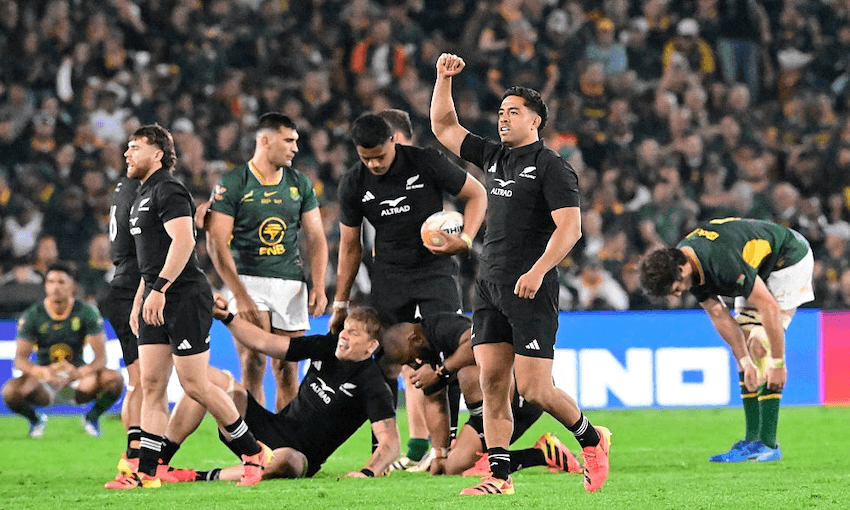
The game at Ellis Park began as many South Africans expected and many Kiwis feared: with one demoralising display of Springbok physical dominance after another. Bruisers like Andre Esterhuizen and Jasper Wiese barged through defenders; the Boks flew off the line to put All Black ball carriers flat on their backs; the mighty Bok scrum made a mockery of the All Black camp’s pre-match assurances that they knew what was coming and were ready for it.
Neither claim stacked up: the green scrum marched forward; the black eight buckled and broke up; penalty South Africa. The mantra “no scrum, no win” would, it seemed, be emphatically re-validated.

But the All Blacks hung in, surely hugely relieved and encouraged that the scoreline didn’t reflect the contest. And, just as Foreman ran out of puff, the Springbok scrum ceased to be a juggernaut. Perhaps conditioning played a part; clearly the vaunted Bomb Squad – the second wave off the bench – failed to live up to their billing.
Much of the credit, though, must go to the All Blacks front row subs: 34-year-old journeyman George Bower, the phlegmatic Cantabrian Fletcher Newell and Hurricanes hooker Asafo Aumua who, at 29, is becoming the test match beast he looked certain to develop into when he announced himself by scoring a hat-trick in the 2017 Under 20 World Cup final.
(New Zealand scored 10 tries in that 64-17 demolition of England. Amazingly, given his All Black strike rate, Will Jordan didn’t get one of them. Their captain Luke Jacobson, who scored twice, has the distinction of being the only currently active New Zealand mens 15s player to take possession of a World Cup.)
As concern about the scrum battle abated, so too did anxiety over the influence on proceedings of English referee Matthew Carley. Yes, he dished out a heap of penalties against the All Blacks in the first half but, given their struggles to cope with the physical assault, few could be quibbled with.
And, with the game in the balance, he twice waved away troubling interventions by his offsiders. Despite the wheedling of the television match official, Savea escaped a yellow card for a high shot that wasn’t a high shot while Bok replacement flanker Marco Van Staden was yellow carded notwithstanding an assistant referee’s attempt to persuade Carley that what was a ruck in anyone’s language somehow wasn’t a ruck.
Thankfully the All Blacks did not, as comments man Justin Marshall bawled, “literally put the Springboks to the sword”. Nor did they do it figuratively. But they won when winning was a tall order. They added to a great legacy built, as much as anything, on being the best international team away from home, a record earned by fronting up year after year to the most daunting opponents in the most intimidating arenas.
To return to Ali. When most were writing him off before the Foreman fight, a Louisville businessman, who’d managed him when he was still Cassius Clay, said: “Nothing overwhelms Cass. Not even if he met God.”