
The agency that upholds broadcasting standards is set to be disestablished, writes Madeleine Chapman in today’s excerpt from The Bulletin.
To receive The Bulletin in full each weekday, sign up here.
Goodbye BSA
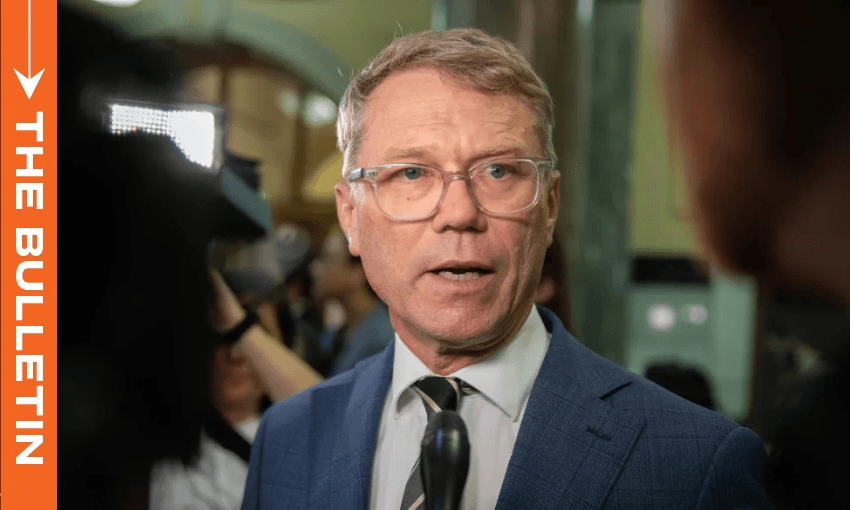
The crown entity set up in 1989 and tasked with upholding standards in broadcast media will be scrapped. On Wednesday, media and communications minister Paul Goldsmith announced his intention to disestablish the Broadcasting Standards Authority (BSA). As Adam Pearse reports for the Herald, the move comes after the BSA ruled it had jurisdiction over The Platform, which is an online-only broadcaster.
The Act Party was quick to claim a win from this week’s decision – MP Laura McClure lodged a members’ bill in November to abolish the BSA in response to the Platform fracas. “What we don’t need is millions in public money, plus levies on struggling media outlets, funding an outdated bureaucracy that was trying to control the modern media landscape,” McClure said in support of Goldsmith’s announcement.
The case that set it off
The move to disestablish the agency was accelerated by the furore over an October case that saw the BSA consider whether to consider a complaint against Sean Plunket’s online media channel, The Platform. The move was controversial, since, as Duncan Greive (a BSA-head, if you will) wrote at the time, parts of the Broadcasting Act 1989 are “sufficiently vague” that the BSA could argue parts of the internet were within its remit while others were not. He noted NZME falls under the BSA for Newstalk ZB, “but what about Herald Now?” Last month, the BSA determined yes, it could consider the complaint, in a move Greive labelled “brave, principled, and indefensible”.
Goldsmith’s reasoning for disestablishment was that currently, different outlets are subject to “inconsistencies and unfair outcomes” depending on where they broadcast.
Is there about to be a wild west of media?
Speaking to Lisa Owen on Checkpoint, an associate professor of media at Victoria University cautions the “commercial race to the bottom” could worsen after the scrapping of the BSA, with media companies likely to continue “cutting corners, cutting costs, cutting journalists, in many cases”. A woman whose complaint was among the 7% upheld by the BSA, told Newsroom’s Fox Meyer she was worried that without some form of regulation, “people will be able to say anything about anything, and you’ve got no way you can complain about it”.
Not everyone is so concerned. Writing for The Spinoff this morning, Hayden Donnell suggestions little will change in the immediate future with no BSA. For outlets like The Platform – who enjoyed a blink of an eye within BSA’s remit – and Reality Check Radio, nothing will change as they were never under the BSA’s jurisdiction to begin with. “For TVNZ, Three and a host of radio stations, life is likely about to get a little less scary.”
All eyes on the Media Council
While the BSA covered TV and radio and had legal powers to enforce fines and punishments, the Media Council, which upholds standards in newspapers, magazines and websites, largely flexed its power through – as Donnell puts it – “shame-outs”. In other words, making outlets post public apologies when the council ruled they’d breached journalism standards.
It’s a self-regulated system and Goldsmith predicts broadcasters will now opt in. “Our expectation is the Media Council will become the primary regulator for journalism,” he said, as RNZ’s Lillian Hanly reports.
Simplifying the ‘mainstream’ news group
Speaking to Donnell as a media expert this morning, Greive said grouping broadcasters with print media opens the door for future regulation. “Australia has just rebooted its News Media Bargaining Code to capture the likes of Meta even if it stops carrying news on its platforms,” he said. “While such an approach feels highly unlikely under the current coalition… it would allow a government of a different stripe to interact with and legislate for all the different vehicles for normie journalism under one umbrella.”
Whiplash: Media regulates social media
The News Publishers’ Association piggy-backed off Goldsmith’s announcement with some regulating of its own. Voyager CEO Seeby Woodhouse has apologised after his company was stripped of its naming rights sponsorship for the upcoming NZ Media Awards following Woodhouse reposting “unacceptable” content online, reports Rachel Moore for Stuff.
NPA said the ceremony will go ahead without a naming sponsor, giving journalists the rare opportunity to win an “NZ Media Award”.