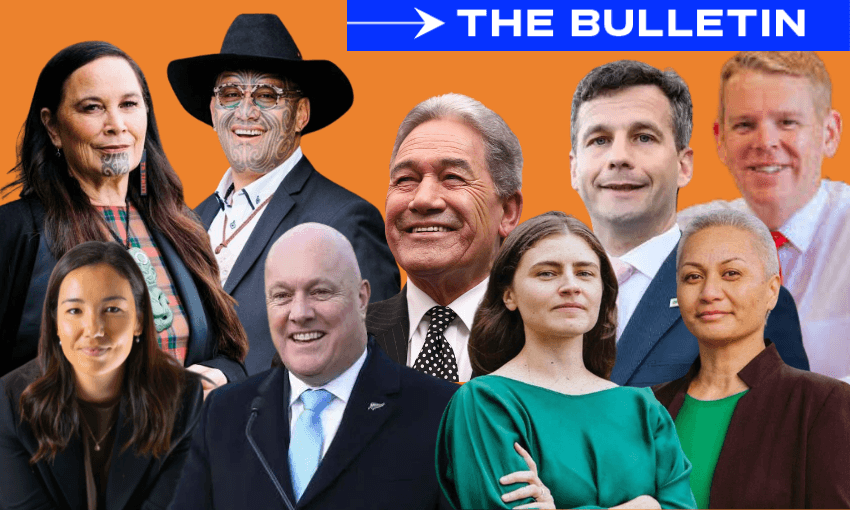
It’s time for a political health check-up six months out from the election, writes Madeleine Chapman in today’s excerpt from The Bulletin.
To receive The Bulletin in full each weekday, sign up here.
National brings in the cash
A turbulent past month for Christopher Luxon has ended with some sweet relief: the National Party has money to spend in the six months till November 7.
Party donation figures for 2025 released Thursday reveal National topping out the list by a healthy margin. The party collected $6,275,234.46 in donations last year, nearly $4 million more than Labour. Crunching the numbers for The Spinoff, deputy editor Alice Neville notes National has led in donations for years. “National’s 2025 donation haul surpassed its 2024 total of just under $4.9m, but didn’t reach the heights of the last election year, 2023, when the party raked in a record-breaking sum of almost $10.4m in donations.” Donation numbers for 2026 won’t be released until next year.
Will Winston Peters be prime minister?
No one is more experienced in election campaigning than Winston Peters. This will be his 18th election, having first run (unsuccessfully) for National in 1975. But while he’s been a political stalwart for decades now and risen about as high as anyone, there’s one position he hasn’t held outside of brief “acting” stints: prime minister.
As former minister and minor party leader Peter Dunne writes in Newsroom, Peters has always harboured a desire to be prime minister, and will be looking to take votes away from National (which has already been happening, according to recent polling), “not to defeat the government but to put NZ First in a position where Peters can become prime minister outright – unlikely – or demand that the role be rotated with National during the coming term”.
Act picks its talking points
As NZ First enjoys a polling boost, Act has picked some early election talking points that certainly sound of an ilk with its minor coalition partner. On Tuesday, Act released its immigration policy which included a $6-a-day infrastructure surcharge on temporary work visas and a five-year benefit standdown period for residence class visa holders. The policy was widely condemned by ethnic groups, and National’s immigration minister Erica Stanford labelled some aspects “kneejerk” and “populist”, reported Thomas Coughlan for the Herald.
On Wednesday, internal affairs minister Brooke van Velden announced a new citizenship test for would-be New Zealanders. In the Spinoff this morning, editor Veronica Schmidt presents The Spinoff’s New Zealand Citizenship Test. How did you score?
Labour continues to wait…
Labour has continued its “lie in wait” approach, with no new policy announcement in months. Where the party has been forthcoming is in its intention to improve its Māori seat tally from one to all seven – Te Pāti Māōri currently holds five, with its former MP Tākuta Ferris holding Te Tai Tonga as an independent.
Writing in Newsroom, Marc Daalder explains how, based on current polling, winning all seven seats may not actually be in Labour’s best interests. “The latest 1News-Verian poll showed that, if Te Pāti Māori won at least one seat, the opposition would hold 62 seats between them (or more if Te Pāti Māori wins three or more seats and creates an overhang). If, however, Te Pāti Māori misses out on all seven seats, the poll delivers a hung parliament.”
The Green-ish contingent
The Green Party is holding steady on 11% in recent polling, and will be contesting general and Māori electorates with a confirmed list, having tightened its candidate selection process. But it has its own minor party to contend with, one which hasn’t factored into coalition projections thus far: Opportunity, polling on 3% in the latest poll and confident they will reach the 5% threshold. The party, reports Nick James for The Post (paywalled) has just released its universal basic income of $19,400 tax-free for every adult, plus a new kiwisaver scheme that would see 12% of gross earnings put away (6% employee, 6% employer). Will 2026 be fourth time lucky?
Related: Iain Lees-Galloway on crashing out of parliament and his new Opportunity