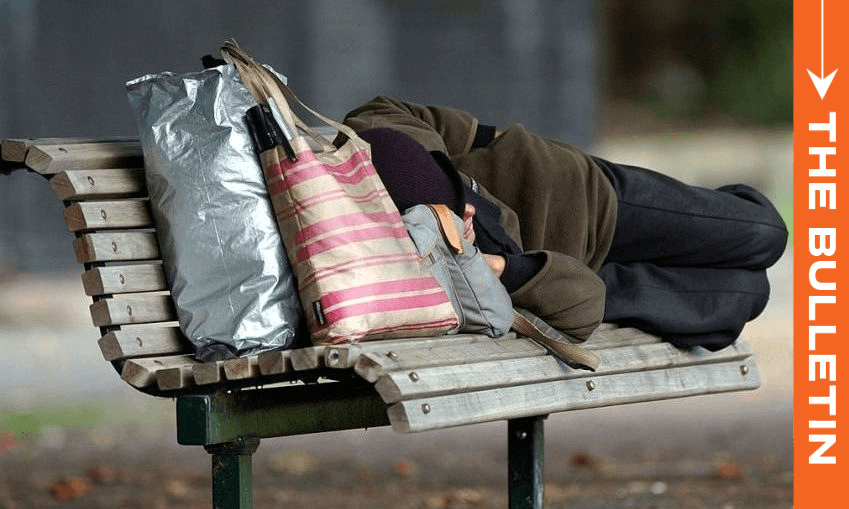

The prime minister says he wants the Auckland CBD to ‘look its best’ and the mayor agrees – but social agencies warn a move-on law will backfire, writes Catherine McGregor in today’s extract from The Bulletin.
To receive The Bulletin in full each weekday, sign up here.
Brown backs government bid to ‘clean up’ the city
The government’s confirmation that it is looking at ways to give police new powers to move on homeless people from public spaces has prompted fierce debate over how to balance safety and compassion. As Tom Dillane reports in the Herald, the National proposal is in such early stages that the other coalition parties were apparently unaware of its existence, “only hearing about it on Tuesday when Labour leader Chris Hipkins started probing Prime Minister Christopher Luxon about it in the House.”
Auckland mayor Wayne Brown has welcomed the government’s involvement, telling Dillane addressing the CBD’s “scruffy” characters is “exactly what they should be focusing on”. As to where the homeless should be moved to, he suggested they could go “out into the countryside” where they would cause less “economic damage”. “There’s plenty of freedom camping places they can go to,” he said.
Critics say law would only shift the problem
Social agencies and opposition MPs have condemned the idea as inhumane and ineffective. Aaron Hendry of homelessness charity Kick Back told The Spinoff’s Emma Gleason it could have “serious and potentially fatal consequences”, particularly for homeless youth. “People who have nowhere else to go will be driven from the city centre and forced to take shelter in more dangerous and unsafe environments.”
In the Herald (paywalled), Simon Wilson questioned police minister Mark Mitchell’s assurance that those moved on would be taken “to a place of safety”. Wilson suggested Mitchell’s words ring hollow when Auckland alone needs around 1000 more Housing First places – and the same number of emergency beds – to meet demand. And in the Sunday Star-Times (paywalled), Andrea Vance contrasted the plan with the government’s eagerness to spend $6.3 million bringing Michelin restaurant inspectors to New Zealand. The government is “moving fast”, she wrote, “clearing the slums for the sommeliers.”
The law as it stands
Police already have powers to act when people are violent, intoxicated or otherwise breaking the law. Local government expert David Collins told RNZ’s Anneke Smith councils can adopt bylaws to address rough sleeping, but any such rules must still comply with the Bill of Rights Act. “You can’t just ban anything that’s a nuisance,” he said. Brown has hinted that Auckland Council might preempt the government’s law change by strengthening its own bylaws, though a spokesperson told The Spinoff no work is under way.
Some politicians, including Chris Hipkins and Green MP Tamatha Paul, have accused the government of trying to “criminalise homelessness”, but move-on orders are not the same thing as criminal penalties: they would likely allow police to direct a person to leave an area for up to 24 hours, not to arrest or fine them. Still, opponents argue such orders risk harassment of vulnerable people without addressing the lack of housing.
Lessons from overseas
Other countries’ experiences show how difficult enforcement can be. In many Australian cities, police regularly issue move-on notices to rough sleepers under public-order laws. In Sydney, the Guardian’s Caitlin Cassidy reports that homeless residents at Central Station are woken at 6am every morning and moved from a sheltered area to a place where they have to “huddle on the floor, exposed to the elements”.
England and Wales, meanwhile, are moving in the opposite direction: the Labour government there will repeal the 200-year-old Vagrancy Act, which made rough sleeping, “loitering” and begging criminal offences. As Emily Wertans argues in The Conversation, “the law does not act as a deterrent. In reality, giving people criminal records and potential debt worsens their chances of securing housing.” While it’s now rare for people to be charged under the law, “it is used informally by the police to move people on and seize their possessions, including tents and sleeping bags.” As in Auckland and Sydney, the issue in the UK comes down to homes. Without them, the power to move people on is simply a way to make the problem disappear from sight rather than to solve it.