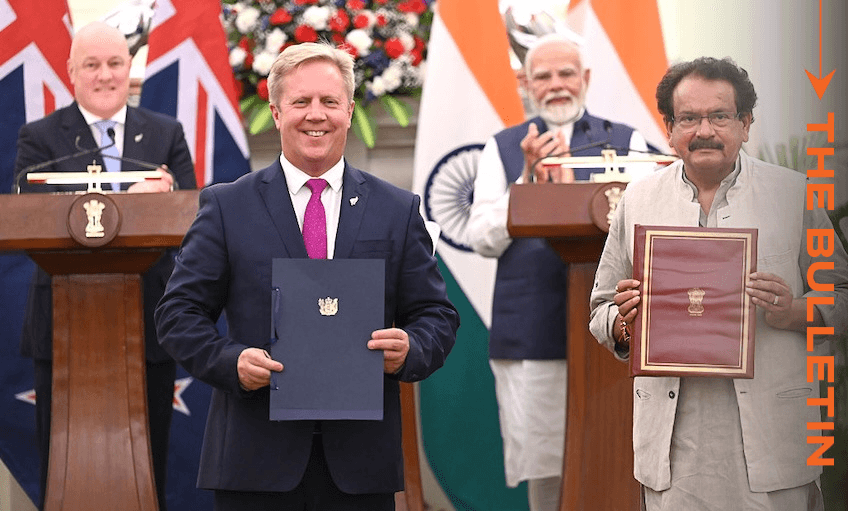

The trade minister will sign the India FTA in New Delhi next week. Getting parliament to ratify it is another matter, writes Catherine McGregor in today’s excerpt from The Bulletin.
To receive The Bulletin in full each weekday, sign up here.
A once-in-a-generation deal – if it gets there
Trade minister Todd McClay will fly out over the long weekend to sign the New Zealand-India free trade agreement in New Delhi on Monday. The government has billed it as a “once-in-a-generation” opportunity: as RNZ’s Penelope Smith reports, the deal would eliminate or reduce tariffs on 95% of New Zealand exports to India, opening a market of 1.4 billion people. More than half of New Zealand’s exports, including lamb, wool and forestry products, would become duty-free immediately, rising to 82% over time. The signing will trigger a formal parliamentary process, with the full text and a national interest analysis tabled before a select committee, with the public able to make submissions.
There is a problem. NZ First has exercised its “agree to disagree” powers and will vote against the deal, meaning National needs Labour’s support to pass it through the House. Labour has not yet given that support.
The stalemate
The two-month impasse comes down, as The Post’s Henry Cooke reports (paywalled), to a question of what counts as “advice”. National argues in-person official briefings are sufficient; Labour wants full, unredacted written advice. Labour has also sought clarity on a foreign investment clause requiring New Zealand’s private sector to invest US$20 billion (NZ$34.6 billion) in India over 15 years. The New Zealand government says the figure is merely “aspirational”. That word is doing some heavy lifting: according to India’s own statistics, New Zealand invested a total of US$88.15 million there across the 25 years from April 2000 to June 2025 – 0.44% of the 15-year target.
Speaking to BusinessDesk (paywalled), Labour leader Chris Hipkins said he did not agree with “the Government signing up to such a significant outbound investment target without any idea of how we could meet that, and sort of brushing it off and saying ‘oh well, if we don’t do it, we don’t do it, so what'”. He called this “potentially quite damaging to New Zealand’s international standing”.
‘Get a room’
NZ Herald columnist Fran O’Sullivan (paywalled) put the situation with characteristic directness: “The two Chrises need to get a room… and iron out their differences on the India free-trade deal.” The continued stalemate, she argued, “does not enhance New Zealand’s reputation with the world’s most populous nation” – and if NZ cannot demonstrate it is serious, “India has plenty of other suitors”. Luxon, she wrote, should have picked up the phone to Hipkins well before the deal was concluded; his failure to do so showed a lack of political respect.
The business community has shown a lot more enthusiasm than Labour. An open letter organised by BusinessNZ, signed by 28 exporters and industry associations, called the deal “a strategic necessity for our economic security” and urged MPs of all stripes to vote it through. Winston Peters, characteristically, described signing the letter without first reading the agreement as “tantamount to those businesses signing a contract blindfolded” and said their decision to do so was “an appalling commentary on them all.”
Shane Jones ‘deploys hyperbole’ on Indian immigrants
Into this already complicated picture stepped Shane Jones. In a video circulating online, the NZ First deputy leader declared he would “never agree with a butter chicken tsunami coming to New Zealand”. Asked to defend his comment, he told reporters on Tuesday that he gets “cut-through on debates by deploying hyperbole” – though he acknowledged parliamentary colleagues had asked him to tone it down. As RNZ reports, the prime minister has called the comments a “gross misrepresentation” of what the FTA was about and said they were “unhelpful”, but stopped short of calling them racist, describing Jones’ “oratorical flourishes” as something New Zealanders were well used to.
The remarks landed against an already tense backdrop. As The Spinoff’s Manisha Bhikha writes, anti-Indian graffiti had appeared near Papatoetoe Central School about 10 days earlier, and RNZ’s Blessen Tom reports that a second piece inciting racial violence was found in Royal Oak last week. Bhikha, who notes this is “the first time I can remember seeing anti-Indian hate expressed with this level of visibility and confidence”, argues the political language is not incidental to these events. “Language like this matters,” she writes. “It reduces people to caricature and reinforces narratives that frame entire communities as a problem to be managed, rather than as part of the fabric of New Zealand society.”