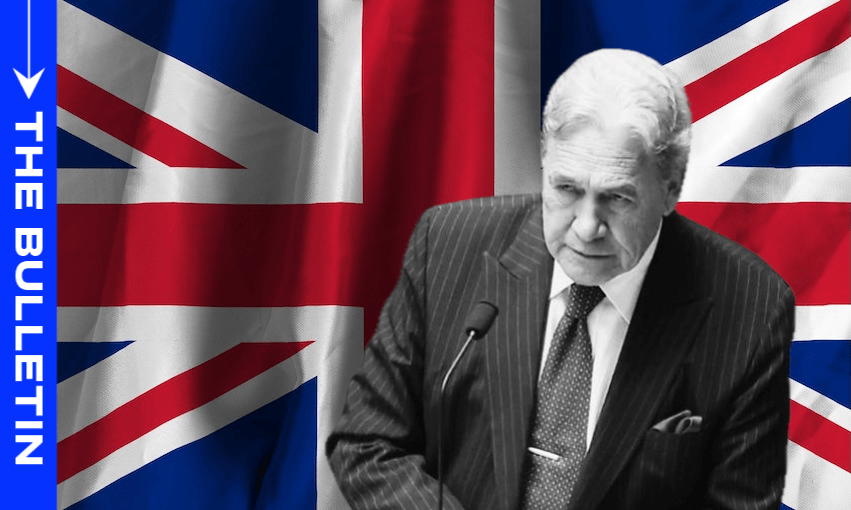

Winston Peters says it’s about ‘common sense’. Critics call it a distraction from real issues – and a solution in search of a problem, writes Catherine McGregor in today’s excerpt from The Bulletin.
To receive The Bulletin in full each weekday, sign up here.
A bill few call necessary
Parliament’s final item before rising on Friday was the introduction of the English Language Bill, formally in the name of justice minister Paul Goldsmith but championed in the House by NZ First leader Winston Peters. As RNZ’s Giles Dexter writes, the bill would recognise English as an official language alongside te reo Māori and New Zealand Sign Language. Goldsmith conceded it was not a priority but said it was a commitment that formed part of the coalition agreement with NZ First.
Opposition MPs were scathing. Green co-leader Chlöe Swarbrick called the bill “bullshit”, Labour MP Duncan Webb said it was “a silly piece of legislation” and Te Pāti Māori MP Oriini Kaipara, who delivered her contribution entirely in te reo Māori, said “This bill is a waste of time, and a waste of breath.” Even the public servants tasked with designing the bill have questioned the need for it. According to The Post’s Henry Cooke, Ministry of Justice officials advised that legislating would make no practical difference since English is already the de facto and default language of courts, parliament and government communications.
A long-running NZ First project
This is not NZ First’s first attempt to make English official. In 2018, then MP Clayton Mitchell lodged a member’s bill to “rectify a longstanding issue”, saying it was “common sense” to recognise the language most New Zealanders use daily. The bill was never drawn from the ballot.
Since entering government in 2023, however, NZ First has had greater success in shifting official language settings. Its coalition agreement required government departments to have their primary name in English and to communicate primarily in English, except where specifically Māori-focused. Early changes to Health New Zealand/Te Whatu Ora and the NZ Transport Agency/Waka Kotahi drew attention, but as Newsroom’s Marc Daalder reported in August, the work has continued agency by agency. It all feels a long way from 2020, when an official push for greater use of te reo saw then transport minister Michael Wood commit to bilingual traffic signs nationwide by the end of the Labour government’s term – a pledge that went unmet.
‘Legal nonsense’
In a paywalled editorial headlined ‘Stare decisis’ – a reference to a Latin phrase favoured by Peters, meaning “To stand by things decided” – the Otago Daily Times condemned the coalition for “wasting time and money” on a law that “does nothing more than recognise the status quo”. Contrary to Peters’ claims, English is under no existential threat, the ODT wrote. “New Zealanders are not wandering the streets bewildered because they cannot find a library, police station or city council building.”
Similar arguments were made in 2018 by Otago law professor Andrew Geddis, who described the earlier proposal as “legal nonsense”. English, he said, already carries a “general, background cultural presumption” as the language of government. The more pertinent question was political: “who is he sending this particular message to, and why?”
How others handle language
According to an article in The Conversation last year, countries with more than one widely spoken language tend to legislate to protect minority tongues, not the majority ones. In the UK, Welsh and Irish enjoy statutory recognition, while English itself has no formal legislative status. Australia has no official language, while Canadian law grants equal status to English and French.
The US had no official language for nearly 250 years, until Donald Trump signed an executive order last March designating English as the country’s first and only official language – a strongly symbolic shift in a highly multilingual society. New Zealand’s bill is narrower: it would add English to the statute books without displacing the other two official languages. Even so, as it works its way through parliament, it underscores how questions of language – and identity – remain potent political tools.
















![On NZ Super, ‘Treasury is very clear,’ said Milford CEO Blair Turnbull. ‘Unless [the entitlement age] goes to something like 72 or 73, we can’t afford it.’ (Image: Getty/The Spinoff)](https://images.thespinoff.co.nz/1/2026/02/Bulletin-160226.jpg?undefined&w=600&w=1290)

