Carrying hope: A young Māori lawyer on the future of the Waitangi Tribunal

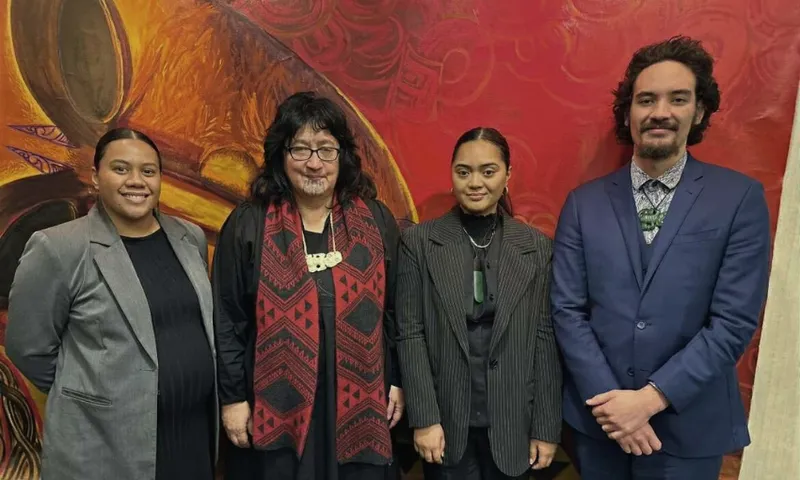
Annette Sykes and Maia Te Hira (standing) present at a Waitangi Tribunal hearing. (Image: Supplied). (Additional design: The Spinoff).
From the descendants of rangatira to the frontlines of Tiriti justice, one Māori lawyer reflects on her journey through the Tribunal and what the future holds.
My tamariki directly descend from three known signatories of He Whakaputanga and te Tiriti o Waitangi – Pōmare II, Te Huhu and Pāpāhia. Their tīpuna fought in the Māori-Crown battles at Ruapekapeka, Ōhaeawai, Kororāreka, Te Tarata and Waerenga-ā-Hika. Most of their kaumātua are either morehu or ringatū and committed to the teachings of prophets and spiritual and political leaders Tahu Pōtiki Wiremu Ratana or Te Kooti Arikirangi Te Turuki. Their inheritance is one of resistance and rangatiratanga.
It was no mistake that my origins as a Māori rights lawyer who deals primarily with matters before the Waitangi Tribunal coincided with my introduction to motherhood. Knowing that my tamariki come from such foundations makes the legal fight against the Crown for breaches of te Tiriti all the more worth it.
The Waitangi Tribunal has been a frontier for the Māori-Crown relationship since its establishment in 1975. As a rangatahi (under 30 years old) working in this jurisdiction, I have felt both privilege and pressure to carry the claims and aspirations of the whānau, hapū and iwi that I get to represent before the tribunal. Hearings provide a niche environment to wānanga with our Treaty partners on issues that traverse tikanga, whakapapa, the law and the roles played by Māori and the Crown as Tiriti partners.
Ngā wheako
Although my experiences in the tribunal pale in comparison to longer-serving, more renowned lawyers, I have had countless opportunities to listen to and learn from a variety of claimants and witnesses – from tohunga and rangatira to academic thought-leaders, people whose honourifics I need to rehearse saying out loud and graduates of the school-of-hard knocks. These are all people who have appeared before the tribunal and given the evidential basis that informs the findings and recommendations that make their way into the reports. It is a forum with participants who constantly remind me of who we are as members of whānau, hapū, iwi and hapori, and who never fail to make me proud to be Māori.
Some notable experiential examples include:
- Listening to Dr Te Riaki Amoamo give the origins and history of his hapū Ngāti Ruatakenga and iwi Te Whakatōhea in the Wai 1750 North-Eastern Bay of Plenty District Inquiry.
- Boarding a boat on Lake Rotomahana and being taken to the remains of the Pink and White Terraces to learn about the 1886 eruption of Mt Tarawera from Te Mauri Kingi as a part of the Wai 2358 Geothermal and Freshwater Resources Inquiry.
- Feeling the raw testimony of 77-year old Dean Wickliffe – the longest-serving prisoner in our country’s history – who spoke of his near lifetime of incarceration in various prisons as a part of the Wai 3060 Justice System Kaupapa Inquiry.
- Sitting before the Whare Rūnanga at the Waitangi Treaty Grounds, witnessing the tribunal hand over the Stage 2 Report on Te Paparahi o Te Raki to Ngāti Manu and other northern hapū, which reminded the Crown that Ngāpuhi never ceded sovereignty.
- Working alongside constitutional law experts Emeritus Professor Jane Kelsey and Dr Max Harris in the Wai 3300 Treaty Principles Bill Urgent Inquiry, which taught me to never underestimate the power of Pākehā allyship in the fight for Tiriti justice.
- Trying to absorb as much wisdom as I can from the powerhouses of the mana wāhine movement, Donna Awatere, Ani Mikaere, Dr Papaarangi Reid, Ripeka Evans, Dr Leonie Pihama, Mereana Pitman and others as a part of the Wai 2700 Mana Wāhine Kaupapa Inquiry.
- Having to be the kaikaranga for the ope manuhiri during pōwhiri on to many marae across the motu where our hearings are held.
- Forming lifelong connections with the colleagues that I have had the utmost privilege in being in the trenches with – the likes of Te Ringahuia Hata, Kalei Delamere-Ririnui, Te Maiora Rurehe, Sam Vincent, Jack Potaka, Mary Peina, Alyssa Valeza, Mihikeita Tibble and Rangipurei Manley.
None of my experiences would have ever been possible without the guidance, mentorship and being thrown in the deep end by Annette Te Imaima Sykes – the institutional memory of the tribunal itself and the force of nature who has dedicated 40 years of activism and lawyering to it. She is a seasoned veteran in the war for tino rangatiratanga who has pushed the boundaries in her arguments on tikanga to ensure the tribunal’s jurisprudence evolves in a way that is Tiriti aligned.
Te anamata o te taraipiunara o Waitangi
The future of the tribunal depends on the law, politics and people it serves. The place of the tribunal as a constitutional change-agent that ensures te Tiriti, the Treaty and its principles are being upheld is as necessary now as it has ever been. However, when the Crown refuses to implement – or worse, even acknowledge – the tribunal’s findings and recommendations, a people’s faith in the institution can wane. A hostile government, critical ministers, ageing claimants, a lack of resourcing, an overworked judiciary and a limited number of lawyers willing to confront the reality of life on legal aid to sustain the work we do are all issues that currently plague the tribunal. It is inevitable that reform will come for the tribunal sooner rather than later, especially given 50 years is a long time to be operating within a legislative framework that has remained relatively the same. If the tribunal is to thrive in the next 50 years, hard questions must be asked. These may include:
- What is the role and function of the tribunal in contemporary Aotearoa?
- Should it remain a tribunal, or become a commission with different powers?
- Should criteria for claims be widened or narrowed, and how?
- How can the tribunal enforce Crown accountability in practice?
- What role should lawyers play? Do we need streamlined representation?
- Should the tribunal be less adversarial, more inquisitorial, more accessible? If so, how?
- What if the tribunal is stripped of its ability to address contemporary breaches?
The future of the tribunal will be determined by a combination of the community activists whose protests will shift the dial on what becomes its social consciousness; the politicians in the House whose legislation will lay the groundwork for its outcomes; the judges, panel members and lawyers who shape its jurisprudence; and the rangatahi who have a sense of duty to seek justice for the claims that their kaumātua made on their behalf.
I have no single answer for what the future of the tribunal itself will or should be, but as I continue to work within it, I’ll carry the same sense of hope that I have in raising my tamariki – that it will contribute to a better Aotearoa that serves tāngata whenua and tāngata Tiriti in just and equitable ways, as te Tiriti o Waitangi envisaged.

Maia Te Hira
Maia Te Hira descends from the tribes of Muriwhenua and Wairarapa. She is a Māmā of 3, a manu pīrere of Kōhanga Reo, a raukura of Kura Kaupapa Māori Aho Matua, and an ika-a Whiro of Whare Wānanga Māori. She keeps busy as a Māori rights lawyer, legal educator, in iwi govenance, pursuing creative endeavors, and as a Kōhanga/Kura parent. She’s passionate about kaupapa Māori, equity in the law and creating the Aotearoa that her tīpuna envisaged when they signed He Whakaputanga and Te Tiriti o Waitangi.


