The reason the government can never erase mātauranga

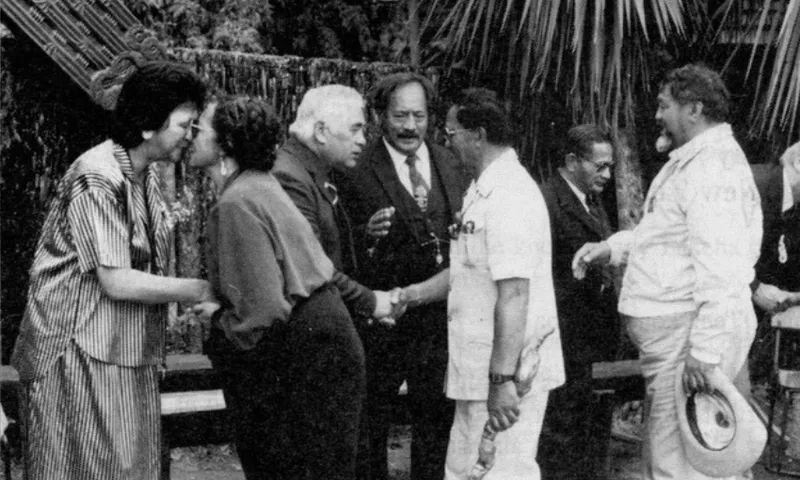
Shane Jones in 1990. (Image: APN. Additional design: The Spinoff).
While some argue tino rangatiratanga is under threat, what’s really under attack is mātauranga, writes Hirini Kaa.
The Resource Management Act was a visionary piece of legislation from 1991. Guided by experts such as Shane Jones, it included a deep recognition of tangata whenua and our mātauranga – our ways of knowing. In particular, section 6e required a recognition of the relationship of Māori with whenua, wāhi tapu and taonga. It also required recognition of the principles of te Tiriti o Waitangi.
In line with this coalition government’s obsession with eradicating every reference to te Tiriti and te ao Māori, the discourse from the coalition government has been telling. While there has been some cross-party recognition of a need to update the legislation, the language continues to refer to “empowering Kiwis” and “letting Kiwis get on with it”. “Kiwis” being, of course, Pākehā capitalists and not, ironically enough, Māori.
And we are seeing this erasure occurring in education, conservation, and all facets of legislation. What are we at risk of losing here and what are we protecting?
Many might say it is tino rangatiratanga – our ability to determine our own path and future. In fact, there’s a whole merch industry relying on this term being the thing. Northerners, you can put your muskets down though, because while tino rangatiratanga is the vehicle to other things, it’s not the whole thing.
I think what we’re protecting is something else, something deeper. What’s the point of being able to self-determine if you don’t know what you’re determining? I think what’s at stake is our mātauranga.
Our mātauranga – our world view sourced in our ancient journey through Te Moana-nui-a-Kiwa, shaped by this whenua and renegotiated in our encounters with global knowledge – is under attack. Some fear it and the impact it is having on Aotearoa, and would relegate it to hidden spaces. Unfortunately for them, it’s too late – mātauranga is here to stay.
Mātauranga is usually used to describe knowledge derived from our ancestors and their practices. Recently, Ta Hirini Moko Mead published a seminal work describing mātauranga Māori. I use mātauranga on its own because, again, there isn’t really such a thing as Māori. There is mātauranga-a-iwi, and the deepest form, mātauranga-a-whenua. Regardless, it’s a worldview that shapes how we see and interact with the world.
The Waitangi Tribunal Report Wai 262 Ko Aotearoa Tēnei/This is New Zealand is a visionary document for Aotearoa. Although it primarily addresses genuine concerns for iwi around the protection and exploitation of our intellectual property, its guiding visionary, Justice Joe Williams, also used it to formulate a future vision for te Tiriti. In this vision, mātauranga regains its rightful place as foundational to our society. This will happen as it is (re)incorporated into all aspects of our life, not just in terms of legislation but also art, health, the economy and even space.
While rangatiratanga has become tied to notions of power, power is not our concept. It is an invention of sociologists and French philosophers. To me, the heart of mātauranga is tapu and mana, and neither of those are in finite supply, nor contestable. It’s a beautiful worldview.
I have great hope in the young people of this land. Yes, they can be incredibly frustrating, with binary views shaped in the terrible crucible of social media. Nuanced views of anything are not for them.
However, they have also been shaped in an incredibly enlightened education system that opened their eyes to the power of diversity and culture. Young people grew up knowing there is an alternative to this capitalist, exploitative system that came as a bonus gift with colonisation. And the climate crisis has forced them to confront their future in an existential way. They don’t want to go back to the old ways represented by Trump, Seymour and company – they want to go forward into mātauranga.
Unfortunately, this means more cultural labour for us as tangata whenua. We have to be open to guide this hīkoi with manaaki and aroha, not with cattle prods and caustic comments. If our manuhiri need guidance, we guide.
The Resource Management Act review is a case in point. Yes, it will seemingly remove the mechanisms that ensured the place of mātauranga. But the thing is, the judges, lawyers and those involved know now that water is more than H2O. It is wai, the source of ora. It has mauri – a life essence.
While the land developers are going to try and avoid this fact, it is existentially unavoidable. It is part of the country’s culture, and culture will always beat law. It is an element of belief for many people now, and that is incredibly powerful. While law merely seeks to restrain the worst of humanity, our mātauranga sees us seek to reach higher in the first place.
It may be terribly naïve of me, but I’m always willing to bet on the power of our mātauranga. I’ve seen it do miraculous things in people’s hearts and heads – it’s incredibly, undeniably transformative.
As Māori we need to exhibit mātauranga in all we do, and be self-critical in doing so. We need to check our misogyny, our homophobia, our will to power. We need to live out mātauranga in a way that make those watching want to be a part of it so they enrol in reo classes, tautoko hui at the marae and honour wai as it should be.
We are in a leadership transition, moving from a generation that grew up of the whenua to one removed from it. Te reo acquisition is not enough – we need the mātauranga that comes alongside it, exercising mana through the acknowledgement of the tapu of all of humanity. Our political leadership could do with some reflection on that at the moment.
But we should be hopeful. We’ve come too far as a collective to not go further, to paraphrase Sir James Henare. Mātauranga is the basis of the new Aotearoa, and there’s no going back.

Hirini Kaa
Dr Hirini Kaa (Ngāti Porou, Ngāti Kahungunu, Rongowhakaata) is Kaiwhakatō (director) of Te Kākano Leadership Initiative. An historian by training, he has worked for his iwi, for social services, as a researcher, for the Anglican Church and his book Te Hāhi Mihinare was a finalist at the Ockham Book Awards.


