From the Amazon to Aotearoa: Māori rangatahi on the frontlines of Cop30

Delegates from Te Kāhu Pōkere at COP30 in Belém, Pará, Brazil.
Two rangatahi share their experiences, insights and reflections on what it was like representing Aotearoa on the global climate stage.
More than 50,000 world leaders, scientists and negotiators came together last week in Belém, Brazil for the most significant climate event in the world. Nestled at the mouth of the Amazon River, Belém is known as the gateway to the Amazon – a region vital to global climate stability and home to some of the most biodiverse ecosystems on Earth.
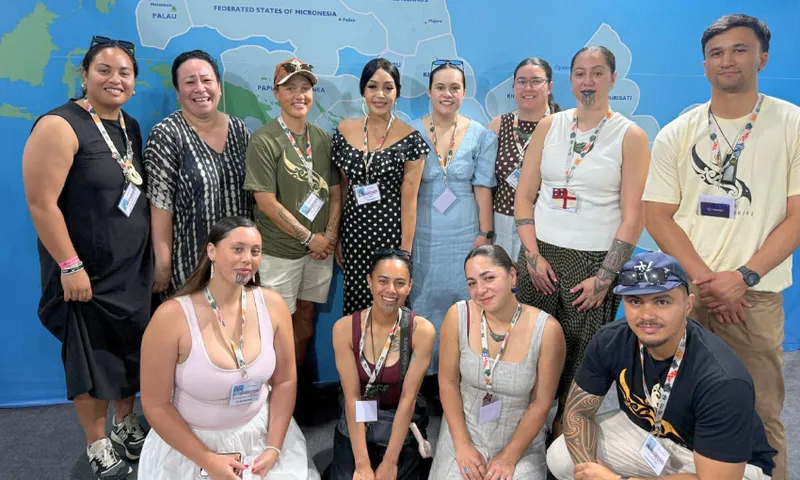
Cop is the annual gathering of the United Nations Framework Convention on Climate Change (UNFCCC), where countries come together to make decisions on climate crises impacting us the most. Among the 50,000 who attended Cop30 were nine rangatahi Māori – collectively known as Te Kāhu Pōkere, we were the first ever iwi-mandated delegation to attend the conference.
We represented a range of diverse iwi and hapū in Aotearoa, each with our own mountains, rivers and ancestral homes. Organised through Pou Take Āhuarangi, the climate change pou of the National Iwi Chairs Forum, the delegation consisted of nine emerging leaders including: Kyla Campbell-Kamariera (Te Rarawa), Waimarama Hawke (Ngāti Whātua Ōrākei), Taane Aruka Te Aho (Waikato-Tainui and Te Aitanga a Māhaki), Harris Moana (Waikato-Tainui), Te Rina Porou (Ngāti Tūwharetoa, Ngāti Porou, Te Aitanga-a-Māhaki), Macy Duxfield (Ngā Rauru), Tahua Pihema (Te Aitanga a Māhaki, Ngāti Whātua Ōrākei), Shannon Mihaere (Rangitāne o Tamaki Nui-ā-Rua) and Aaria Rolleston (Ngāi Tahu).
As an island nation in the South Pacific, Aotearoa is known for its rich biodiversity, deep cultural heritage, and strong connection between people and place. We have long cultivated a global reputation for being a “clean, green” country, but this narrative does not tell the full story. The reality is that our maunga are on fire, our marae are flooding and our awa are contaminated.
As young Māori, we have never known an Aotearoa where ancestral waters run clean, where birdsong is uninterrupted, and where food sovereignty is a lived experience. Through our whakapapa, we carry an intergenerational responsibility to care for the land and therefore, the people. However, through colonisation and centuries of environmental abuse, this responsibility has become a burden. Our generation has inherited a climate crisis that we are not responsible for, but are expected to navigate and repair.
Most would assume the work we do for the environment looks like supporting tuna migration, planting kūmara or restoring mussel beds. And while this is true, we also recognise the importance of climate governance, policy and advocacy. The decisions made at Cop impact us directly here in Aotearoa. So, it was important that we attended to ensure our experiences and worldviews are not just considered, but central in global climate decision-making.
Cop is an overwhelming political environment. With rolling waves of blue suits, swarms of cameras and international delegations, the atmosphere is lively, spirited and truthfully chaotic. The heat of Belém amplified this even more. We became accustomed to the constant embrace of hot air and persistent buzz of air conditioning units. The venue was a labyrinth of pavilions and siderooms, full to the brim with people.
This Cop saw the largest turnout of indigenous peoples, particularly from the Amazon. With between 2,500-3,000 indigenous people in attendance, only 14%, or between 360 and 420, had accreditation to the Blue Zone, where official negotiations take place. We were part of that minority with accreditation to the Blue Zone.
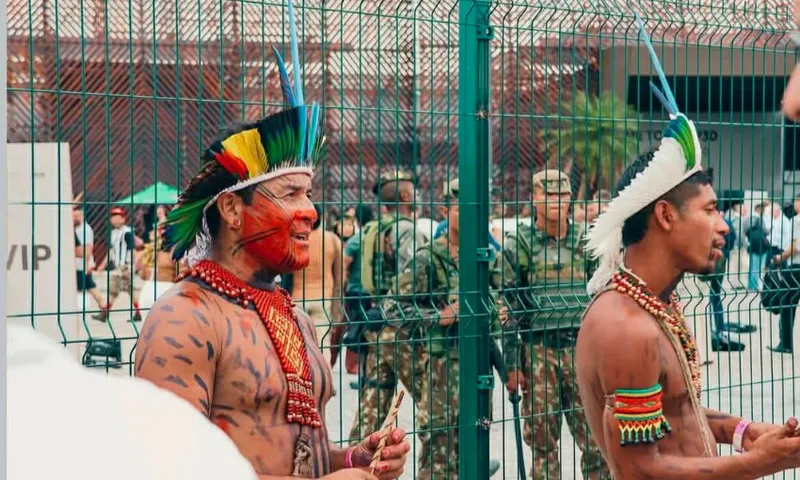
On our first day, indigenous peoples of the Amazon protested through the halls of Cop30, demanding an end to the exploitation of their ancestral home. As mokopuna of protest, we felt many synergies to what we experience in Aotearoa and were prompt in releasing a statement of solidarity: “As Māori activators and manuhiri on the whenua of the Indigenous peoples of Belém, we tautoko their right to activate, to protect and to stand for their whenua and kaupapa in their own ways. We acknowledge the mana and rangatiratanga of the local peoples whose whenua we are on.”
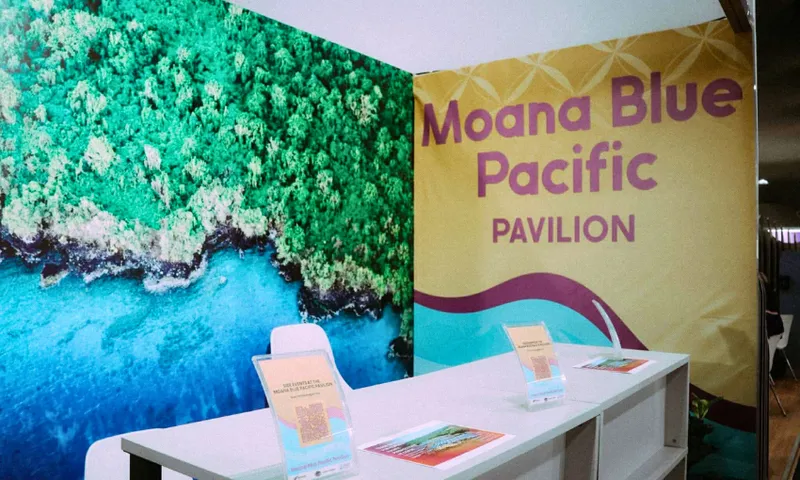
Following the protest, there was a dramatic increase in military and security at every entrance. From Pará to the Pacific, indigenous people are at the forefront of the climate crisis. We know that our whanaunga from Te Moana-nui-a-Kiwa are experiencing loss of land and cultural heritage due to rising sea levels. In a cruel twist of fate, the Moana Blue Pacific Pavilion was flooded due to heavy rain. It was the only pavilion impacted, a reflection of the reality experienced in the Pacific.
The Moana Blue Pacific Pavilion was our home at Cop30. We delivered two independent side events there and one at the Indigenous Peoples Pavilion. With a focus on the importance of indigenous knowledge and leadership, we presented more than five iwi case studies from across Aotearoa.
One of the presentations was titled Mana Motuhake Climate Solutions by Taane Aruka Te Aho. His case study was on the impacts of Cyclone Gabrielle in the small settlement of Te Karaka. His iwi of Te Aitanga a Mahaki, alongside Toitū Tairāwhiti Housing led the response, establishing 60 temporary houses and creating evacuation sites and tribal safe zones for the entire community. This response was completely iwi funded. Te Aho summarised his presentation by stating: “Iwi are committed to building resilience, innovation and leadership. Iwi are investing in the future. When Māori people look at solutions, we look at solutions so that we can all win.”
One of us (Shannon Mihaere) took the floor at the Youth Led Climate Forum on behalf of Te Kāhu Pōkere. It was the first time the conference at large would hear an extended piece of dialogue in te reo Māori. She reminded the room that climate responses advanced within negotiations must uphold justice for indigenous people. As a group, we challenged the young world leaders in the room to commit to embedding genuine indigenous leadership in climate decision-making spaces.
There is a lot of ground to cover in negotiations. The agenda is dense, the consultations constant, and the sessions run late into the night. Being able to see various states present their concerns was an experience that better shaped our understanding of why reaching consensus takes so long. It can take hours just to agree on the addition of a single word.
We attended as many negotiations and plenary sessions as we could, including the launch of the Belém Health Action Plan. This was a moment that brought together a multitude of member states to commit to strengthening resilient health systems and recognising that climate action is inseparable from community wellbeing. While it signalled a genuine step forward, it was impossible not to notice New Zealand’s absence. It was unsurprising, considering the official party consisted of 14 people, only five more than our own delegation. It showed the constraints of participation from the government. The upside, though, was that we got to sit with the New Zealand country plaque, right where our negotiators would have been.
On the topic of climate finance, there are no current pathways within the UN system to support indigenous peoples, with less than 0.13% of climate finance available to our communities. The line we repeated in backrooms, plenaries and coffee queues was: “Although Aotearoa is considered a developed country, its indigenous people are living in underdeveloped conditions.” Māori communities face extreme climate vulnerability and are unable to access climate finance because we live in a developed settler state that shields us from eligibility.
Under the 2015 Paris Agreement, each country is required to set a Nationally Determined Contribution or NDC, a climate action plan that outlines their contribution towards reducing greenhouse gas emissions. New Zealand’s current NDC commits to a 51-55% reduction in emissions by 2035, only a 1% increase since our last NDC. Minister for climate change Simon Watts stated in his speech to the assembly that our NDC was “ambitious”. However, many on the ground held little belief in this. “Fossil of the Day” was a recurring activation awarded to countries who are “doing the most to achieve the least” on climate action. New Zealand was awarded Fossil of the Day for weakening its methane targets.
Amid the chaos of the conference, the weight of the negotiations, the late nights and the constant political fragility of climate agreements, we were empowered by the leadership and courage we witnessed in indigenous people and communities. Cop30 reaffirmed the power there is in being indigenous and that our innate ways of connecting to the environment are the solution to the climate disasters we are facing today.
From the Amazon to Aotearoa, the Klamath River to Columbia, Rapa Nui to Te Whenua Moemoeā, there is a new generation of young indigenous people who are not waiting for permission to lead. Instead, we are stepping into the spaces that our tūpuna cleared for us and fighting for the futures our mokopuna deserve. Indigenous youth are not the leaders of tomorrow – we are the leaders of today. And when we stand together, our collective strength is impossible to ignore.

Shannon Mihaere
Shannon Mihaere, born and raised in Manawatū, is a recent University of Auckland graduate whose work spans law, health, and climate justice. She hopes to return home to support Rangitāne through legal and research expertise in resource management and climate resilience.


