When I finally spoke to money, I realised we’d never been properly introduced

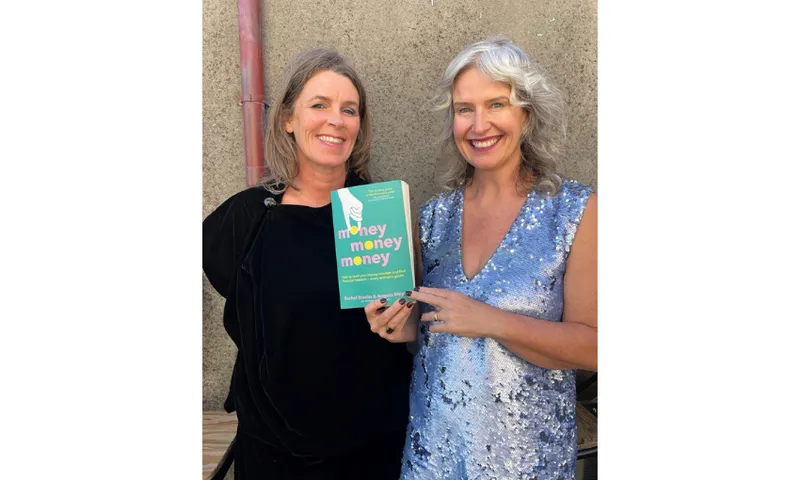
Megan Dunn finally has a chat with money (Photo: Robert Cross)
Made possible by

Megan Dunn tests the bestselling Money, Money, Money, a new book full of exercises and tools to help get to grips with your relationship with wealth.
“Hi Money. I don’t think we’ve ever met before,” I said.
Money looked a little surprised. “We’ve never met?” Money was another middle-aged woman down a Zoom screen.
“Yes, I’ve heard of you,” I said. “It’s like you were always at the party first but gone by the time I arrived. You’ve met other people I know. I just always got there too late,” I said.
That’s the guts of my first meeting with money. I was about 49 going on 50 at the time. So, my shame compass was wobbling all over the dial. “Hi Money”, is a therapeutic role play exercise. You do the role play in pairs. One person assumes the character of money, and then you have a first-person chat about your relationship. The person playing the character of money doesn’t have to do too much, just reflect your words back. I first did this exercise about a year ago when I signed up for a 10-week online course exploring my relationship with money.
Now, I’ve been speed-reading the just-released book Money, Money, Money, co-authored by Rachel Davies and Angela Meyer, the creators of the role play exercise and of that 10-week online course. This is the duo that co-founded Hi Money, and their book walks the reader through this exercise and a range of other psychological tools that might help you get to grips with your relationship with money. The “shame compass” is helpfully outlined on page 72. Just in case you need it too. I’ve carried a lot of shame about money throughout my life.
I also feel a bit guilty that I am speed-reading the book, rather than slowly absorbing it and doing the chapter checklists and exercises, but I’m not a patient woman and time is running out!
This is my money story. I didn’t learn anything about money growing up, I was raised by a single parent mum who worked in an old people’s home. We lived in a granny flat above the old people’s home. We didn’t own a house. My Mum died aged 69, still renting a room. I was 45 at the time she died, and out of work, with barely a cent in my bank account. It was like I just woke up – cold water lashed across my face. As Meyer and Davies’ book will tell you, more women die in poverty than men. Women have 25% less in retirement savings than men. Retirement? I never thought I’d live long enough to see old age. Now I am over halfway through my life, so for me this book is personal.
Money, Money, Money says right up front that if you are on the breadline, barely able to pay rent and eat, then it is not the right time to read this book. When you are in total survival mode (and I have spent decent chunks of my life in survival mode, no judgement) it’s not possible to unpick your personal money story or investigate the attitudes you might have inherited about wealth.
However, what I’ve noticed about living in survival mode is that it can last long after your personal circumstances have changed. In my 40s, I was still frittering money away and living in the moment, avoiding a range of more nebulous emotional problems that I could have faced earlier.
I needed a wakeup call, and then I got one when Mum died. Are you on track to die in a rented room with hardly anything in your bank account? That was a question I had never asked myself, until Mum died and at the time the answer was yes.
Fact: most people find it easier to talk about their sex lives than what’s in their bank account. So, what’s good about this book is that it helps you explore your own attitudes to money and any psychological blocks in your way. Money is not just a matter of dollars and sense, it’s emotional.
A friend remembers how in my 20s I told her, with absolute conviction, I’d never own a house. That’s a dangerous wish that has come true. I’m from a Catholic upbringing and money lurked in the background as a villain, never at our door, but out in the neighbourhood slyly corrupting. God isn’t typically depicted in flash clothes and a Ferrari, you know? Or perhaps I should update that to a Tesla? Being tight with money was also looked down on in our family.

What’s your money story? Do you talk about it out loud? Can you say what you earn to someone else? Why is that considered rude? Davies and Meyer are both upfront about their money stories: quickly but meaningfully, and chapter by chapter, the book carefully includes other women’s stories, representing a variety of cultural backgrounds and experiences. This isn’t a blame game. It’s about pulling up a bandage to look at the wound. You might find your money scars are nicely healed. If so, good for you.
Have you ever considered what your ideal relationship with money would look like? Or put a cash figure on your lower and upper limits? Now, that exercise blew my mind. I think for most of my 20s I probably had a lower limit of zero dollars, meaning I could and often did live with absolutely nothing in my bank. I had never even considered what my upper money limit might be. How much money would be enough for you to feel good, to feel safe, to have options? (Caveat: I started out as a video artist then went into writing, so my life is not exactly Wolf of Wall Street territory.) Now, I’m thinking about my upper money limit. Is it $500,000? Is it one million dollars? And why does that phrase make me think of Doctor Evil, holding his pinkie finger next to his mouth, as though the very existence of a million dollars is ridiculous? I currently live in a city where the average house price is not far from one million dollars. Fact.
Last night I asked my partner to try out some money exercises with me. I tried out some questions from the chapter “Becoming Unshakeable” with him.
“Why do you want money?” I asked.
“To buy nice things for myself,” he joked.
“What’s underneath money for you?” I asked, trying another probe.
“A table,” he replied.
I rolled my eyes.
I had not picked the right moment.
You will get out of this book what you put into it. But if you’re another woman who suspects that buried attitudes and assumptions to money have been holding you back, this is the read for you.
Money, Money, Money is divided into three sections. Section one is the “The System” and contains an analysis of the patriarchy with a strong societal lens and lots of numbers and stats to crunch. Section two moves into the psychology of your relationship with money – this is the meaty stuff. The stuff that gets my shame dial spinning 360 degrees, looking for people to blame. Section three is about the practical stuff. That’s where I am up to now. I’m taking stock, I’m giving myself a financial audit, and sorting out short-term, mid-term and long-term financial goals. I am not investing yet, but that’s another option.
This isn’t the first or the last book about finances, but it is impactful, concise and practical and it goes straight to the heart of the disadvantages stacked against women.
Did you know that 30% of New Zealanders have no financial goal at all – other than winning the lottery or picking up some prize money. For a long time, I’ve been one of those people – I thought money was like a stork delivering a baby. It would arrive from outside myself; I’d be bestowed with a gorgeous little bundle of cash. A year ago, in a local art gallery, I saw a lovely Erica van Zon embroidery of a Powerball ticket against a blue-sky background. I wanted to buy it for my partner, but you know the drill. I didn’t have enough money.
I wanted to write this review because that role play, “Hi Money”, was powerful. When I finally “spoke to” money, I was surprised to realise that we’d never been properly introduced. My whole life, I’d envisaged money as some cool dude at a party that had ghosted me before we’d even met. Money was someone so hot, I could never have them. Money was also a man.
It is only in my very late 40s that I have started to talk to other people – other women – about money. I hired a young female financial advisor and paid off my student loan. My financial advisor runs her own business called Know Your Worth. She is part of a generation of millennial women who are leading the way with money and self-awareness. But Money, Money, Money is a vital tool from two Gen X women – my generation – who are helping to change the narrative around women and wealth. The book went straight to number one in the New Zealand bestseller charts last week. I’m pleased for the authors, but I know what that many copies sold really means. Women in Aotearoa need to talk about money, perhaps especially in a cost of living crisis, because that’s when having money (or not) really counts.
Money, Money, Money: Every Woman’s Guide to Finding Financial Freedom by Angela Meyer and Rachel Davies ($38, Allen & Unwin NZ) is available to purchase from Unity Books.
The Spinoff Books section is proudly brought to you by Unity Books and Creative New Zealand. Visit Unity Books online today.

Megan Dunn
Megan Dunn is the author of Tinderbox, Things I Learned at Art School, and The Mermaid Chronicles: A Mid-life Mermoir (forthcoming, 13 August 2024).


