The prime minister we almost had: Grant Robertson’s memoir, reviewed

The former deputy prime minister’s memoir is out today, August 19.
Made possible by


Henry Cooke reviews Anything Could Happen by former deputy prime minister Grant Robertson.
He was almost elected Labour leader in 2014. He almost became the prime minister when Jacinda Ardern resigned in 2023. And he almost got a wealth tax over the line that same year. But not quite.
In his new memoir Anything Could Happen, we naturally learn much about what Grant Robertson did do, from his days designing election-winning policy for Helen Clark’s Labour government (interest-free student loans) to the frantic opening of the fiscal taps during the pandemic. But the book is haunted by all the stuff that Robertson didn’t quite achieve. We hear about the achingly close Labour leadership loss to Andrew Little in 2014, and the genuine agonising over whether he should step up when Ardern resigned in 2023. Robertson openly expresses frustration about missed chances and lost arguments, even as he generally gives the other side a fair hearing.
By “the other side”, I am talking about fights within the Labour Party – not politics itself.
If you’ve come to this book believing that Robertson spent far too much while finance minister, and hoping for some kind of lightbulb moment of regret, you will be disappointed.
Robertson does not argue that he and Labour got all the calls right. But he does make it clear that he still believes that a huge dose of spending was needed to combat the pandemic, and that while some level of cuts was needed by the time he left office, the state of the books was far from as dire as his critics now constantly claim. (Unsurprisingly for a committed sports minister, he calls in the international referee for this issue – noting that New Zealand’s credit rating survived the pandemic intact, leaving it as one of 12 national economies with the top triple-A rating from two of the big global credit rating agencies by Budget 2022.)
His argument is somewhat undercut by Treasury’s long-term insights briefings, released just weeks before this book was published but long after it was written, which shows officials believed the stimulatory spending was too high after Budget 2022 and was contributing to inflation.
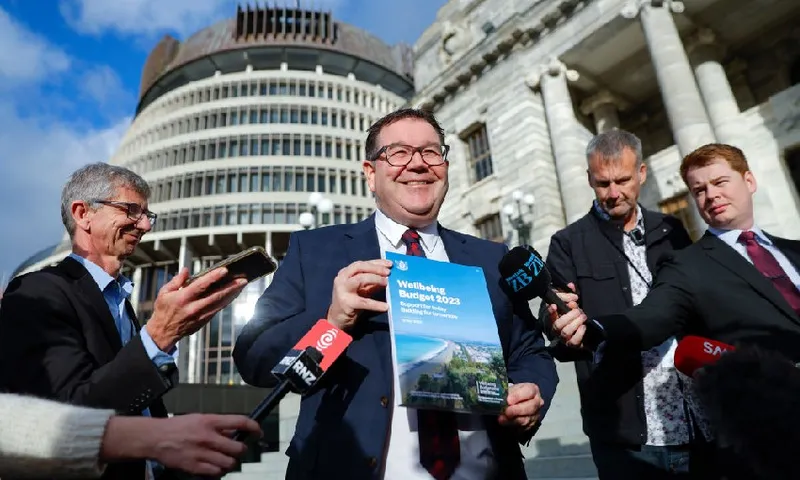
Robertson was never the kind of finance minister the median Treasury staffer would adore. He might run a university now, but he will be a politician forever, and it shows in the passing strays he has for the National Party – he notes that one of the first things new leader Christopher Luxon did was call for Labour to spend more money.
So no, this is not an apologia for the country’s debt track, and if you came looking for that you will not find it. But if instead you are trying to understand more about the decisions of the sixth Labour government, you will have a far better time. Unlike Ardern’s recent memoir, this is a book squarely aimed at New Zealanders, meaning Robertson can actually get into the meat of some issues rather than just briefly explain them for foreigners. Tax, monetary policy and the difficulty of hosting international sporting competitions are all dealt with at some length.
Robertson embeds into this policy and political history a lot of personal detail. We learn about his somewhat troubled upbringing as a gay teenager in 1980s Dunedin, how he met his partner Alf, his brief career as a diplomat, and a lot about a back problem in recent years that contributed both to mental health issues and his decision not to take over from Ardern.
Yet Robertson the policy strategist is never that far away – he explains his father’s imprisonment for stealing company money in part by noting that the fraud put his family above the student allowance income cap.
As a book the memoir is extremely readable and often funny, much like a Robertson general debate speech. I ate it up in about 48 hours and I think anyone interested in New Zealand politics could do similar with no real boredom. Sections on Labour’s time in opposition contain juicy tidbits from the Cunliffe debacle that leave you wanting more, as well as Robertson’s play-by-play of Andrew Little’s resignation as leader, including Robertson’s exasperation with him.
We get what I believe to be the fullest accounting yet of the NZ First and Labour negotiations in 2017, including Ardern staring down Winston Peters over his desire for a numbers-based immigration cap. This was a red line for Labour and one that Ardern worried had cost them government – and according to Robertson ended up making Peters so bitter he ruined much of the government’s work programme in both immigration and workplace relations, given they shared a minister.
Indeed, the enmity between Robertson and Peters emerges as one of the clearest throughlines in the book. The relationship between Labour and NZ First in government sounds like it was far worse offstage than on it. Where Robertson does admit fault with the Covid cash infusion is with the so-called “shovel ready” programme of spending announced in Budget 2020, which deeply involved NZ First’s Shane Jones and therefore became “politicised”, in Robertson’s viewing.
The base-level bitterness Robertson feels for a man and party who stymied so much of his programme has likely been increased by Peters’ embrace of the Covid fringe. After all it is hard to imagine Ardern stepping down without that Covid backlash spilling onto parliament’s lawn – and Robertson is clear that he thought Ardern stepping down would greatly harm the party’s chance of re-election.
If Ardern hadn’t stepped down, Robertson might still be in the Beehive, or at least able to properly run on a wealth tax in 2023 as he had long planned. He might not have time to write a book, busy instead with the cut and thrust of politics he was addicted to for so long, trying to get the books back in order himself.
In fairness, all political memoirs are tales of chances not taken and battles not won. They are almost always written once the protagonist has lost an election or somehow been turfed from office. Robertson just has a few more sliding doors moments than most.
Anything Could Happen by Grant Robertson ($40, Allen & Unwin) is available from Unity Books.
The Spinoff Books section is proudly brought to you by Unity Books and Creative New Zealand. Visit Unity Books online today.

Henry Cooke
Henry Cooke was chief political reporter at Stuff. He now lives in London.


