‘She’s out there vibing’: Amber Esau and Coco Solid in conversation

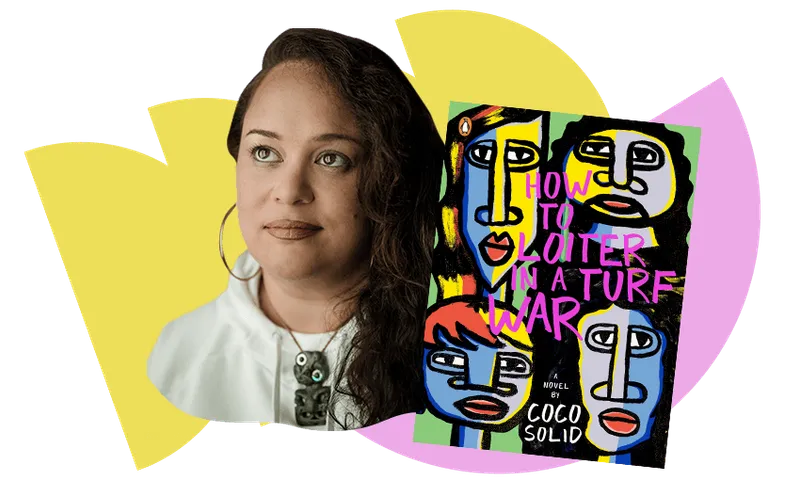
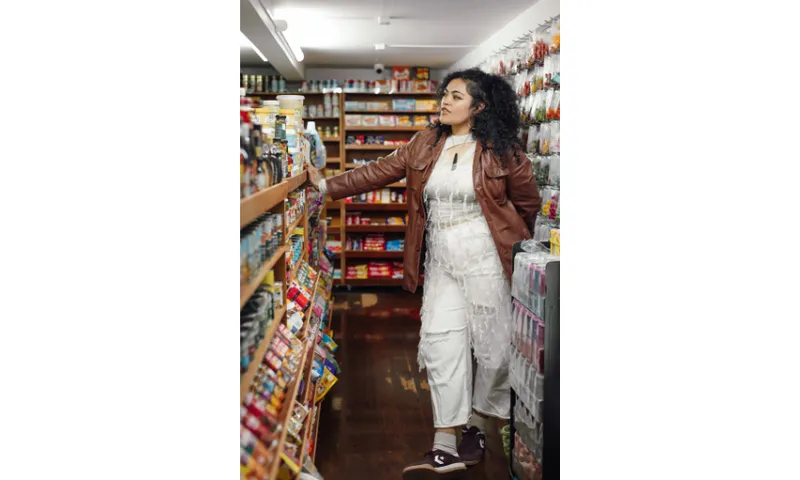
Amber Esau and Coco Solid discuss Hungus, Esau’s new collection of poetry (Photo: Tokerau Brown)
Made possible by

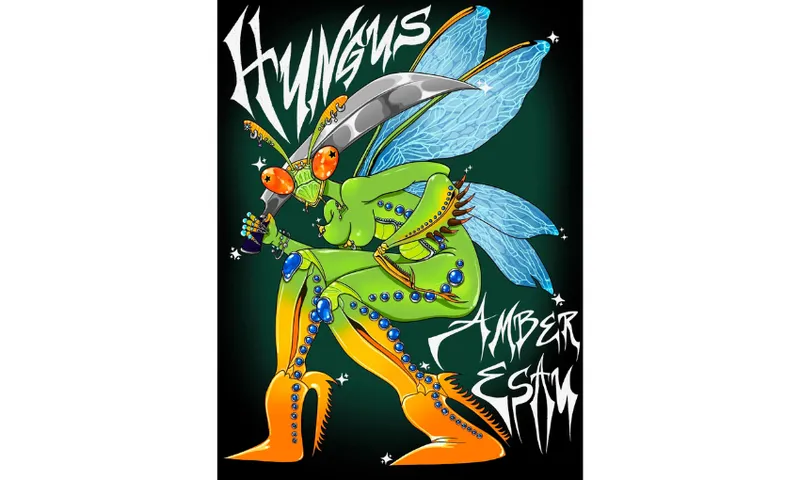
Hungus is a deadly new poetry collection by Amber Esau (Ngāpuhi/Manase), a mantis-themed ode to nuance, tower moments and addiction. Esau sits down with fellow Ngāpuhi Samoan writer Coco Solid to discuss the joys of being misread, multinesian multiplicities, putting repression to work and how it feels to have your darkest matter become public poetic property.
Amber Esau: Hungus is textbook – “the girls that get it get it”. Some people might not have the full context to understand the world that has created this collection, but most books are a house of mirrors and this one isn’t any different. I think if you’re a lil too uncomfy with being on the outside of a work… what are you bringing to the reading experience?
Coco Solid: Whereas I thought, “Oh it’s my diary, period”. I am a Māori Samoan Palagi who’s gonna get down with poetry and trauma, so I was like a nepo baby to be fair. I also don’t think people realise how special it is when we share a body of work like this. How it’s literally a part of your psyche and gafa just walking around.
AE: I agree. It’s been strange, because this is such an exaggerated version of who I am. And some of it is completely outlandish, but there is always an undercurrent of truth. The environment that I grew up in was tense and hilarious and there’s always that tension of big and little violences.
CS: Violence is always just there looming when things go left. Liminal, lateral; emotional violence, physical. I think when you’re growing up within a lot of contradictions that soft threat is always there somewhere.
AE: “Soft threat”, it’s so that. I also feel it highlights how cartoonish and surreal growing up in those environments can be. Not in a way that’s inherently bad. It’s just sort of navigating by streetlight.
CS: We often cling to “this will make sense one day”. Not necessarily. You just put out a hot book about it and that might be the closest you’ll get.
AE: We write to better understand those essential and personal questions that keep circling us. A lot of Hungus is about the pervasiveness of trauma. It’s about addiction, but I think that’s just the underbelly of different kinds of trauma.
CS: This cool device of the praying mantis. That’s such a deep totem for us in cultural ways, like a tōhu for pregnancy among other things.
AE: Hardout. I used to dream about praying mantises a lot. I reckon they embody the power and terror of womanhood.
CS: And I like the way Hungus moves through the plural life. Selfishly I love that it moves through the plurals of my life. Those whakaaro that swim and knock into each other. Suddenly, “oh, I’m in this quadrant now”. I’m suddenly at a fiafia night, we’re in the tension of “baby sharks trying not to allure,” and then I’m marvelling at the heaviness of a soft-boiled moon. Collaging all these contexts with lush language, it’s just so technically impressive too.
AE: Nah, thank you. The earlier drafts were a lot more elusive and opaque. I was a little too prepared to free fall into a vat of hearty Moana metaphors, eh.
CS: Are you like: “If you don’t get it, it’s not my problem?”
AE: More like: “This is my version of the poem. But what is coming up for you?” I’ve always thought there’s a collaborative approach to offering such a tricked out poem, lol. I love mixed metaphors – they are kinda fobby which feels like home – but with the original intentions that I had for writing the work, I hadn’t fully realised what was truly pushing the opacity.
CS: I‘ve read interpretations of the praying mantis as an alter ego, or a buffer between you and the you saying what you need to say. The tension between wanting to cloak and wanting to connect. Poetry shit.
AE: “Whatever comes up for you is none of my business” is how I have always felt, but sometimes I think that can be used to warp a work so out of context, which is a little bit sus. This has made me consider my responsibility to the kinds of images and metaphors I use. I get the impression that some people want so badly for poetry to do the work of really taut fiction, a style of poetry that is also very awesome, but it’s not entirely what I’m interested in. I think of the Mantises and the Manaia more like the major arcana in a tarot deck.
CS: When I’m writing, there’s this quiet resentment wanting to buck those assumptions, it’s always there burning. But Hungus has that duality and it does that. It’s not glaringly academic, but even when it was mysterious to me I could feel that labour. If you’ve been in a white forensic writing class, you’d know why Hungus ate. But also if you’ve got a Samoan grandmother you’d know why it ate as well.
AE: That was super important to me. From the earlier drafts, I had to accept that actually there is an elitism in the way I’m using language that will not be accessible for a lot of my family and the community I grew up around, most of whom aren’t poets. They couldn’t care less about the juxtaposition, volta, anaphora and enjambment in the work. If they feel it, they feel it.
CS: We live opaque lives and similarly poetry is at the mercy of those perceptions too. People are going to be misreading me every day well into the double digits. I accepted that a long time ago, that’s the waka I’m soldered to and no one has the time or range to casually work through that and reassure you. We’ll never provide people that clean, reductive read, right? So why wouldn’t our writing be like that as well?
AE: One hundred percent. It’s hard not to feel a little cynical about it, eh. It’s twofold though, because again, how you read Hungus is none of my business. But also you’re gonna read it how you read it anyway. Whatever I say has the potential to be misrepresented or misunderstood so why not get a little freaky with it?
CS: Did you have fun in that way, playing with perception on your terms? Hungus has visuals in it and all these moving poetic forms. As soon as I started reading it, I see “the Moana is a rolling mirror and will definitely fuck “. There was a line break there and it turns into another sentence. But I’m still frozen thinking: “You damn right, the Moana will definitely fuck!” I felt every choice you made was experimental. Were you seeing how much you could get away with?
AE: My general sense is that I’m probz a surrealist – I love incongruous images/language/form. I find that kind of confusion exciting and familiar and crack up, and embodies the soft threat you mentioned earlier.
CS: I think you’re a surrealist too. Did you want to go all out? Use the maximalism in your kete?
AE: Before I went back to study, I was just doing a lot more intuitive writing and a lot of it didn’t really make sense. Afterwards, I had a bit more understanding of my process which was useful. I’d always taken being a stream-of-consciousness writer quite literally and thought editing would muddy the “raw confusion” or something like that lol. There is a version of this collection that’s even more hungus. I was so lucky to have Ashleigh Young as my editor – she really understood the essence of the work. And now editing feels closer to refraction.
CS: And how do you feel about the book?
AE: I don’t hate it?
CS: That’s major.
AE: I mean, I’ve read it a lot and I’m still okay, this is still revealing new things to me. That is a good tell. I’m really glad to have had time from the first draft to focus on other things. Distance definitely helped the overall arc and made me a lil more ruthless.
CS: And it’s editorial murder on the dance floor before you put that shit out. It’s horrible.
AE: Hard not to be so attached. Even just submitting the work took me ages. I was holding onto my finished draft for a few months before I thought maybe it’s time to send it. I needed to give myself the time to grieve that period where it was just me and the work.
CS: Because once it’s out there, it’s no longer yours.
AE: Exactly, and it feels so separate to me now. I’m still a little surprised when I see the book out in the wild and think, “Oh, that’s right, I let her go and do her thing”.
CS: The cover for a book ends up setting this energetic tone. Can we have a moment for yours? It’s almost like “brace yourself, bitch”. This is such a bombastic, incredible visual world. It really sets the mood.
AE: It all came together really quickly and randomly. I’d met Katrina Steak at a Yellow Lamp poetry night maybe a month before Te Herenga Waka University Press told me they wanted to publish the book. We followed each other on Insta and I was absolutely floored by her artwork. The visual worlds she creates resonate so deeply with me and with what Hungus is. She’s mean AF!!!!! I felt so certain that it had to be her, that she would really “get” the work… and she did.
CS: With a pukapuka, you’re building the whole culture around the work after creating the work itself. Making sure that you’ve packaged it beautifully and the way it’s aligned, the way it finds its audience — you push the work out as best you can. I feel that’s a really big win for this body of work, because when I got into it, I felt like all the elements co-ordinated.
AE: I love that. Yeah, I think with the way that the work is, it was important to make sure anyone who entered this poetic fale had some idea of what they were stepping into. Also, there was no way I could let my girl, Hungus, go out in an ugly fit haha.
CS: I’m thinking about the tension of having subscriptions to so many worlds. I really love that line: “split across timelines is the her of many hers.” That’s the fantasy, right? That part of us that is uncontestable, the ultimate you. And it’s the core of your being, the spirit that trauma and other people can’t destroy. We’re often trying to get to the centre of trying to find her.
AE: Absolutely. I can’t remember who said it, probably lots of people, but there’s a thing called multi-consciousness. It’s all intersectional and we’re just Venn Diagramming our ways to where the parts of our wakas overlap/are bound well enough to hold us, eh.
Although, sometimes the process of naming things and being named can distance us from actually doing the work. In this age of social media, we are even more used to abstracting ourselves to the point that we might avoid the responsibility of actually being ourselves in the world. I definitely struggle with this. I mean, I’m Samoan, Māori, NZ Irish, bi, woman and I’m also a daughter, a sister, an aunty, a niece, a friend, a lover, and just me?
CS: That is so much of what writers do, the laser-pointing of trying to reach your internally mutated people.
AE: I grew up with a diasporic Fa’asamoa and there is always the expectation to be the most Samoan you can be. But I’m someone who is constantly feeling like a fractal and always living between different cultural contexts. It’s interesting, but it’s also always feeling like you have to explain yourself.
CS: Even to yourself. Those assumptions make the sex and eroticism in this mahi leap out too. It feels 4K when you bring those kinds of themes to the front of what is stereotyped as “brown woman work”. Like, PinkPantheress is this illegal? No, it’s not, but damn sometimes you’d think it was.
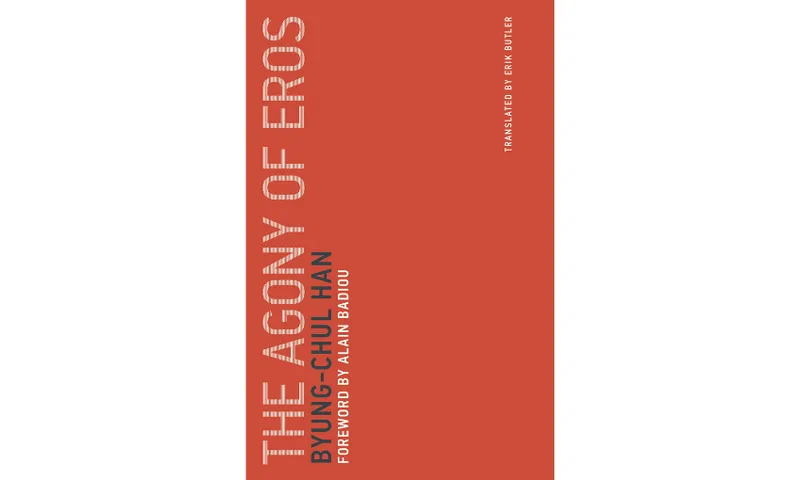
AE: Haha, I’m honestly sick of feeling like I have to do “brown woman work”… can’t a girl just vibe? I read this book called The Agony of Eros by Byung-Chul Han. One of the things that I understood from what he wrote was: we don’t know how to hold space for the other. The eroticism is in the conflict of “us” existing and an “other” existing and holding them together – that is eroticism. But within a colonial framework, we’re expected to overtake rather than sit with that uncertainty.
CS: Conquer. Control the dominant narrative.
AE: Exactly. And a dominant narrative must be consumable, standardised.
CS: Literally state-sanctioned.
AE: Truly. One of the hopeful parts of Hungus is: how do we hold the other? It’s uncomfortable if you’re still in survival mode, but something’s gotta come after that.
CS: And how do you hold the other with integrity, whilst also upholding your own integrity? And knowing that it doesn’t really deplete anything by being open and doing that. I like how you associate that with eroticism.
AE: I grew up in a pretty repressed and village-like household. I had very little privacy and was expected to be as transparent as possible. It cultivated a sort of gullibility in me, eh. I naturally assume people are straight up. It took me ages to accept otherwise haha.
When I was writing the first draft, it was shared in the workshop space and that was a little triggering. Once I had distance from the therapy draft – and also, I ended up getting some therapy to work through some of my stuff – it felt healing to reimagine the darkness thematically and on the sentence level. Not just for my mana but also for the mana of anyone entering the work. A feeling that I wanted Hungus to have is pulling teeth, pulling a bad tooth so you can get some relief. There’s a tension of leaving it for so long that it overwhelms you, the hurt and aggression of it, and then the catharsis … but it’s also kind of gross.
CS: To me, it captures that real heavy metal side of being a wāhine. What we are forced to socio-spiritually do. So it feels cathartic that it’s all these themes I know well. You give it that brutal treatment yet the work ends up being quite chic and shiny. You’re holding the glam but also the gory.
AE: I love that. I’ve known too many strong women holding it down for everyone and feeling like they can’t be messy and spiritual.
CS: And with ‘2Puna’, how you talk about the log flume at Rainbow’s End, the ticking rails, the regurgitated water. If you know that clapped fun park, it’s very sensory but you give it this cute mihi. I have to feel close with my tūpes to be able to call them my tūpes, just like you do 2Puna. I love how you culturally relax and get to play with them too, at Rainbow’s End of all places. You flex that security, to make the casual sacred and the sacred casual.
AE: For a long time, I felt like a spectator to myself, my 2puna, and others. It sort of makes the rituals of everyday life seem rote rather than a chance to be present. We all have our cultural customs that maybe operate in the same way that religious customs can. This sometimes abstracts and outsources spirituality and tries to pigeonhole us. I think it’s easy to lose connection to the land if we’ve put our faith too out of reach.
CS: And you want to have polyphonic abilities, right? You want to be a Mongolian throat singer, where you can hit all three, four, five frequencies within everything you say. Someone can hear it from every realm in which you belong and feel attuned. That’s our grand wish. Under the rubble and the limitations of language, I just want to know that you feel me.
AE: That’s one of the dreams for sure. But not everyone is gonna come into something with that openness and that good faith. We can only offer it up and hope they want to sit down next to us and try to hear. Sometimes tiring, though.
CS: Especially when you put in all that energy and still get misread for your troubles.
AE: I think part of the work is an attempt to understand faith and belief. It is about the glam holding the gory, which I love, that’s so the vibe. But it’s also about the systems of power and the abuses that can pervade not just the home and family dynamics but on a grander, societal level, too. Maybe this is the true manifestation of trickle-down economics lol.
CS: The real call coming from inside the house.
AE: People will often think that this is where my power is, so I can be this way. I think it’s also an opportunity to check how we interface with Empire.
CS: Look how the government historically treats Māori women members of parliament when things get too messy. I have a theory our scapegoating is baked into life here, it’s hidden in the collective consciousness and in all kinds of dynamics I experience. I’m often laughing at Empire like, “oh, you think this is the first time I’ve had my resources or public approval or power stripped away from me?”. I was born into it. Like Hungus we’re holding up a mirror and testing these default narratives every day.
AE: Throughout this work is the “hurt people can still hurt people” narrative. I think that’s a big part of our upbringings, the work, and understanding that in the context of Empire. It’s my attempt to offer people a way to check themselves as much as they check others. Because these kinds of power imbalances are not just for one type of person. Everyone is as capable of this. It’s a gentle reminder. I know I’ve been a dick in ways too, so how do I renegotiate that?
CS: You get harmed, you cause harm, and you want the reader to benefit from knowing that’s a constant relationship and truth we all live inside. It’s inescapable and it’s ongoing, no matter how “good”, “correct” and God-fearing you are.
AE: Exactly. To really access that part of it you have to be open to seeing yourself in the work. And I think a lot of people aren’t willing to hold the nuance.
CS: I think holding all of these competing doctrines comes through, even in your use of astrology. That’s not the same as a whimsical Anglo girl putting astro references in her poetry. It goes through the vetting process and mythologies and guilt-ridden distortions of a Polynesian mind. I gotta consider maramataka, menstruation, navigation, if the church is gonna call me a witch yet again. Astrology and your use of planets, like ‘The Uranus trap’ and the ode to our mutual (brilliant) friend Chance ‘Stfu about Your 12th House Stellium’. What’s your relationship like with astrology?
AE: Astrology was a big part of my twenties. I think that it’s quite common for people who have unresolved trauma to really flock to astrology, because it helps to provide a framework from which you can understand yourself a little better and give yourself some grace. Like, “Oh okay, this is the energy that I’m working with”.
I would love to understand the maramataka better and actually link to seasonal living, rather than being on the clock and constrained for the sake of convenience/productivity/labour. Even though it’s not fully possible, that is definitely something that excites me about understanding our relationship to the skies a little more. I’ve also always felt at a distance from things, on purpose or otherwise, and the avoidant in me loves that but, I’ll be looking at the moon and am still shocked that we get to share this view.
CS: And how do you feel about entering into the culture of being an author? I guess participating in the… not the industrial complex of it… but the very real thing where putting a book out just really changes things. You are in the libraries and you’re in the bookstores and people are talking to you about your book for a long time. And then you have to get into this almost rhetoric as an author and then you get this whole new community. I found it really exciting, but also really jarring. What about you?
AE: I’m proud of the work and I’m happy that she is able to do her thing. That she’s out there vibing. I think that’s so cute and intrepid of her.
And the author part of it, I’m weirded out by. I’m quite shy and awkward but also loud AF when I’m comfortable. These days, I’ve been trying not to get too overwhelmed being in group dynamics, especially now that I’ve stopped drinking, but it’s still kinda hard for me. I am very much a one-on-one kind of person.
I find it exciting being able to talk about the work with people who engage with her thoughtfully. This? Amazing, thank you. It’s really interesting to me hearing how Hungus shows up for others.
I’m still getting used to the fact that people are talking about the work, or talking about me rather than Hungus. It’s so nosey sometimes haha. I know that we’re gonna be intrinsically linked, but she’s not mine anymore. I’m just over here making sure that she is supported through her journey.
CS: You’re just like a kaitiaki.
AE: Yeah, maybe.
Hungus by Amber Esau ($30, Te Herenga Waka University Press) is available to purchase from Unity Books. Amber Esau is one of the writers selected for the 2026 New Voices Aotearoa campaign.
The Spinoff Books section is proudly brought to you by Unity Books and Creative New Zealand. Visit Unity Books online today.

Amber Esau
Amber Esau is a Sā-māo-rish writer (Ngāpuhi / Manase) born and raised in Tāmaki Makaurau. She is a poet, storyteller, and amateur astrologer.


