How to move mountains: the stories of Rodney Bell and Maia Marshall-Amai

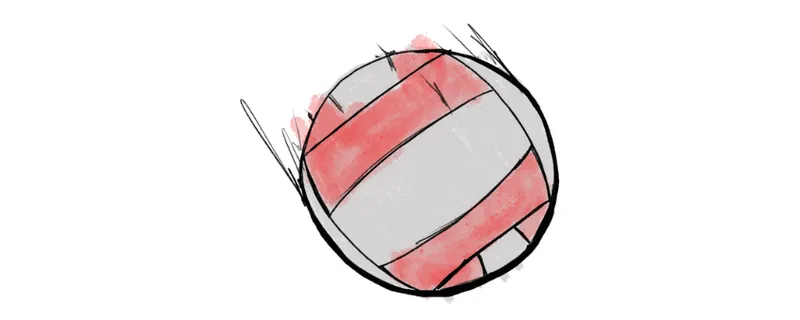
Illustrations from Out of the Box, depicting Rodney Bell (right) and Maia Marshall-Amai (left). (Images supplied)
Made possible by

A new book celebrates 25 Deaf and disabled New Zealanders who have moved mountains.
Trish Harris is a founding member of Crip the Lit, a collective of writers who celebrate Deaf and disabled literature and stories and refuse to be sidelined out of mainstream consideration. I have long admired Trish’s advocacy and her own work. Her new book, Out of the Box, is an essential book celebrating Deaf and disabled “artists, activists and adventurers” who have, writes Trish, “broken out of the box and claimed their space”.
The first half of the book is dedicated to telling these stories (like the two evocative profiles, below) while the second half is an invaluable timeline of Deaf and disability milestones in Aotearoa from the 1840s to the present year. It covers the Polio epidemic of the 1920s which led to an increase in disabled peoples; to the world wars; the rubella epidemic which resulted in a rise in children born deaf; to the establishment of the Health and Disability Commissioner in the 90s; and runs right up until March 2026, covering, among other things, the government’s decision to reverse the decision to restrict disability support service funding after disabled people, whānau and caregiver groups called on them to do so. Though that win has already been superseded by the introduction in May of the controversial Disability Support Services Bill.
It’s a remarkable book and best of all, it’s designed for ages 12+ so is a text to be enjoyed and shared with young readers, too. / Claire Mabey
Rodney Bell (Ngāti Maniapoto): Dancing on the spin of a wheel
Rodney spins upside down in his wheelchair above the stage. He’s suspended by a cable and so is his dance partner. She’s not in a wheelchair. Their cables twirl together like muka. His arms stretch out like the wings of a huge bird and his fingers whisper like feathers.
The music becomes louder. The two dancers twirl apart and descend to the ground. Rodney pivots upright in his wheelchair and he and his dance partner bow as the audience claps and claps and claps.
Rodney has been dancing for nearly 30 years. He’s danced at marae and in prisons. He’s danced around the United States, Europe, Australia and Aotearoa New Zealand. Everyone who sees him dance, remembers it: the way he uses his body, the way he uses his wheelchair, the way he tells a story with no words at all.
One of the stories Rodney tells is Meremere, a narrative about his life. It’s a collaboration with musicians, audio-visual artists and a co-dancer. He talks about his motorbike accident and how he felt disconnected from his tinana afterwards because he was paralysed from the chest down.
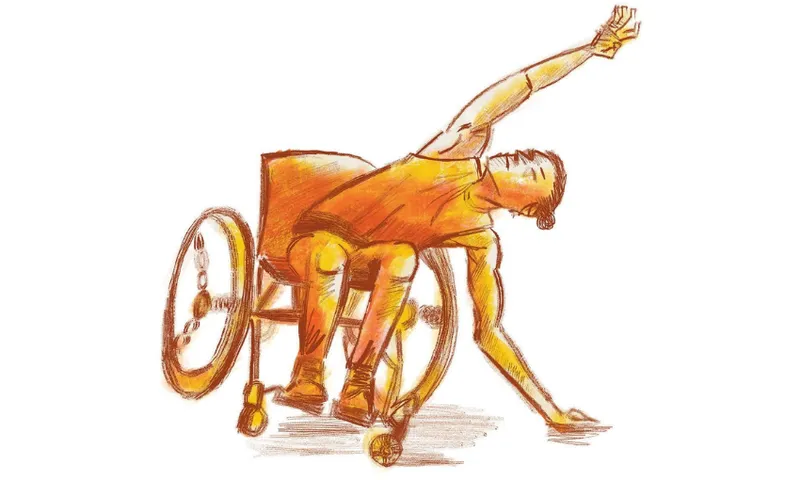
Then dance found him. That’s how it felt. Dance helped him be in his body and use his body – Rodney calls it his vessel, his container – in a new way. He joined Touch Compass, a mixed-ability dance group. “I didn’t know about dance techniques or the commitment you make to your body to be fit. It took me a while to be disciplined. Dancers are like elite athletes!”
Then Rodney joined a dance company in the United States and worked there for several years. When the dance company ran out of money, Rodney lost his job and his accommodation.
In Meremere he dances what it was like to be homeless in San Francisco. He slides out of his wheelchair, lies on the ground. He is alone, yet he also has company. He used to go down to Pier 1 and seagulls flew down to him “like angels”. “One of the seagulls only had one leg. I named it Moana – it reminded me of home.”
He always wanted to return to Aotearoa New Zealand and when he had enough money for his flight, he did. That was many years ago. As he finishes Meremere he twirls his rākau and bangs it on the stage. He’s taken this show all around the world and he’s performed in and created many other shows, too.
“Creating makes me happy,” he says. “I’m able to draw on my ancestors and bring them into the present in whatever I do. We can dance anything. You make toast – it pops up, you grab it, you butter it – you’re dancing. Then you put music to it,” he says, clicking his fingers to the beat.
“I believe everyone can dance. You can flow, just like that.”
Maia Marshall-Amai (Ngāti Awa, Tūhoe): Skin in the game
Maia plays rugby – wheelchair rugby. It’s a sport that used to be known as murderball.
She snatches the ball from an opposing player and speeds up the court, weaving through a swarm of players trying to snag her.
Her wheelchair has small bumpers at the front with rounded wings – she’s an offensive player. The defensive players on the opposing team have longer wheelchairs, with a wide bumper. They use this to try to hook her chair.
Maia’s teammates zoom in to support her. All the wheelchairs are scarred and battered, and you can see why. It’s rough out there! A player flips backwards on to the court. Maia balances on one wheel. Then she cuts loose from her opponents, whizzes over the line and bam, scores a try.
“Look at her wheel control! Look at her speed!” shouts the match commentator.
Wheelchair rugby is a mixed-team sport for girls and boys, men and women. Ever since Maia discovered it in 2013, she has loved playing it, nationally and internationally.
Maia grew up in a rugby family. Her cousin, Benji Marshall, who’s played rugby for the National Rugby League in Australia, can remember Maia being competitive, right from when she was a child.
From childhood Maia also knew what it was like to live with an impairment. She was badly burned in a car fire, then an infection caused her to be paralysed and she had a leg amputated. She was only 18 months old when this happened, and she didn’t get out of hospital until she was five.
As an adult Maia liked to play wheelchair basketball and that’s where someone from Aotearoa New Zealand’s national wheelchair rugby team, the Wheel Blacks, spotted her. “Try out for us!” they said. She nearly didn’t – her life had been tough after her mother died, and she’s also shy – but her support worker said, “Why not?”
By 2018 Maia was seen as the best woman player in the world. She’d already competed in world championships and her big goal was to compete in the 2020 Paralympics in Tokyo. But her health was deteriorating, and she needed surgery to amputate her other leg and part of her pelvis.
During the Tokyo Paralympics, she was still recovering at home. She had to watch every match on TV. She felt rotten, thinking, Man, that was supposed to be me. I should be there!
So she came up with a new dream: to be fit enough to make the next world championships in Denmark in 2022. She trained every day, sometimes twice a day, to improve her strength and balance. At the national championships she was named best in her classification, and later that year she made it to Denmark.
It was an impressive achievement. But then, Maia’s entire career has been impressive – for years, she was the only woman player in the national squad.
No wonder the organisers of the women’s Rugby World Cup in 2021 noticed her while looking for people to champion the non-wheelchair rugby game. Maia starred in a promotional video for them, in which four Papakura High School students chanted a powerful spoken-word poem while her face flitted across the screen:
Precision and perfection combined with unwavering faith and endurance results in unimaginable power. Her power, her capabilities . . . she evolves and shape-shifts every day . . .
Out of the Box: 25 Deaf and disabled artists, activists and adventurers from Aotearoa New Zealand by Trish Harris with illustrations by Benjamin Ackerman and Peter Woodfield ($45, Otago University Press) is available to purchase from Unity Books.
The Spinoff Books section is proudly brought to you by Unity Books and Creative New Zealand. Visit Unity Books online today.

Trish Harris
Trish Harris is author of The Walking Stick Tree, and Out of the Box.


