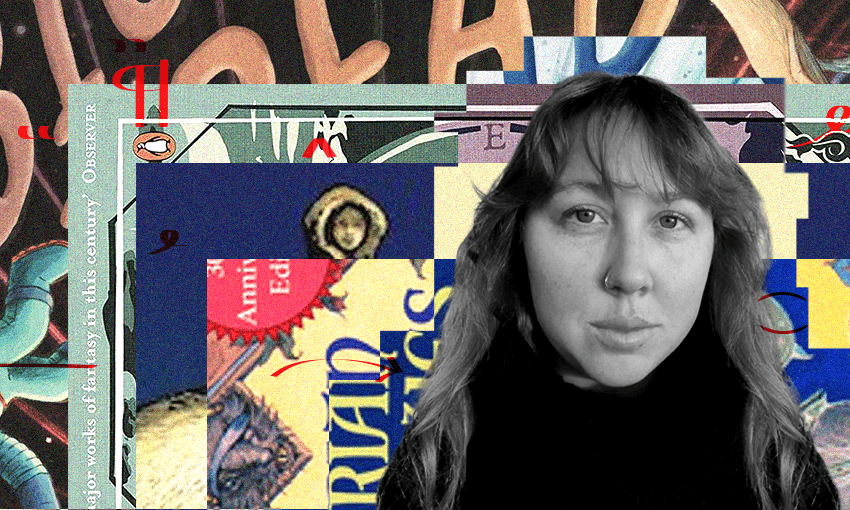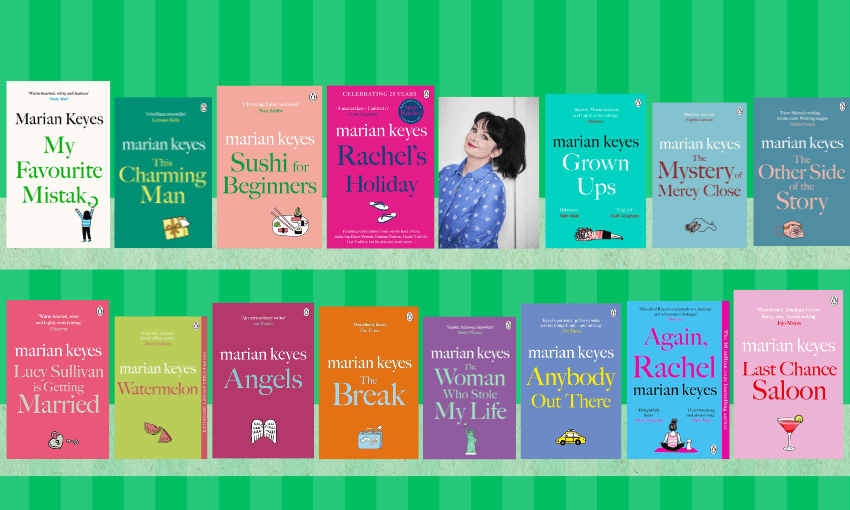



The master of ‘chick lit’ (though she hates the word) has 15 bestselling fiction books. But which one is best? Mad Chapman read them all to find out.
Is Marian Keyes the master of the fluffy holiday read? Or is that condescending given she paints all manner of everyday struggles, particularly depression, anxiety, addiction and disordered eating?
Will Keyes be a writer whose work is destined to remain in a time capsule? Or will a new generation of readers grow to appreciate her work’s literary merits? Whatever the answer, Keyes is still going strong. Did you know she hasn’t gone a full two years without publishing a book since 1995? Her latest, My Favourite Mistake, was published in 2024 and one can only assume a new release will be announced imminently.
Keyes’ number one pull is that she’s genuinely funny. While her humour has changed over the decades (and, like all humour, some has not aged well), the writing is always wry and sharp. You get the feeling that Keyes is the party storyteller, and would happily shut someone up with a cutting one-liner. Woven into her humour, and the reason her novels have found homes all over the world, is an honesty and frankness when writing about women. Every character is deeply flawed. Most of them are experiencing one of, if not the worst moment of their life when we meet them, and Keyes gently shows readers how women pull themselves through the likes of clinical depression, suicidality, disordered eating, anxiety, infertility and grief.
She writes so well about these topics because she’s experienced them. The Walsh Sisters series (Watermelon, Rachel’s Holiday, Angels, Anybody Out There? and The Mystery of Mercy Close) follows an Irish family of five sisters across three decades. Keyes herself is the eldest of five siblings, and the strength of her inter-sibling dialogue is a testament to that.
Before publishing any books, Keyes went through rehab for alcoholism as a young woman; she’s been open about her struggles with depression and suicidal ideation; and in 2010, at the height of her fame, she posted this note on her blog to explain a period of silence: “I can’t eat, I can’t sleep, I can’t write, I can’t read, I can’t talk to people.”

The first Marian Keyes book I read was Rachel’s Holiday (1998), after putting it in my $2 bag at my 2005 primary school fair alongside Girl With The Dragon Tattoo and a random Jack Reacher novel. I was immediately hooked. Keyes wrote about complex, scary issues with the humour and fun of a rom-com. I then sought out her other titles at every garage sale and op shop until I drifted away at university. In 2020, I saw a review copy of Grown Ups in the Spinoff office. I excitedly read it and hated it, and wondered if all those books I’d loved as a teen weren’t near as good as I remembered.
I never sought the answer to that question until now. In the past four months, I have read all 15 of Keyes’ fiction books in order of publication. (Note: Penguin Random House sent me the full set, but did not include The Brightest Star In The Sky so it’s not included in this ranking.) Every Keyes book is large. In total, I have read 9,087 pages of Marian Keyes’ fiction, in varying font sizes, and saw her humour and sensibilities evolve across 20 years of writing. Despite reading none of her non-fiction, I feel as if I have read Keyes’s life story, parcelled out across two dozen female protagonists.
Some of the books were better than I remembered, some worse, and others brand new to me. If you’ve never read Marian Keyes before and don’t know where to start, this ranking from worst to best might help.
15. The Woman Who Stole My Life (2014)
This book is quite bad! Felt like a filler book between the big guns. Perhaps Keyes is on a strict delivery schedule with her publisher and sometimes has to just file something to buy time.
Stella Sweeney writes a coffee table platitudes book after getting locked-in syndrome (Keyes uses the official name – Guillain-Barré syndrome – but that’s effectively what it is) and recovering. Quite a random illness that is purely for the plot twist of being unable to speak or move but fully conscious. Otherwise completely immaterial to Stella as a character or the plot in general.
There is, however, this meta comment from one of the publishing characters: “First rule of publishing: if something works, just do it again, with a different title.” Made me wonder if even Keyes herself considered this book to be a rinse and repeat exercise.
14. This Charming Man (2008)
I am sad to put this so low because the first 200 pages were so good but it can’t be helped. This Charming Man is a three-character story (two written in first person, one in third), connected by one slimy politician. Lola Day, stylist, is dumped unceremoniously by Paddy de Courcy and moves to Knockavoy – a fictional coastal town that appears in many Keyes novels – to recover.
Lola’s chapters are fun and clipped, evidently inspired by the staccato diarising of Bridget Jones. They’re particularly fun to read given how many, usually online, writers carry that styling to this day. My favourite new term from this book was “rawlrawlrawl” as both a noun and adjective for what a room with too many men sounds like.
Much like Stella in The Woman Who Stole My Life, Lola has a, let’s say, keen interest in Muslims. From 2007-2014, a number of Keyes characters have an in-passing fear of Muslims. More often than note, supporting characters chide them for their bigotry, suggesting Keyes was attempting to lead close-minded readers to tolerant waters.)
In This Charming Man, there’s a whole b-plot about the cross-dressing men Lola comes to tolerate (the “trannie” word count alone is easily triple figures) that is far too involved and often misses the mark, but you can see Keyes is trying for a net positive. This from Lola after being corrected on her transphobic language shortly after being chided for Islam ignorance: “Am learning all kinds of unpleasant things about self since came to Knockavoy.”
It’s an admirable intention from Keyes but very much of its cultural time, and it makes for some deeply punishing reading now. Similarly, the basic premise of a charismatic public figure (Paddy) being a serial abuser of his partners – including some graphic depictions of assault and rape – is an ambitious and worthy topic to unpack in popular fiction. Unfortunately, in this, the pre-MeToo era, journalist Grace comes up with a plan after discovering multiple victims of physical and sexual assault by a leading politician. Does she report on it? No. Does she investigate it further to find out who knew? No. She convinces the terrified victims to show up to their abuser’s house unannounced and blackmail him. For what? Nothing. Just so that he won’t oust his own (female) party leader, who Grace likes. It was genuinely infuriating to read and I think Keyes meant it to be empowering.
Strangely, this one has blurbs on the back cover saying how funny it is when it’s by far Keyes’ darkest book. In fact, the chapters on Marnie (Grace’s twin sister) and her descent into rock-bottom alcoholism are genuinely horrifying to read – and some of Keyes’ best work. Sadly they can’t make up for the fact that, on the whole, this book is a time capsule and probably one that should stay shut.
13. Angels (2002)
Poor Margaret ‘Maggie’ Walsh. Rachel (Rachel’s Holiday) and Claire (Watermelon) have previously damned their sister with faint praise. She’s the boring one, the do-gooder, the “lickarse” sister who scolds her rowdy sisters for getting into trouble. So it makes sense then that Maggie’s own book would be the dud of the Walsh sisters’ series.
Maggie runs away from her sturdy, boring husband after she discovers he’s having an affair. She runs to Los Angeles and her old friend, aspiring screenwriter Emily – a rare undeveloped friend character who is mostly in the book so Maggie has someone to talk to.
Nothing happens. Because Maggie doesn’t want anything except to not be in Dublin, many pages are devoted to her going to the beach, getting her nails done, thinking that the first (and maybe last?) lesbian character in a Keyes novel is attracted to her. Side note: Where Keyes has fairly regular gay best friends for her protagonists, a proper lesbian is hard to come by in her books. Not a great character but I did enjoy the term “lezzerness”.
Finally at the end we learn the real reason Maggie ran away and for about 50 pages I was deeply invested. Keyes loves time jumps and dual timelines but in this case, she should have gone chronological and put the motivation at the beginning. Without that, it’s a book about a boring character getting sunburnt.
Note: While I’m on the topic of dud Walshes, in 2025 we were finally gifted a TV adaptation, The Walsh Sisters. Except it tried to cram every sister’s book into one six-episode mini-series and subsequently failed to capture any of the magic.

12. Grown Ups (2020)
I don’t understand how Grown Ups has the highest average rating on Goodreads of any Marian Keyes book. It’s not very good! It’s well-written, sure, and a noteworthy departure from Keyes’ comfort zone in that it features a full ensemble and a complicated Love Actually-esque web of relationships and connections.
But it’s sooo long. I thought it was about the same size as the others because all the books had the same dimensions (or close enough); but when I opened it, the font was two points smaller than all the other books. Even then it’s more than 600 pages when it should have been 400.
In short, three brothers and their wives navigate middle age and many crises – eating disorders, money troubles, infidelity, hating each other etc etc. Everyone sucks in a quite boring, realistic way, and no one is self aware enough to be funny.
The whole time I was reading it, I felt like I was reading a very long description of a TV miniseries. And guess what, it’s currently being made into a miniseries and I think the show will be great. Maybe just wait for that.
11. The Last Chance Saloon (1999)
This was Keyes’ first time writing in third person and it’s much shakier than her first two (Watermelon, Lucy Sullivan is Getting Married). Also her first time playing with different chapters for different characters – a technique that she’d deploy many times again.
There’s plenty of fat jokes (the 90s!) but they’re a bit more deliberate than lazy; in other words the fat jokes are about the protagonist not a slighted side character. It’s worth remembering that even award-winning literary authors (Ottessa Moshfegh) of the 21st century write much worse about fat people, but it’s still not the most fun to read.
Tara, Katharine and Fintan are best friends in their 20s with very different jobs, families and relationships. They’re not bad storylines but without Keyes’ internal monologue humour, the plot holes are harder to ignore. As a sign of the times there’s an obligatory gay male best friend with an Aids-like storyline.
It’s also the first book with an actual straight up villain, Lorcan, who’s a serial rapist and horrible man. He’s not unbelievable in real life but is kind of unbelievable in the book.

10. Lucy Sullivan is Getting Married (1996)
I remember reading this one at least twice as a tween and feeling very mature learning about the complexities of adult relationships. It was only Keyes’ second published book and featured one of her youngest protagonists (Lucy is 26).
Lucy is depressed, serially dating and always finding herself pining for terrible men who ignore her or use her solely for sex or money (or both). Gus is the worst offender, a man for whom Lucy falls hard, despite his very clear alcoholism and skintness. Reading her obsession with his every cringe move is genuinely painful, and goes on longer than it needed to to make the point. Meanwhile, her best friend Daniel cops the worst of her – so bad it becomes quite hard to want a positive outcome for Lucy given her treatment of him – and is our friends-to-lovers hero.
This book is 55% excellent, top-of-the-ranking material, and 45% aged-like-milk-chuck-it-in-the-trash. What’s interesting is that at 641 pages, it’s so long that actually you could literally cut 45% and be left with a heartwrenching mid-sized drama about a young, clinically depressed woman trying not to become her alcoholic father or her trapped mother.
First, the 45%. There’s a colleague of Lucy’s who appears to be there solely as a means to make horrendous fat jokes. If you redacted every mention of her the book would be no different whatsoever except a bit easier to read.
There are a lot of zingy one-liners, some that are genuinely funny and others that have not aged well (see fat jokes above). I did, however, laugh out loud at this description of visible wealth: “Immediately upon meeting her, you could tell that Hetty was posh. Not just because she looked like a horse, but because she had horrible clothes.”
The 55% that is excellent is Keyes’ brutal and unblinking descriptions of depressive episodes and alcoholism. In Lucy’s father, the sheer tedium of caring for an alcoholic parent makes for compelling and devastating reading. And as for the depression, I still vividly remember being 13 and reading the chapters on Lucy unable to leave her bed despite being the joker at work and the life of the party, and wondering if there was anyone I knew who was like that when they got home.
Overall, this book has one of Keyes’ most interesting protagonists and arcs but unfortunately gets way overshadowed by the uneven pacing, the jarring 90s humour and too many unnecessary characters.
9. Watermelon (1995)
The book that introduced Keyes and the Walsh sisters to the world. Claire Walsh is 29 and living in London with her husband James. On the day she gives birth to their first child, James announces that he’s leaving her for another woman. Claire moves back to Dublin to live with her parents and two of her sisters while she recovers from the betrayal.
On the whole, Watermelon is the perfect introduction to Marian Keyes. For a “romantic comedy” or “chicklit” protagonist, Claire kind of sucks. She’s narky (a word I adore and am now using regularly thanks to all these Irish characters) and self-obsessed and frankly not very good at looking after her baby. And, even though it’s never stated it is clear, when reading in 2025, that she is suffering from postnatal depression. People who are at their lowest are arseholes a lot of the time. Keyes is nothing if not realistic about that in all her books.
With more than 93,000 reviews and ratings on Goodreads, Watermelon was a global bestseller, and yet a lot of reviews from people (mostly women) reading it 30 years after publication are one-star slatings. They don’t like Claire’s sisters, Anna and Helen, who are rude to her and generally annoying (again, realistic). They don’t like that Claire is mopey and depressed and crying over a loser man instead of being a strong new mum for her baby. And they don’t like that Claire’s parents are not as supportive as they should be.
In short, with the lovely green cover and pencil watermelon illustration and bestselling holiday read status, readers of today searching for escapism and a better reality are unhappy being presented with saddo and narky regular women desperately searching for self-respect while living with their parents in Dublin and making unwise life decisions. Classic Keyes.

8. Sushi for Beginners (2000)
First of all, terrible name. Can’t believe it got past the editors. Sushi for Beginners (ugh) follows Ashling and Lisa as they navigate the magazine publishing world, and Clodagh as she realises her perfect housewife life is anything but.
I read this as a kid and the only thing I remembered from it was the weird moment when an American character asks Ashling how to pronounce her name even though in the book it’s spelled “Ashling”. Very confusing, can only assume the spelling was changed for international editions and they forgot to remove that little interaction (it’s still there in the reprints).
Keyes is at her best when her characters exist in worlds not far from Keyes’ own, both mentally and literally. Lisa and Ashling’s magazine life is well-rounded and fun. Ashling’s familial history of depression feels real.
There’s a few clunky of-their-time elements. Lisa is quite boldly racist to the one Asian (Vietnamese) character; Lisa’s ex is black and described in that cringe way all black side characters were described by white authors – long dreads, a “hard body”, “ebony”. He becomes less racially stereotyped as the story goes on but not great overall.
As a plus, the Ashling will-they-won’t-they with her boss Jack Divine is one of the more fun romantic storylines in Keyes’ work and frankly deserved a longer sex scene than it got.
A solid book with some dud moments.
7. My Favourite Mistake (2024)
After reading the first 50 pages of this not-really-sequel to Anna Walsh’s Anybody Out There? I placed it way down in the ranking. Opening in 2020 amid a Covid lockdown made me want to immediately stop reading. Turns out the pandemic element barely factored in the story of Anna, 15 years on from her husband Aidan’s sudden death and back in Ireland after nearly two decades living in New York.
The hot topic? Perimenopause. Much chat about HRT and the rollercoaster that is hormones for women in their 40s. As Keyes herself has aged, so too do each of her protagonists (they’re usually a few years behind her) and in the past 10 years, there’s been an interesting evolution from true rom-com genre writing – always with a serious twist – to either outright drama (Grown Ups), crime (The Mystery of Mercy Close) and now, with My Favourite Mistake, a mix of the two.
Anna moves to smalltown Maumtully to do some damage control for her friend’s new luxury resort being built there. It’s Big Little Lies if instead of a murder it was angry locals vandalising construction sites. My Favourite Mistake warms up well, and beloved recurring characters Jacqui and Joey (Narky Joey) feature heavily. As a standalone book it holds up well as a true holiday read – in fact, there’s nary a mention of depression and alcoholism beyond references to winter blues in small towns – but as a sequel to Anybody Out There? there’s some creative licence taken in rewriting the events of that book in order to drum up motivation for present-day Anna’s feelings and relationships. I can imagine loyal readers despising the direction Keyes took with Anna’s story but I didn’t mind it.
6. Rachel’s Holiday (1998)
Rachel Walsh is being forced to go to rehab even though she’s not an addict. This was the book that got me hooked on Keyes as a wee lass and introduced me to the concept of an unreliable narrator. Rachel, 27, lives in New York as an assistant hotel manager with her boyfriend Luke Costello. The book opens with Rachel describing the events that led her sister Margaret to show up in New York and escort Rachel home to Dublin and rehab. “They said I was a drug addict – I found that hard to come to terms with. I was a middle-class, convent-educated girl whose drug use was purely recreational.”
Keyes has been open about her own addictions and stint in rehab as a young woman, and Rachel’s Holiday is a gentle and funny peek into the mind of an addict in denial. Rachel spends much of the book believing she’s being pranked and judging the “real” addicts who are her rehab mates.
Luke Costello is her (ex) boyfriend and maybe the best love interest in any of Keyes’ books. He’s also much hornier than Keyes’ usual protagonists, and is Keyes’ introduction to blunt blue writing, for example, “He played with my nipples, running the slick tip of his erection over them.”
Sometimes Keyes’ later books deploy the dual timeline format (timeline one: consequences, timeline two: past actions that led to consequences) without much payoff. But in Rachel’s Holiday it’s perfect. It allows us to see the slow dissolution of a life due to addiction and pinpoint exactly when Rachel’s self destruction set in.
5. Anybody Out There? (2006)
Another Walsh sister going through the worst period of their life. This time it’s second-youngest, Anna, who spent her 20s travelling and being skint, then got into PR, moved to New York and met the love of her life, only for him to die suddenly two years later (this is only a tiny spoiler, it happens early in the book).
And so the big topic to unpack for the day (sushi for beginners, if you will) is grief. The grief writing is deeply affecting. Anna’s best friend Jacqui is well-rounded and holds up much of the book without feeling like an overt plot device. And while the “resolution” is a bit too tidy, Keyes never loses the core of Anna as a protagonist.
The bad: There’s a bunch of random emails from little sister Helen and Mammy Walsh about Helen’s work as a private investigator in Dublin. They’re reasonably funny but so long and mostly unnecessary. Did Keyes have a word count to fulfill? Maybe.
The Penguin Random House reprint must have been in a rush because they spelled Aidan’s name wrong (Aiden) on the back cover, and the title was missing a question mark on the front. Strange.
Favourite term: “Feathery Stroker” being derogatory for any man who’s nice or thoughtful (coined after Jacqui dated a man who stroked her arms too softly before sex). Almost homophobic but not quite. A great little tangent about the arbitrary ways we all judge potential suitors.
Possibly Keyes’ first book with no overt discussion of disordered eating or fat jokes. Really sets the bar high for a crazy Helen Walsh finale for the Walsh Sisters series.
4. Again, Rachel (2022)
Rachel is back and, despite the terrible title (a formatting nightmare when trying to write about it), Keyes has pulled a Godfather and produced a sequel that outshines its predecessor. Probably a bit unfair as Again, Rachel benefits from readers having the full context of Rachel Walsh’s addiction and love life.
We return to Rachel 20 years after her stint in rehab. Since Rachel’s Holiday, she’s appeared in every other Walsh sister’s book as the mildly pious, clean-living, responsible sister with the ridey husband Luke Costello. But now she’s moved back to Dublin from New York, is separated from Luke and working at Cloisters, the same rehab where she was a patient.
Therefore Again, Rachel is effectively a do-over of Rachel’s Holiday, with the same supporting characters, the same ragtag dynamic in rehab and some of the same delusional thinking about Rachel’s own behaviour. What makes is better? Time, I think. Keyes’ writing is clearer and more intentional – there are fewer tangents for the sake of humour than in her earlier work. Every character has developed since 1998 and becomes more defined throughout the book. And the Big Issue (which I won’t disclose) is heartwrenching. There’s been a lot of sadness in Keyes’ books but none have made me openly weep like Again, Rachel.
3. The Other Side of the Story (2004)
This book is great fun and is probably what got me interested in writing and publishing as a teen. Jojo is a literary agent representing Lily and Gemma, two ex-friends and aspiring writers with very different sensibilities. Lily and Gemma are written in first person with Jojo in third person, and it really, really works.
Jojo is cool and sexy and is basically Joan from Mad Men. No one in the book can believe she’s so hot while not being rake thin. Progress!
The concept is simple, Gemma’s life is ruined because of Lily. Then we meet Lily and get her side of the story, plus her stress about her book and Jojo. Then we get Jojo’s side of the story. Basically, everyone is a villain in someone else’s life, and we’re all just trying to survive.
I like this one particularly because it doesn’t try to tie up every loose end. Some things end awkwardly and stay awkward. And no one comes out looking squeaky clean.
There’s a buzzy sponcon plot detail where a slimy guy at Jojo’s agency suggests product placement in books. The idea is sold in as financially lucrative but morally bankrupt. Yet at the very same time, Lily’s housemate works the counter at Clinique and is always mentioning their products…
2. The Break (2017)
Amy, 44, is about to watch her husband Hugh leave her for six months on a break. It’s 2017 and Keyes has entered midlife crisis territory. Amy works in PR (a common profession for Keyes protagonists) and is a complex character with much more introspection than wry observation of others.
I liked this one a lot! Not as long as some of the other books (and yet, I reckon they could have cut 10 pages in the third act and been all good) and a more straightforward premise. There’s a real sense of maturity in Amy (and Keyes) that befits a more experienced, older writer. There’s still plenty of humour but a lot of it is more subtle and self-aware and less at the expense of random supporting characters.
Keyes’ protagonists are never straightforward and never without fault, but in The Break, Amy is not remotely an innocent party or a victim. She is both a major contributor to her current predicament (her husband has left for six months to travel and be single) and for the most part, not in denial of that fact. Published in 2017, it was almost jarring to read modern references in a Marian Keyes book, given the heavy cultural references from the 90s scattered throughout her early books. Gone are the CD players and landline phone calls, replaced by Game of Thrones comparisons and watching Crazy Ex-Girlfriend on Mondays. Impressively, Keyes folds in the new online reality delicately, with a daughter who (realistically) vlogs and many references to people getting mad on Twitter.
Sometimes, particularly in her early books, it felt like Keyes had the more-is-more approach to characters and storylines. In The Break, she keeps it simple and it works wonders.
1. The Mystery of Mercy Close (2012)
Helen Walsh at last! My expectations were high (readers had spent a decade hearing from Helen in her sisters’ books and she was always the most interesting of the Walshes) and at the same time extremely low (it had set a terribly high bar that would be near impossible to clear).
But Keyes nailed it. The Mystery of Mercy Close is a departure from her usual fare – even down to the crime jaunt title, but it’s the perfect approach for Helen, who has been described as caustic, unfeeling and pragmatic to a fault. She’s a private investigator who needs no man (allegedly) but we soon learn that she has severe anxiety and depression. Because Helen has always been a lone wolf, Keyes resists the urge to fill the book with “supportive friend” characters and we’re granted full and unfiltered access to Helen’s mind as, over four days (a very short timeline for a Keyes book), she descends rapidly into suicidality while trying to solve a missing persons case.
There’s frank memories of attempts and ideations in a way that could only be written by someone who’s been there. In fact, Keyes has spoken about suffering through an 18-month depressive episode starting in 2009, with constant suicidal ideation. The Mystery of Mercy Close was written during this period and is a noticeable departure in tone from her other work, but one I welcomed. After much anticipation, The Mystery of Mercy Close does what few writers (in novels, TV or movies) have achieved: it takes a beloved supporting character and makes them three dimensional without losing any of their spark. There was only one dud note for me, an unsatisfactory reveal for one of the b-plots – which makes sense when you consider Keyes’ insular state of mind while writing it.
Outside of all that, it’s a genuinely fun crime novel with a reveal that pays off.
PS: After reading every Marian Keyes fiction book, I drove to my brother’s house and deposited the lot in the Little Library that my sister-in-law started there. Three days later I returned for dinner and every last one of them was gone.

Marian Keyes’ books can be purchased at Unity Books.