Can late-stage capitalism survive without insurance?

Image: The Spinoff
If dire warnings from scientists and sobering IPCC reports haven’t been enough to shift governments into meaningful action, perhaps the stark reality of uninsurability will – because these kinds of moves will ripple through the entire economy, argues WEAll Aotearoa director and former Green MP Gareth Hughes.
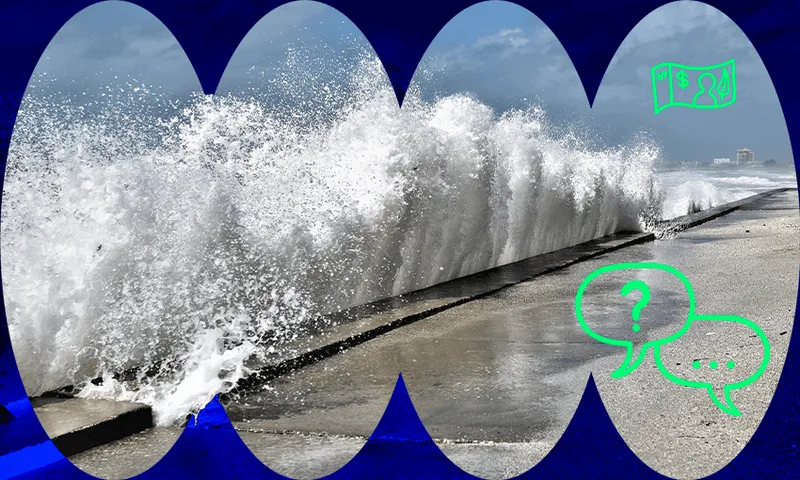
Tower Insurance, one of New Zealand’s biggest general insurers, is expanding its use of risk-based pricing, continuing to raise premiums on homes at higher risk of landslips and climate change-related sea surges. This means that while 90% of customers will see modest drops in their premiums, the remaining 10% living in high-risk areas will see their costs rise. This move is reportedly a world-first, building on Tower’s earlier adoption of risk-based pricing for earthquake coverage and inland flood risk.
So what are the broader implications of such a move? In its 2024 Insurance availability and risk-based pricing report, the Reserve Bank of New Zealand warned that rising premiums could result in widespread underinsurance, leaving property owners dangerously exposed when disasters strike.
The reality here is unavoidable: expecting affordable insurance in a world where we continue to fuel the very risks we are insuring against is pure magical thinking.
Maybe it won’t be scientific research, protest marches or international court cases, after all, that moves us on from our extractive, polluting economic system. It could be those spreadsheet-wielding radicals in the insurance industry instead!
In fact, the insurance industry has long been ahead of the curve in acknowledging the real costs of climate change. They have not done this out of ideology, but because of cold, hard facts. Insurers deal in risk and they know the costs of floods, landslides and storms. They also know that these disasters are becoming more frequent and more severe.
As Gunther Thallinger, a board member of one of the world’s largest insurers, Allianz, bluntly put it recently, “we are fast approaching temperature levels … where insurers will no longer be able to offer coverage for many of these risks. The math breaks down: the premiums required exceed what people or companies can pay. This is already happening. Entire regions are becoming uninsurable.”
So if dire warnings from scientists and sobering IPCC reports haven’t been enough to shift governments into meaningful action, perhaps the stark reality of uninsurability will, because these kinds of moves will ripple through the entire economy.
What do I mean by that? Well, as the Reserve Bank advises, “banks need to be conscious of the ongoing insurability of properties against which they lend. This will require more scrutiny in their lending decisions than currently.” In other words, banks need to assess whether homes will remain insurable in 10, 20, 30 years’ time. And if insurance becomes too expensive, or disappears altogether, homes can’t be mortgaged.
I wish they’d pull a Thallinger and say what it really means: “This is a systemic risk that threatens the very foundation of the financial sector. If insurance is no longer available, other financial services become unavailable too … Credit markets freeze.”
I can’t help but wonder, can capitalism survive without insurance?
Thallinger doesn’t seem to think so: “The idea that market economies can continue to function without insurance, finance, and asset protection is a fantasy. There is no capitalism without functioning financial services. And there are no financial services without the ability to price and manage climate risk.”
So what’s the answer? There are small-scale responses and big-system ones.
At the (relatively) small scale, Tower is encouraging risk mitigation by offering lower premiums for homes with seawalls or flood-proofing. But these are individualised solutions to systemic problems. Not every household can afford major upgrades. Not every community can build a seawall.
What we really need is public investment in community-level resilience, stronger infrastructure, smarter land-use planning where we aren’t building or rebuilding in hazardous areas, and climate action that reduces emissions at the root.
As Tower chief executive Paul Johnston said, “Tower’s evolution of risk-based pricing reflects New Zealand’s need to be more prepared. As a nation, we must focus our collective efforts on climate change adaptation, which is what will ultimately help keep insurance accessible and affordable in the long term.”
But the truly upstream solution is that we need to redesign our economic system. The way we have designed the current economic system in New Zealand with its focus on the short term over the long term, super profits over public goods, and extraction over regeneration, is an important cause of the multiple crises we face.
Late-stage capitalism assumes if we grow the economy we might afford to tackle any problem. But in reality, this uncritical growth is making the problems worse. Want an example? Just look at parliament passing legislation at the end of last month to repeal the 2018 oil and gas exploration ban. In making this decision, our law-makers were turning their backs on the collective action needed to meet climate goals, all for the sake of short-term economic goals.
However, it is possible to move to a world where prosperity is measured not by GDP, but by the health of our communities, the sustainability of our environment, and the inclusiveness of our societies. To achieve this vision, we need transformational change. Change that challenges the status quo and addresses the root causes of inequality and environmental degradation. We need bold action.
Don’t want to take my word for it? Then perhaps you’ll listen to the mild-mannered actuaries, the experts who use their incredible mathematical skills to guide the insurance industry on long-term risk. Just a few months ago, the Institute and Faculty of Actuaries issued a stark warning: without decisive policy action, planetary insolvency is on the horizon. Their modelling suggests that between 2070 and 2090, the global economy could suffer a 50% loss in GDP due to the compounding shocks of climate change.
And while framing the economy as the be-all and end-all is part of the problem (the economy should serve people and the planet, and not the other way around), their modelling still makes the stakes painfully clear: either we act now to build resilience, or we face escalating, unmanageable crises.
The biggest risk isn’t unaffordable insurance, it’s a world where natural risks are so bad they are effectively uninsurable.

Gareth Hughes
Gareth is a former Green MP, now the country lead for the Wellbeing Economy Alliance and chairperson of SAFE.


