Why New Zealand is seeing the impact of the sale of TikTok US

The effects of TikTok’s transition period have been felt by users around the world. (Design: The Spinoff. Map: Auckland Libraries Heritage Collections Map 3307)
After the sale of the American arm of the Chinese social media giant, users here and abroad have been complaining about technical glitches, blocked words and censorship. What’s going on?
Catch me up real quick – there’s a lot of news right now.
OK, so a significant update to the long-running TikTok saga came on January 22 when the US app was transferred to majority-American ownership in a divestment required by federal law. Chinese parent company ByteDance had to sell 80% of its US businesses or be banned entirely from the market, which is home to its largest global user base.
The governments of China and the US inked the deal, allowing an American consortium – described by US president Donald Trump as a “group of Great American Patriots and Investors, the Biggest in the World” (yes, those are his capital letters) – to take control of US TikTok. Assets include the app, user data and algorithm (leased), and the new company has responsibility for privacy and security. It will operate as an “independent entity” and be governed by a majority American board of seven directors, including Shou Chew, the CEO of TikTok.
TikTok USDS Joint Venture LLC will control 80.1% of the venture. The consortium includes three managing investors: the Larry Ellison-owned Oracle; private equity group Silver Lake; and Abu Dhabi government-owned investment firm MGX (each have 15%). There are also eight smaller stakeholders. ByteDance retains 19.9%. Agreements were signed back in December and the deal was finalised last week.
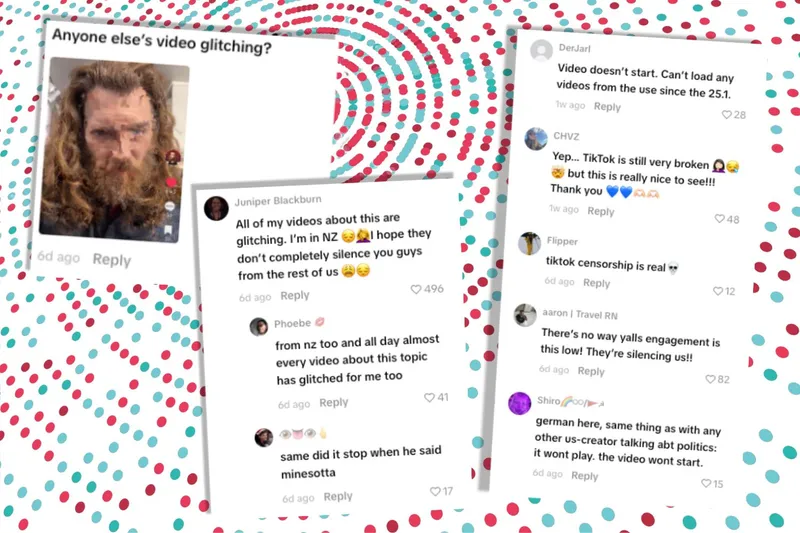
Since then TikTok users here and abroad have been complaining about major technical glitches, like low viewer counts and glitchy feeds, trouble uploading and loading content, blocked words and censorship. TikTok’s first week of US ownership was described as disastrous.
Sounds frustrating.
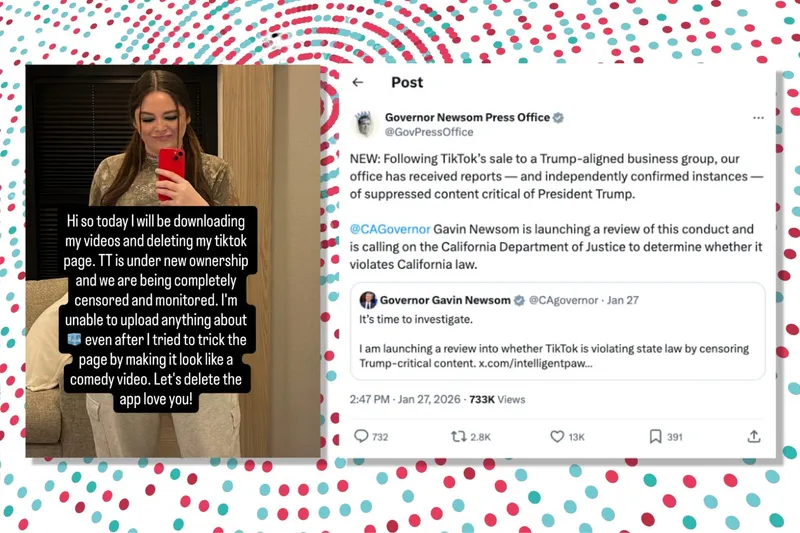
Many users claim that TikTok is increasingly suppressing content about Ice (US Immigration and Customs Enforcement) and Palestine. There are high-profile names among them. Billie Eilish posted on Instagram that “TikTok is silencing people”, and Hacks actor and comedian Meg Stalter said she was leaving the platform, saying users were being “completely censored and monitored” under the new ownership and she was unable to upload any content about Ice.
California governor Gavin Newsom isn’t stoked either. He questioned TikTok US’s allegiances and supported allegations of censorship. “Following TikTok’s sale to a Trump-aligned business group, our office has received reports, and independently confirmed instances, of suppressed content critical of President Trump,” his press office said in a statement published on X. Newsom announced he would be launching an investigation into whether the app “censoring Trump-critical content” violated California state law.
There are also concerns about data privacy and increased surveillance following an update of US TikTok’s privacy policy and terms of service – the contract users agree to with its new owners – which allows for the optional collection of “precise location data, depending on your settings”.
What did TikTok, sorry, TikTok US, say about it all?
Well, some of the censorship claims, including reports that particular words can’t be sent via direct message, prompted a response from TikTok. “We don’t have rules against sharing the name ‘Epstein’ in direct messages and are investigating why some users are experiencing issues,” a spokesperson told NPR.
Other glitches were blamed on external factors. Oracle has said that the “technical issues” users were experiencing were caused by a “temporary weather-related power outage” at its data centre (the destructive winter storm Fern was hitting the US at the time). It confirmed users could experience multiple bugs, slower load times, timed-out requests, trouble posting new content, and may “temporarily” see zero views or likes on their videos.
By February 1 the company said service had been restored and issues resolved, explaining more about what happened. “The winter storm led to a power outage which caused network and storage issues at the site and impacted tens of thousands of servers that help keep TikTok running in the US. This affected many of TikTok’s core features – from content posting and discovery to the real-time display of video likes and view counts.”
Mystery solved then?
Some of it, maybe. Some details of the divestment remain unclear. AP reports that under the terms of this deal, ByteDance will license the influential and closely guarded TikTok algorithm to TikTok USDS Joint Venture LLC “for retraining” purposes, but “any cooperation with respect to the operation of a content recommendation algorithm” is prohibited.
Wait, hasn’t this been going on for ages?
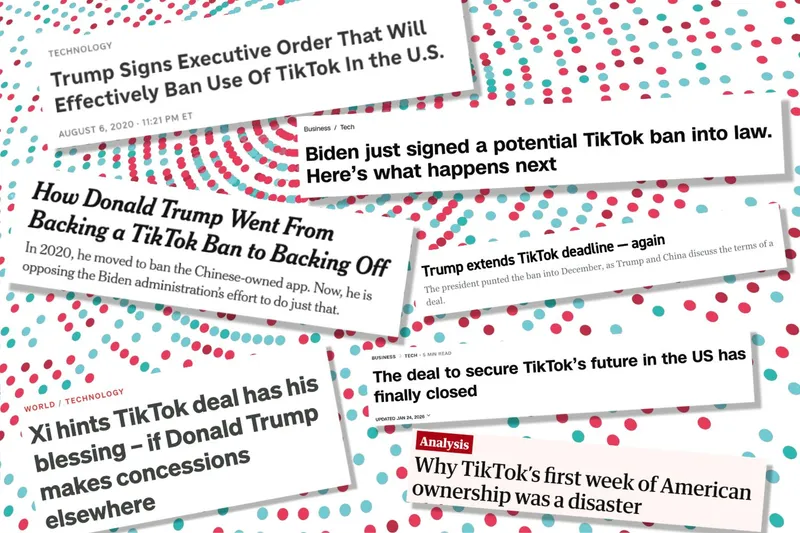
Good memory! Banning TikTok was first suggested by Trump in 2020. On August 6 of that year, the president, then in his first term, signed an executive order addressing the “threat of TikTok” and the risk foreign-owned apps posed to “the national security, foreign policy, and economy” of the US, effectively outlawing “transactions” between ByteDance and US citizens.
In April 2024, then president Joe Biden signed a federal law – the catchily named Protecting Americans From Foreign Adversary Controlled Applications Act – that would make it illegal for web-hosting services to support “foreign adversary apps” like TikTok. It would be removed from app stores unless ByteDance sold the app.
By December 2024 Trump appeared to have changed his mind, the then president elect calling the app a “unique medium for freedom of expression”. While TikTok challenged the law, in January 2025 the Supreme Court upheld the ban, which came into effect on January 19. TikTok went dark for a day, before returning to the app stores and normal use when Trump extended the divestment deadline. He would do so four times before this final deal was, finally, done.
And TikTok’s still pretty influential, sorry, a ‘unique medium for freedom of expression’?
The US is its biggest market in the world, with over 200 million users, according to TikTok. A 2025 study from Pew Research Center showed 55% of TikTok users regularly got their news from the app, and 20% of US adults consumed their news on the platform, compared to 3% in 2020.
The outsized influence apps like TikTok, Instagram and Facebook have on young people is part of a growing backlash against the platforms, manifesting in app-blocking technology and dumb phones, ongoing media coverage and challenges via legal channels. This week’s “social media addiction” trial in Los Angeles is poised to be a landmark case in the push for accountability and responsibility from tech companies, with lawyers representing 1,6oo plaintiffs accusing them of “negligently” creating digital products that caused harm like addiction and depression. TikTok was among the defendants, along with Meta and Alphabet, but it reached a settlement with the claimants hours before jury selection began. Snap Inc, which owns Snapchat, has too.
TikTok has seen its popularity – and influence – skyrocket since launching in 2018 and competitors were quick to follow the format. It’s among the apps being targeted by Australia’s social media ban. France is following that country’s lead by putting in place age limits; this week its National Assembly voted in favour of banning under 15-year-olds from using both social media apps – including TikTok – and “social networking functionalities” on other platforms.
There’s also fresh concern from users about the data collected by TikTok from profiles and content on the platform. Its privacy policy itemises sensitive information like users’ race, ethnicity and nationality as well as “religious beliefs, mental or physical health diagnosis, sexual life or sexual orientation, status as transgender or nonbinary, citizenship or immigration status, or financial information”. (TechCrunch notes that many users might be reading the terms and conditions for the first time, following the in-app message after the divestment.)
OK, but what about New Zealand?
For users outside the US, TikTok is still owned and operated by ByteDance, which is headquartered in Beijing. But we’re served a lot of US content on the app. Exactly how much is hard to pinpoint since each personalised feed is wildly different, but it’s safe to say there’s a ripple effect. The “technical issues” were noticed here by local users.
“Any effects will likely be secondary and inconsistent. The change in TikTok ownership is only for TikTok US, and changes to terms and conditions apply to US users,” says Michael Daubs, a senior lecturer in the media, film and communication programme at the University of Otago. “There have also been some complaints about bugs and glitches with the app and videos not loading properly since the ownership change, though mostly in the US.”
Any dramatic shift in user base, like people leaving the platform, would also be noticeable (and possibly followed) here in New Zealand. “The change in ownership and to the terms and conditions have led many US users to post less or even delete their accounts. Some who have deleted their accounts have pointed to privacy concerns (location tracking, collection of ethnicity and gender data, though that was in the user terms before the ownership change), concerns about or claims of censorship, especially of content critical of the current US president or Ice, or ethical or moral differences with the new ownership,” Daubs explains. “That means some content creators that users in New Zealand may have followed might not be available any more.”
TikTok opened an office in Auckland in 2022. That year the Parliamentary Service warned all political parties (via email) that using TikTok on a government phone “could pose a security risk where data on your devices could be accessed by ByteDance (the owner of TikTok) and the Chinese government”. The app was banned on government devices from 2023 – including for members of the defence force – but prime minister Christopher Luxon operates a TikTok account, as do Labour, the Greens, Act, Te Pāti Māori and New Zealand First. New Zealand company Zuru, reportedly one of TikTok’s biggest advertisers, focuses most of its spend on the US market.
They’re all among the estimated 1.9 million New Zealanders understood to use TikTok, though the app showed a slight decline among 15- to 39-year-olds in NZ On Air’s last Where are the Audiences study.
Trends on the platform move famously fast. Recent months have seen “analog bags” (an antidote to doomscrolling), Chinamaxxing and the year 2016 seizing the attention of users here and around the world. If, like many TikTok users, you’re in a “very Chinese time” in your life and planning to travel there this year, don’t expect TikTok to work. ByteDance operates a separate algorithmic, user-generated video app, Douyin, for the Chinese market.

Emma Gleason
Emma Gleason is a staff writer at The Spinoff and an award-winning fashion journalist. But it’s not just clothes that interest her, you’ll find her exploring tasty cheese, influenza outbreaks and more important things right here. She has experience with some of the country’s leading media outlets as well as the toaster in our kitchen.


