A history of New Zealanders slipping on banana peels

Slipping on a banana peel: hilarious stunt or mortal danger?
Today, slipping on a banana peel is the ultimate comedy cliche. A century ago, it was a serious public health hazard that took the life of one of the world’s most fearless daredevils.
Bobby Leach was one of the world’s greatest stuntmen. He survived a dive from a 45m platform into a 1.5m pool, jumped off the 63m Honeymoon Bridge into the Niagara River, and climbed a rope ladder suspended between two moving aeroplanes. He achieved his most famous feat in 1911 when he went over Niagara Falls in a steel drum.
After living such an adventurous life, his death in 1926 at age 68 was one of history’s best examples of situational irony. According to a report by the United Press Association, he died from “the effects of skidding on a banana peel at his home in New Zealand”.
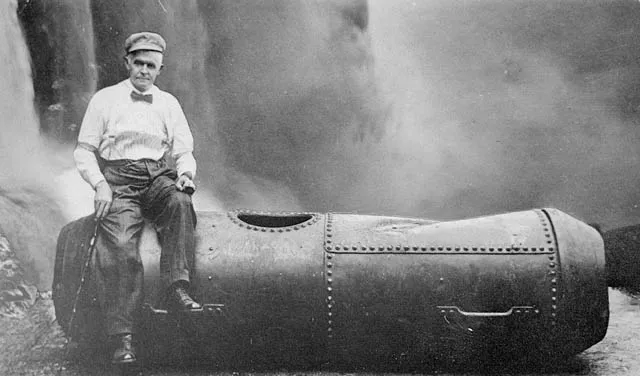
Journalist Jon Bois covered Leach’s tragic end in his excellent documentary: The history of slipping on banana peels. But as Bois noted, the exact details of Leach’s death were subject to mixed reporting and misinformation.
Leach did not live in New Zealand; he was born in England and lived his adult life in the US. He visited Auckland in 1926 for a short public speaking tour, bringing his wife and daughter with him. And the fatal fruit was an orange, not a banana.
Initial news reports said the slip happened on Queen Street, but during an interview from hospital, Leach gave more specific details: he fell on February 26 outside the front gate of 10 Princes Street, where he was staying in a rented villa. The fall caused him to break his leg, which, due to complications from previous stunt injuries, had to be amputated. He never fully recovered from the surgery and died on April 28, 1926 at Mater Misericordiae Hospital in Mt Eden and was buried at Hillsborough Cemetery.
Slipping on a banana peel is undeniably funny. It’s one of the great comedy tropes, and was particularly popular at the time of Leach’s accident due to the slapstick stylings of Charlie Chaplin. But Leach’s story shows that there is a dark side to fruit-based humour.
In the late 1800s and early 1900s, slipping on oranges and bananas was an epidemic in New Zealand. Newspapers reported on it constantly, and there was widespread political debate about what should be done.
Bananas were first imported to New Zealand at scale in the 1870s. Before that, orange peels were the greatest threat to surefootedness and the finest source of humour.
The first reference in a New Zealand newspaper to someone slipping on an orange skin comes in the form of a joke. In 1844, the Auckland Chronicle and New Zealand Colonist published a satirical recipe for a “mimic tempest” which involved tossing orange peel on the floor, tying a cord around the stairs, letting the dog loose and waiting for someone to trip.
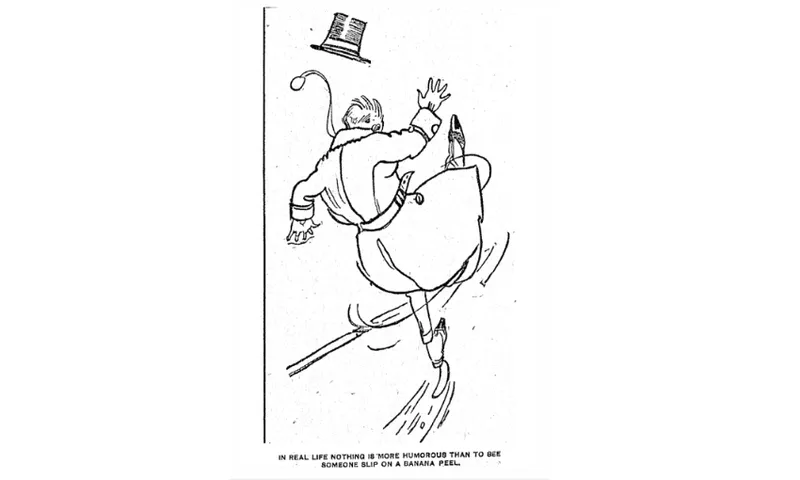
In 1859, the Taranaki Herald reported on the plight of a poor woman whose husband was out of work because he “slipped upon a piece of orange peel and fractured his ankle badly”. In 1867 a British navy sailor on a visit to Auckland slipped on an orange peel on Collins Street, Morningside. In 1879, a man who was arrested for smashing a window claimed he had slipped on an orange peel. In 1896 a woman on Karangahape Road, Auckland stepped on “a piece of banana or orange skin” and sprained her ankle.
In 1887, a visiting lecturer at the YMCA, the Rev Mr Chew, fell on an orange peel during his address and “all his ideas were lost with the shock”. In 1889, a young man in Wellington slipped on an orange peel and was run over by a passing vehicle. In 1887 a man slipped on an orange peel in the Octagon, Dunedin and dislocated his shoulder. In 1892 a man slipped on orange peel on Wellesley Street in Auckland and began “bleeding profusely from a wound in the back of the head”. In 1892, a single mother of four in Wellington slipped on orange peel, breaking her head and leaving her “little children crying for bread”. In 1893, an elderly man slipped on orange peel on Cuba Street, Wellington, and sustained “some nasty cuts on the head”. In 1897 a young woman slipped on orange peel on Hardy Street, Nelson, and injured her ankle. In 1899, while a police officer was arresting a drunk man at Waipawa railway station, they both fell over on an orange peel and the drunk man broke his rib.
Other orange peel slips were recorded on Princes Street, Dunedin, in 1900, Pollen Street, Thames, in 1907, High Street, Dunedin, in 1910 and at South School, Invercargill, in 1916.
Once bananas arrived in the country, the slips happened with even greater frequency. In 1880, a man “of a portly presence” slipped on a banana peel on Devon Street, New Plymouth and hit his head on the curb. In 1891, a New Zealand theatrical company had a particularly disastrous tour of Sydney, where two performers hurt themselves by falling off the stage and a third slipped on a banana peel while entering the theatre and broke his arm.
In 1892, an opera performer slipped on a banana peel and dislocated his shoulder near Lambton Quay in Wellington. 1893 had three recorded incidents of banana peel slips: a 60-year-old woman in Dunedin broke her right thigh, an 11-year-old boy in Thames broke his arm, and a young woman sprained her ankle in the square in Palmerston North. In 1894, a woman in Hastings slipped on a banana peel and broke her thigh. In 1895 a young man in Wellington broke his leg by slipping on a banana peel while playing rounders. In 1901 an elderly man fractured his skill in Milton, and a police officer broke his collar bone after slipping on a banana peel on South Belt, Rangiora.
A particularly dramatic fall happened in 1901 on Pollen Street, Thames, when a man slipped on a banana skin, fell into an open drain, cut his head, broke his nose and sprained his wrist. In Dunedin in 1906 a man cut his face after slipping on a banana peel and landing on a glass. Similarly, in Thames in 1913, a man slipped on a banana peel, putting out his hand to stop his fall and landing on broken glass, cutting his palms.
There were further incidents in 1914 when a woman sprained her ankle on Colombo Street, Christchurch, in 1920, when a man fractured his ankle in Newmarket, Auckland, and, that same year, when an eight-year-old boy broke his arm on Carlton Gore Road, Auckland. In 1931, the Southland Times reported that a horse collapsed on a main road. “A few bystanders thought that the horse was breathing its last, but the mishap was not as serious as that. The animal has merely slipped on a banana peel.”
The crisis of slipping on skins became so severe that the public, journalists and politicians demanded something be done about it. The NZ Herald got things started in 1869, asking “how can such a state of things be prevented? People will eat oranges and won’t bother about the skins. We much fear it is beyond remedy.”
Dunedin got the discussion started in 1870 when a city councillor pointed out that Melbourne had introduced a fine for throwing orange peel on the footpath and urged his city to do the same. The following year, the editor of the Otago Daily Times wrote that the practice of littering orange skills was “certainly a dangerous one” and complained that it was not punishable under any council bylaw.
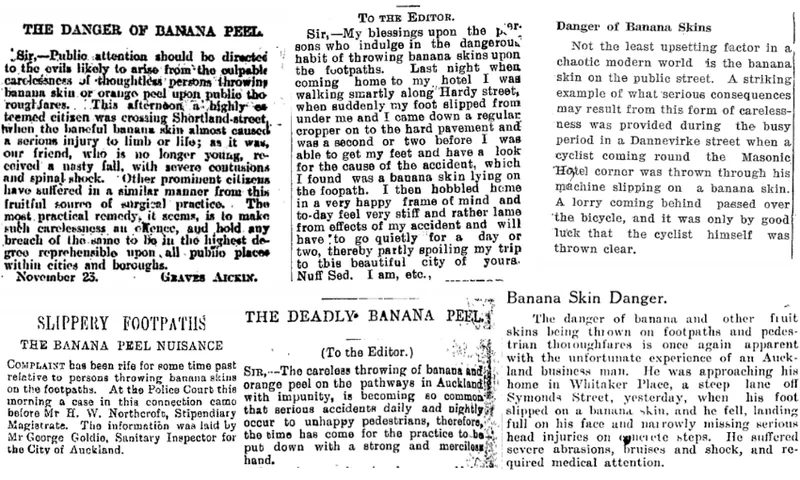
By 1873, Auckland had outlawed throwing orange peel on the footpath, but a writer at the NZ Herald urged them to go further: “Banana peel is equally dangerous for the foot passenger to tread upon, and it behooves the city rulers to pass another bylaw prohibiting under certain pains and penalties the deposit of the skin of the banana upon the footpaths in this city.”
Anti-littering regulations were adopted in Napier, Timaru, Woodville, Christchurch and Wellington, among other cities. Around the turn of the century, many councils invested more in waste management in response to several public health scares, providing public waste bins and more regular street cleaning.
This coincided with many municipalities cracking down on “street hawkers” who sold fruit from carts. Wellington restricted them to back streets in 1908 and banned them entirely in 1939. This was ostensibly done to protect shop owners from competition, but was motivated by racist sentiments towards Chinese fruit sellers. With fewer fruit stands on the street, bananas became less common as an on-the-go snack option and banana skins became a less common sight on the ground.
From the 1930s onwards, there are very few mentions of orange or banana-related injuries in New Zealand newspapers. Most of the references come from fiction, jokes or other newspaper “funnies”. Here are a few examples:
- What does orange peel make? Good slippers. (Manawatu Standard, 1932)
- Why is a jersey like a banana peel? Because it is easy to slip on. (Evening Star, 1935)
- Schoolmaster: Can any boy tell me what is meant by the “yellow peril”? Bright Boy: Please sir, a banana skin left on the pavement. (Hokitika Guardian, 1930)
Bobby Leach’s dramatic death marked the end of a golden era for fruit-related injuries in New Zealand. From this period onwards, slipping on a banana or orange peel went from being an active, everyday threat to what it is today: a well-known comedic trope but not something anyone is likely to actually see or experience in real life. But that’s not to mean it doesn’t happen any more – data provided to The Spinoff by ACC shows that there have been 140 new claims since 2021 for injuries caused by slipping on a banana. While banana peels may have slipped out of the news cycle, they still manages to trip people up from time to time.
Joel MacManus
Joel MacManus is a senior writer for The Spinoff. He previously worked at RNZ and Stuff, and began his career at Critic Te Ārohi. His writing explores the political, economic and cultural systems that underpin modern New Zealand. He won the 2025 Voyager Media Award for Best Columnist, Opinion or Critique.


