The Golden Mile project deserves to die. But it must rise again

RIP. Image: The Spinoff.
Wellington’s decade-long failure to upgrade Courtenay Place is a damning indictment on the council and the city itself. What Andrew Little does about it could define his mayoralty.
The Golden Mile project is about to be put to death at the hands of Andrew Little, The Spinoff understands. Council will vote on the future of the contentious project this week and sources say it will be axed. Good riddance. For more than a decade, the project has been trapped in a Sisyphean cycle of reviews, pauses and inaction, and Courtenay Place still looks just as shit as ever.
Wellington desperately needs an upgrade to its dilapidated main street. Every day that Courtenay Place is allowed to fester, it drags the city’s economy, culture and reputation down with it. It has become symbolic of a declining city which lacks the competence, confidence, or courage to turn itself around. Why should any young person believe it is worth staying in Wellington and building a future there if the city can’t even lay a footpath and plant some trees?
The latest chapter in the saga is an external review of the project which the council commissioned in November. Like most things involved with this money pit, the review was expensive and massively overspecced, with a total of 241 pages and a cost of $460,000 ($60,000 over budget).
The finding that sentenced the project to death was this: It’s now projected to cost $215 million with a 50% chance it ends up higher. Even with $71m from Waka Kotahi NZTA, Little clearly thinks that’s too much money for a city council to spend on one street. Back in 2020, the entire thing was projected to cost $78m.

Previous calculations gave the project a benefit-to-cost ratio of 5.8, but the new team of consultants decided to use a different methodology and produced a result of 1.78. The review was quick to claim that the Golden Mile upgrade has negative transport benefits (but positive benefits for the local economy). However, that’s only true because the review’s definition of “transport-related benefits” didn’t include the $43m in “pedestrian travel time savings”, the $96m in “pedestrian safety benefits” or the $50.4m in “public transport reliability benefits”. And the review didn’t consider cycling benefits at all. Also, the negative impact on motorists who have to spend a few extra seconds driving around Courtenay Place rather than along it has somehow jumped from -$21m in 2024 to -$443m today.
Whether you trust the numbers or not, this review has done its job by providing political cover for Little to pull the plug. Credit for killing the project has to be given to Diane Calvert, Nicola Young and the cohort of conservative councillors who opposed it from the start. Their strategy of predatory delay was a political masterstroke. By demanding reviews, pauses and re-assessments at every opportunity, they ensured that the project would eventually become too expensive to be feasible.
The blame, however, doesn’t really lie with the opponents but the supporters. This ought to be a moment of reckoning. Every politician, civil servant and consultant who wanted to get the Golden Mile upgrade built should be considering what went wrong and what part they played. Urbanists and activists who want more people-friendly and vibrant public spaces need to figure out a new strategy because this ain’t it, chief.
At its core, the Golden Mile upgrade is not a difficult project. It’s basically a fresh footpath, some new trees, bus stops and some signs telling motorists they can’t turn down Courtenay Place. These are the kinds of little things that well-functioning cities just chip away at over time rather than turning into a decade-long talkfest.
Let’s Get Wellington Moving, the entity which began work on the project in 2016, had an obsession with over-designing and over-engineering. Even when Wellington City Council took the project in-house and removed the Lambton Quay section, the promise of NZTA funding meant they were mostly locked into the original design.
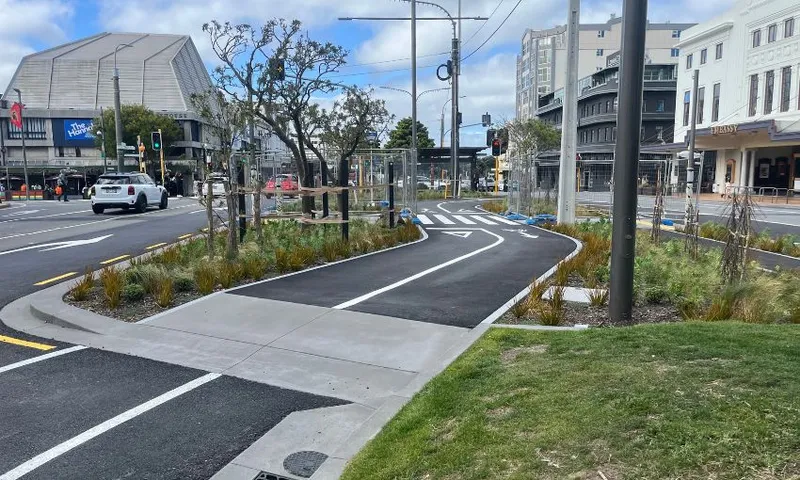
The gold plating didn’t stop there. At some point it was decided that if you were going to dig up the road you might as well replace the pipes while you’re at it. A good idea in theory, except that it would’ve added at least $20m to the budget and caused the construction to take much longer, and Wellington Water never actually asked the council to do it. Digging up the road again in a few years would be annoying, but trying to do everything at once just guarantees nothing will ever happen.
Public servants are generally well-meaning people but they have a tendency to go overboard if they’re not reined in. Andy Foster was too weak and Tory Whanau too inexperienced, so the council’s management team was able to take the lead. Andrew Little is considerably better at calling bullshit and putting his foot down. It’s clear he won’t allow the project to continue in its current form. It’s less clear what comes next.
Cancelling the Golden Mile project without offering an alternative would be a huge political risk. Progressive voters would see it as betrayal. Worse, it would signal that Little has settled for managing Wellington’s decline rather than reversing it.
Wellington City Council will meet on Thursday to officially decide on the end of the Golden Mile, as well as the next step. Thankfully, there are plenty of options available. Even without the NZTA money, WCC can probably scrounge up something in the $40m range, which should be more than enough to make a difference – especially if Little gives the staff a good growling and makes them stick to the budget.
The Golden Mile never needed to be a mega-project. Courtenay Place doesn’t need another 10 years of consultants’ reports, it needs new paving, lighting, trees and a few benches. Just clean up the damn street.

Joel MacManus
Joel MacManus is a senior writer for The Spinoff. He previously worked at RNZ and Stuff, and began his career at Critic Te Ārohi. His writing explores the political, economic and cultural systems that underpin modern New Zealand. He won the 2025 Voyager Media Award for Best Columnist, Opinion or Critique.


