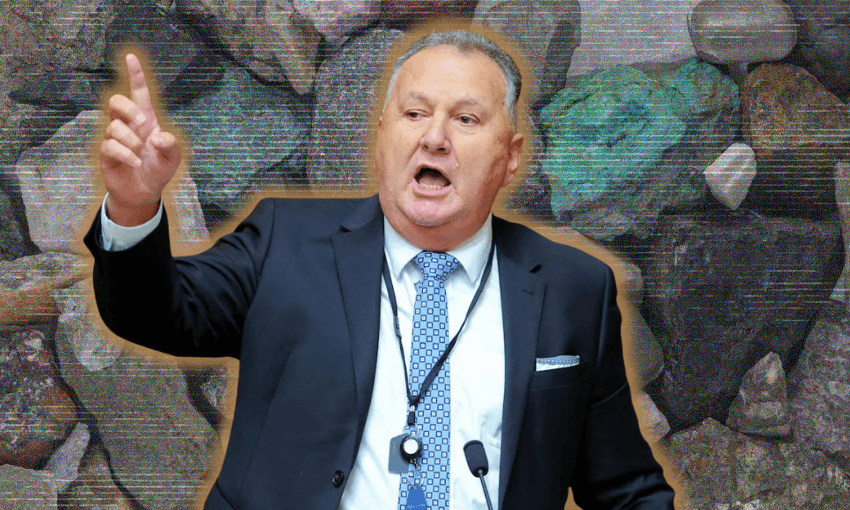



The serial kingmakers of MMP politics are riding a global wave. And they want more.
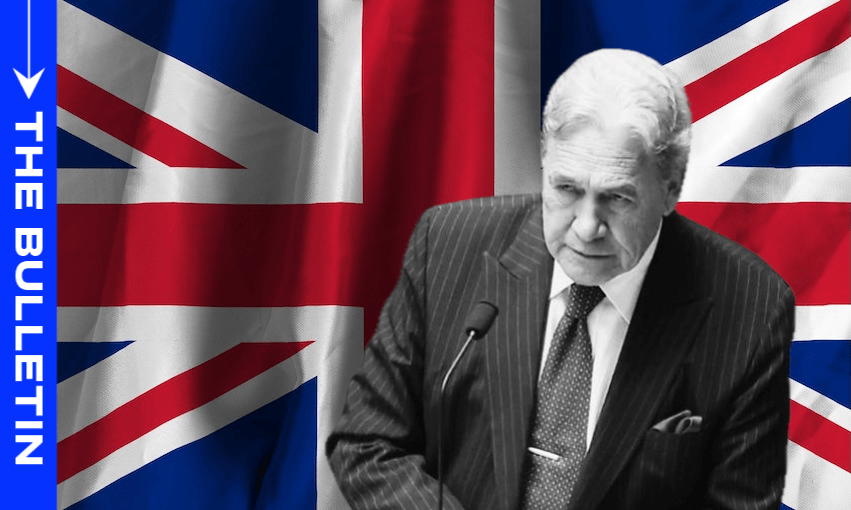
Immigration is rendering New Zealand “unrecognisable”, says Winston Peters. We are “being colonised without having any say in the numbers of people coming in and where they are from”. His political opponents decry “somewhat nasty, subliminal racist undertones” and “hysterical anti-Asian rantings”.
Say what you will about the one and only leader of the New Zealand First Party, but on this front at least he’s consistent. The comments above are from the 1990s and 2000s; the opponents of that moment are Jim Bolger and Bill Birch. And in the early part of election year 2026, he’s warming again to that rhetorical tune. In the last few days, for example, he has lambasted a proposed new free-trade agreement with India, warned of “mass immigration”, and lashed out at the use of the word Aotearoa in parliament, in remarks condemned as “pure racism”.
Expect more in the months to come, because it is working. Just take a look at the polling across the last three years. At the start of 2023, out of parliament, New Zealand First was polling as low as 2%. Today, having made it into parliament and into government, and having conquered the tendency of MMP to punish coalition support parties, the party sits close to 12%.
Here’s another way of looking at it, this time drawing on a different poll and putting alongside the other outrigger to the National-led coalition.
New Zealand First has plenty there to be pleased about, but it wants more, and it believes this is its time. Strategists reckon that NZ First can continue to peel support away from Act, from National, and from Labour. Winston Peters is a complex character: a respected, globally engaged foreign minister who is a merciless slayer of globalist tendencies, leader of a party he trumpets as “nationalist with a capital N”. There is at least one global trend towards which he is fully on board: the rise of populist-nationalist sentiment.
Encouragement for those of the populist-nationalist persuasion, propelled above all else by an anti-immigration, culturally conservative rhetoric, can be found everywhere you look, from the rise to power of Donald Trump in the US and Giorgia Meloni in Italy, from the populist revival in Poland via Karol Nawrocki to Hungary’s Viktor Orbán – whose grip on power could soon end at the hands of another kind of nationalist – and from Marine Le Pen in France or Geert Wilders in Holland. There is plenty that is different among these figures, including some authoritarian proclivities that could not reasonably be attached to Winston Peters, but there’s an undeniable pattern there.
The most inspirational models, however, are blazing trails in the UK and Australia. Founded and led by the rightwing firebrand Nigel Farage, who counts Donald Trump and Winston Peters among his personal friends, Reform UK this week pledged Ice-esque mass deportation and a big escalation in domestic surveillance. Though it has only eight MPs, on current polling it would come first, with hundreds of parliamentarians. The party – to the right of the Conservatives – tops every poll across the last nine months. The Politico poll of polls puts Reform on 27%, well ahead of Labour in second on 18%, the Conservatives on 17% and the Greens on 16%.
In Australia, another familiar reactionary is on the rise: Pauline Hanson and her resurgent One Nation – or, to give it its full name, Pauline Hanson’s One Nation. The party boasts four senators, including Hanson, but just the one MP, Barnaby Joyce, a once-popular choice for New Zealander of the Year and recent political migrant from the Coalition.
One Nation polling suggests they could dramatically boost that contingent. Across February, polls put Hanson’s party in the mid-20s on primary vote. A Capital Brief/Demos poll published this week measured their primary vote at 28%, breathing down the neck of Labor on 29% and opening up a gap over the Liberal-National Coalition, which – much like its establishment counterpart of the right in the UK, the Conservatives – is floundering on 21%, with a new Liberal leader installed after yet another spill. (Putting to one side for a moment his commitment to the maxim that one stays out of the domestic matters of another nation, Winston Peters last week said he was “aghast” at inexcusable and ego-driven churn in Australian party leaderships.)
In both examples, the playbook bulges with similar stuff: scapegoating of immigrant communities, a loathing of international institutions, an anti-elitist platform (albeit one funded by some of the wealthiest and connected people imaginable) and appeal to the disenfranchised. It comes with an embrace of the culture wars, shaking a fist at “wokeism” and identity politics, and a willingness to puff on the dogwhistle with such energy that it sometimes looks more like a foghorn.
There’s an appeal to nostalgia, buttressed by veteran personalities who have become part of the national furniture. Put Nigel Farage in a room with Pauline Hanson, Donald Trump and Winston Peters, and he’s easily the baby of the group – at 61, 10 years junior to the next youngest, Hanson. And at a time when so many politicians are the world’s dullest LLM chatbots, having had any shred of character media-trained out of them, they are brazen, imperfect, unpredictable. Talent, in other words.
One Nation and Reform are not just sailing into the upper-20s, they’ve prompted discussion about whether they might outflank and permanently displace the establishment parties of the right. That’s especially the case in the UK, where the Tories cannot get close to Reform and talk of fresh MP defections springs up routinely, but in Australia, the Liberal-National Coalition is also starting to fret.
Some commentary suggests such an existential prospect beckons for the New Zealand National Party, too. It is not beyond the bounds of possibility. New Zealand First did once poll as high as 29%, in May 1996, just six months out from the first MMP election. It’s worth noting that 18 months later, after NZ First had been elected to parliament with 17 MPs and a clean sweep of the Māori seats (seats Peters today wants abolished, saying he’s “learned my lesson, never go back there again”), the party was polling down a bit – on 1.1%, to be precise – but there are other reasons to pause before imagining that the British, or even Australian, scenario might be repeated here.
The first and most obvious difference is that our borders are not routinely and visibly tested by asylum seekers or economic migrants. In the UK and Australia, headlines about would-be refugees arriving by sea are a regular sight. And inward migration is, relatively speaking, fairly modest in New Zealand. There simply isn’t the same source material to make anti-immigration noise.
The electoral systems are different, too. Arguably, the regular participation of New Zealand First in MMP governments has provided a valve for the sort of sentiment that has elsewhere had only rare or fringe representation, allowing a frustration, a pressure, to swell over time. (Australia’s preferential voting system has provided a buffer, some have said, to One Nation getting a serious foothold – but a poll this week cast doubt on that, with 60% saying they were open to voting for One Nation at the next federal election.)
And while it is straightforward to say Farage and Hanson and the others listed above lead movements of the right – or, in the eyes of many, far-right – not so with Winston Peters and New Zealand First. While Reform has unquestionably scooped up many former Labour Party supporters, not least across the “red wall” of the Midlands and the North, it does not straddle the divide in the way NZ First does. The party leader is a former National minister; the deputy leader was once a Labour minister. A tranche of voters bounce between NZ First and Labour, the New Zealand Election Study suggests.
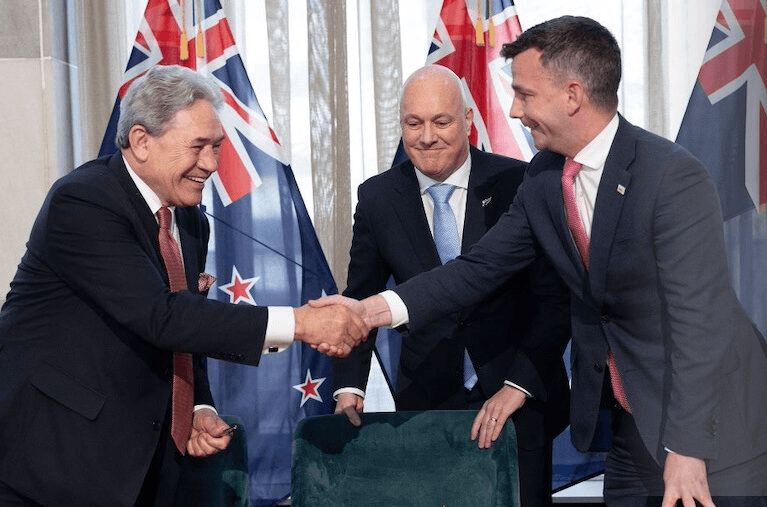
Winston Peters has gone into government with National, twice, and with Labour, also twice. He could coalesce again with Labour in 2026, he says, if they’d only bin that Chris Hipkins. The idea of Farage or Hanson, or the rest, coalition-building with a party of the left is pretty well unthinkable.
And another difference: As of today, Hanson and Farage are very much in opposition, in every imaginable way. Peters is not in opposition, but this has at last proved a surmountable challenge. Unprecedently, he has managed to thread the gnarly needle of retaining appeal for his party from the government benches. Unprecedently, at this point in the cycle, no one is asking whether NZ First will make the 5% threshold.
On some days, the 80-year-old looks like the most sprightly, vocal and effective opposition politician in New Zealand. It’s no accident that he plumped to do his shift as deputy PM across the first half of the current term.
With the white heat of an election campaign a little over six months away, that is only going to ramp up. Whether it’s railing at immigration numbers and asset sales, dissing the judiciary, dressing down Christopher Luxon or calling David Seymour a cuck, and propelled by a set of political siblings soaring around the world, Winston Peters can be expected to go full opposition mode in 2026.