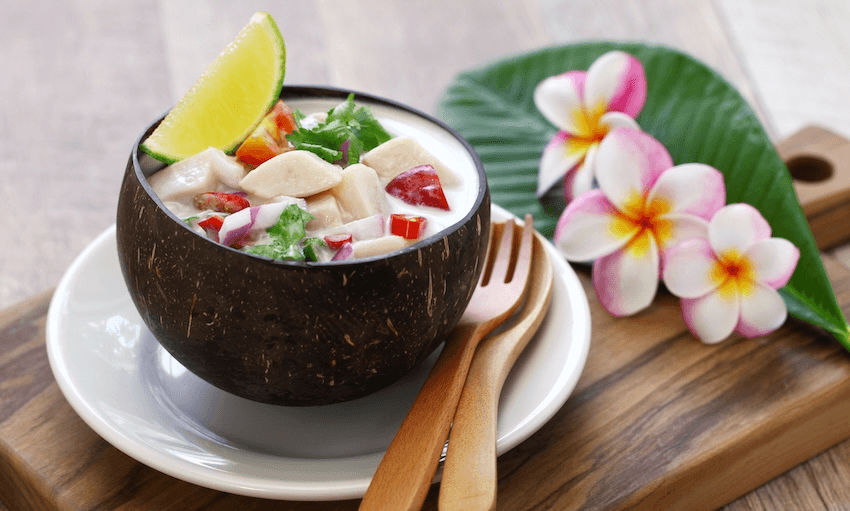



From inventive fusion dishes to beautifully fresh expressions of Indigenous cuisine, Fijian food is reliably delicious – and a reason to visit the islands all on its own, writes Charlotte Muru-Lanning.
If you’re anything like me, you don’t just look out for good food when you travel, you plan entire trips around it. That’s exactly why I was so excited to embark on a trip shaped entirely by food, set in one of my favourite culinary destinations in the world.
Fiji, for many, will bring to mind swaying palms, crystal-clear waters, sublime sunsets and long stretches of sunlit sand. And it is all of that – but it is also so much more. Beyond the picture-perfect scenery, lies a food culture that’s worth travelling for in its own right.
The food in Fiji reflects a long, layered history – Indigenous traditions shaped over thousands of years, intertwined with influences from communities who arrived later, and shaped further by the diverse geography of the archipelago’s 330-plus islands, as well as contemporary trends and cooking techniques. This is to say, in Fiji, a single plate of food often tells a richly detailed story of people, place and history.
On a three-day trip based at the Sheraton in Nadi, I set out to explore it all – letting my appetite lead the way. Here’s what I found.
A farm in the middle of a golf course

Just moments after finishing my welcome bubbles at Sheraton Denarau, I was whisked away by golf cart for a tour of the resort’s farm. Set within an 18-hole golf course – once an abundant mangrove forest – the two-hectare plot is the horticultural backbone of the resort’s culinary offering.
Led by garden manager Shahil Ram, the tour offered an insight into the farm’s sustainable practices and farm-to-table philosophy. The farm grows an abundant mix of produce, including lemongrass, spring onions, papaya, basil, lemon, dragon fruit, bananas, chillies and guava, with plans under way to introduce beehives for producing honey.
Every Wednesday and Saturday evening the resort hosts a Farm to Fork experience where guests are given a guided tour of the farm before sampling food harvested from the garden and cooked in the lovo (earth oven), as well as taking part in a kava ceremony and watching a meke (fire dancing) performance. Resort guests can also enjoy the own-grown produce in the restaurants, including at the breakfast buffet – which, by the way, is one of the most astoundingly varied I’ve encountered (and I have eaten a lot of breakfast buffets). Where else can you start your day with kokoda (raw fish salad), dosa, fresh passionfruit, congee, pancakes and hash browns, all alongside a long black?
A must-visit market in Lautoka

Fiji’s history is woven into its food. Over more than 3,000 years, iTaukei (Indigenous Fijians) developed culinary traditions based upon local ingredients and creative resourcefulness. Later, Fiji’s time under British rule brought indentured labourers from India to the islands, leaving a lasting imprint on the cuisine. The result is a vibrant blend of Indigenous iTaukei and Indo-Fijian foodways, further shaped over time by Chinese, British and broader global influences.
On my second day, I experienced this culinary heritage firsthand at The Fiji Orchid, a secluded six-room resort on the outskirts of Lautoka, about half an hour north of Nadi. Once a month on a Saturday, the resort offers a market trip and cooking experience with the resort’s chef Losavati Sewala. I arrived on a Tuesday but was invited to join chef Sewala on her morning shopping trip where she sources fresh produce for the resort’s meals. Our day began at the fish market. It was quieter than usual, Sewala told me, with fewer fish on display. For me, there was still plenty of action – men returning from overnight diving trips, their brightly coloured boats lining the wharf.

For any food enthusiast, our next stop, the Lautoka Markets, is a dream. Hand-painted signs hung above precarious towers of root vegetables and citrus. Vivid heaps of okra and pineapples led to a central kiosk selling snacks, sweets and baked goods. I sampled wee, a highly seasonal local fruit dusted in mango skin powder and chilli, staining it a fluorescent red.
Chef Sewala introduced me to her regular vendors, and I found myself marvelling at the neatly arranged mounds of ingredients you’d never find in Aotearoa: nama (sea grapes), kai (fresh water mussels), kumquats, diverse banana varieties and an array of chillies – bongo, junglee, and my personal favourite, cherry, of which I bought a generous bunch.

Back at the resort, we began cooking – or, more accurately, Chef Sewala and her team did, assigning me easy tasks like plucking ota (young fern fronds) from their tough stems and squeezing freshly grated coconut for milk. The highlight for me was trying vara, sprouted coconut, whose coconut water has transformed into a soft, spongy core. I had previously searched for it in Fiji without success and it was everything I had imagined – spongy, slightly sweet, with a texture reminiscent of marshmallow. Magical.
The spread created by chef Sewala reflected the richness of Fiji’s culinary landscape – a melding of ingredients and techniques established within iTaukei culinary traditions and those brought later by the Indo-Fijian community. At the centre was a salad of smoked chicken, tomato, ota and those spongy bits of vara. Surrounding it was steamed okra and eggplant, rourou (taro leaves cooked in coconut milk), cassava, dishes of onion, fresh tomato, homemade chilli sauce, and a crushed papaya seed dressing. A jug of coconut milk accompanied it all, with the ever-present duo of kumquat and fresh chillies – essentially Fiji’s equivalent to salt and pepper.
Crab curry at the port

Down at the lively Port Denarau, I followed the scent of frying spices and tandoor smoke to a dockside restaurant, Indigo, known for its Indo-Fijian fare. The menu is sprawling, spanning dishes from across India and local Indo-Fijian specialties – tandoori platters, curries of seafood, chicken, duck, lamb, goat and beef, vegetable dishes, biryani, 10 varieties of bread, and an even broader selection of pan-Asian fare.
I opted for the dish that came recommended to me: mud crabs from the mangroves cooked in masala, cashew, coconut and curry leaves, along with roti and rice. Then, with the restaurant’s multicoloured lanterns bobbing above and the water just metres away, I cracked open my bottle of Fiji Bitter and settled into a spot of people watching.
First came a plate of tools and a neatly folded bib (an ominous sign), followed a few minutes later by a towering heap of crab draped in a deep mahogany sauce. What followed was glorious messy eating: furiously cracking shells, gently teasing out the sweet white meat and swiping pieces of bread through the rich, spiced gravy. At some point, mercifully, a finger bowl arrived. It was spectacularly good – and spectacularly large. I couldn’t finish it in one go, so I packed the rest into a container and enjoyed it the next day on my hotel balcony.
A village lunch along the river

It was a bracingly early start to reach Sigatoka town for a jetboat tour up the river of the same name. Around an hour and a half drive from the Sheraton in Denarau, I arrived with 40 minutes to spare – a small blessing for someone desperately in need of caffeine. Wandering, blurry eyed, nearby, I found Corner Cafe, which, to my surprise, served New Zealand’s Ozone Coffee. I then ducked into a branch of Hot Bread Kitchen – an institution in Fiji – for a cream bun. Suddenly the morning felt much more manageable.
Time for the jet boating excursion. The journey upriver was breathtaking. There are 52 villages along the river, our boat captain Lep told us as we sped past green-carpetted mountains, dense forest and the occasional herd of goats. Amid the beauty, Lep spoke about flooding made worse by climate change, of the practical realities of living far from roads, schools and hospitals; and of the resilience that has allowed Indigenous Fijians to continue to live on their land and their traditional ways of life. Along the banks, we spotted kids cooling off in the shallows and people bringing in buckets of freshly caught fish, before arriving at our main stop for the day, Navula Village.
Our group of around 30 clambered awkwardly up the hill from the water, and were welcomed by our guide Neori. We were ushered straight into a kava ceremony, sitting cross-legged opposite the chief and his assistants as they prepared the drink in a large wooden bowl known as a tanoa.
I had been slightly uneasy beforehand about the potentially voyeuristic nature of intruding on a community’s ordinary, everyday life. But I was struck by how respectful and appropriate the entire experience felt. Coming from a river tribe in Aotearoa myself, I hadn’t anticipated just how moving it would feel to be offered a glimpse into another Indigenous community’s connection to their river – the parallels, the differences, the shared love for place. Even as part of a guided tourism visit, it felt like a privilege.
Lunch was shared, served marae-style on communal plates: roti, grilled eggplant, pineapple, rice, fried noodles, curry, whole bananas, and, of course, cassava – abundant, thoughtful food prepared by a group of women from the village. Though we spoke little of each other’s spoken languages, hospitality, kava, dance and importantly, food, did the work of connecting us.
That language of food became a thread throughout my short, but delicious, trip. “Kana vakalevu” is a phrase often uttered in Fiji. It means “eat a lot, eat more”. In Fiji, it’s impossible not to.